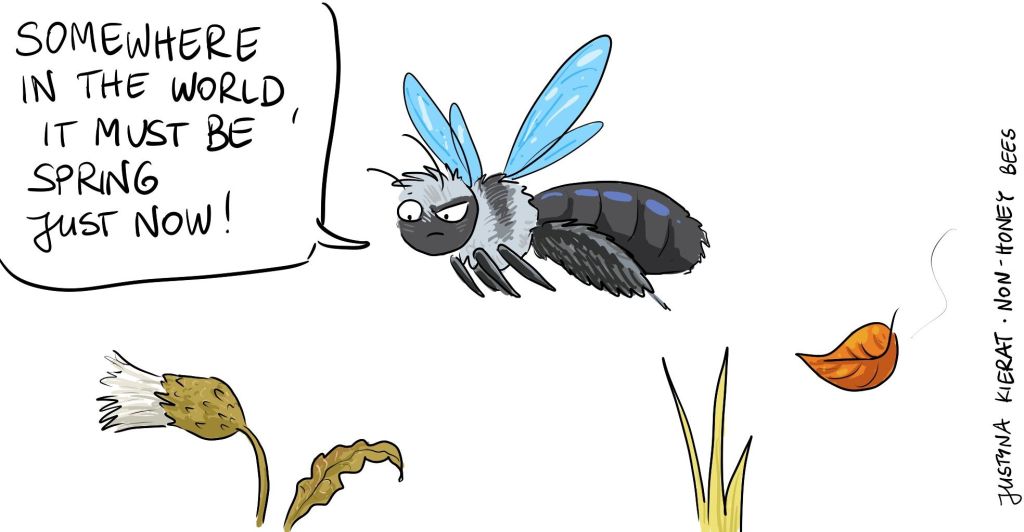
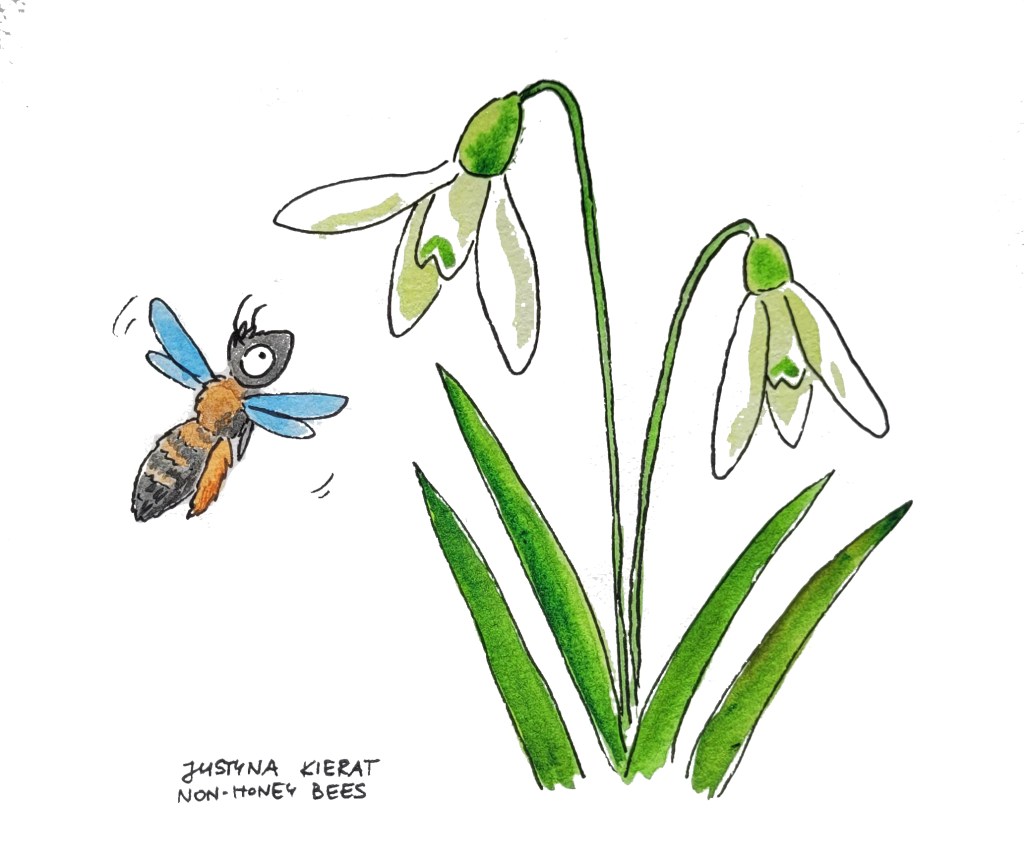
The season for pollinators is slowly coming to an end in many places. There are fewer and fewer bees, butterflies and hoverflies around… but some species thrive in autumn. If you have a blooming ivy in your neighbourhood, take a look at the pollinators visiting it. Maybe you’ll see the ivy bee (Colletes hederae) or the ivy longhorn hoverfly (Callicera spinolae)? They are examples of pollinators with autumn peak of activity.
Today is the International Women’s Day. Best wishes to all female readers of my blog! It’s a good opportunity to mention that the world of bees is ruled by females. And no, I’m not referring to the queens of social bee colonies. In fact, they are not as powerful as their title suggests.
What I mean is that the vast majority of tasks is done by females, without any assistance from the opposite sex. Females collect food for their offspring, build nests and (in some species) actively protect them from predators and parasites. In social species, all the workers are female and they care for their siblings and the queen. Most (but not all) of the bees you see on the flowers on a warm summer’s day are likely to be females.
And what do the males do in the world of bees? Their role is also very important, though much smaller. But that’s a topic for another post 🙂
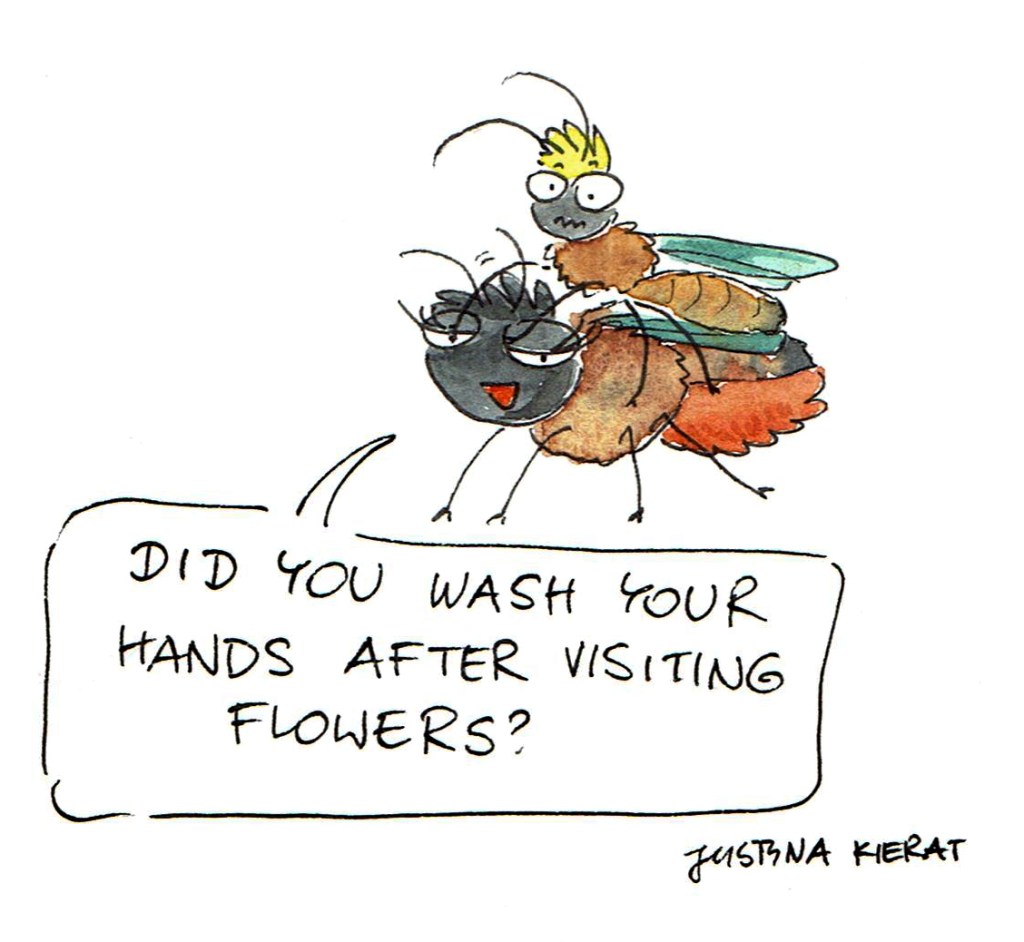
Bees, like all other organisms, suffer from various diseases. Among the causes are RNA viruses, which can evolve fast and thus quickly change host species (between bees but sometimes also to other insects). These viruses can be transmitted via flowers, the latter compared to “dirty doorknobs” by Burnham et al. in their article from 2021.
On the cartoon you can see a pair of red mason bees (oops now I see that I forgot to picture horns on female’s face!). Males in this species have quite sophisticated courtship, involving stroking of mate’s eyes with front legs. One would assume they should wash their hands before doing that. Oh wait…
Transmission of RNA viruses, and also other pathogens, to the wild bees is one of the risks associated with mass breeding and transport for large distances (eg between countries or continents) of the honeybee, bumblebees and other bees.
Have you heard of that recently published report of honeybees stealing pollen directly from scopa of wild bee species? Although competition between honeybee and wild bees is an often studied and debated topic, there are only few observations of direct agressive interactions. What is interesting, the victims of theft seem indifferent to what is happening to them, and only rarely try to resist in any way.
Some bees don’t emerge from their natal nests the next season. Especially in case of desert species, they can skip a year… or several years. As Danforth et al. mention in “The Solitary Bees”, Rozen once kept prepupae of Pararhophites in his desk drawer for five years! And it was not even the record because Amegilla dawsoni can wait for ten years for emergence.