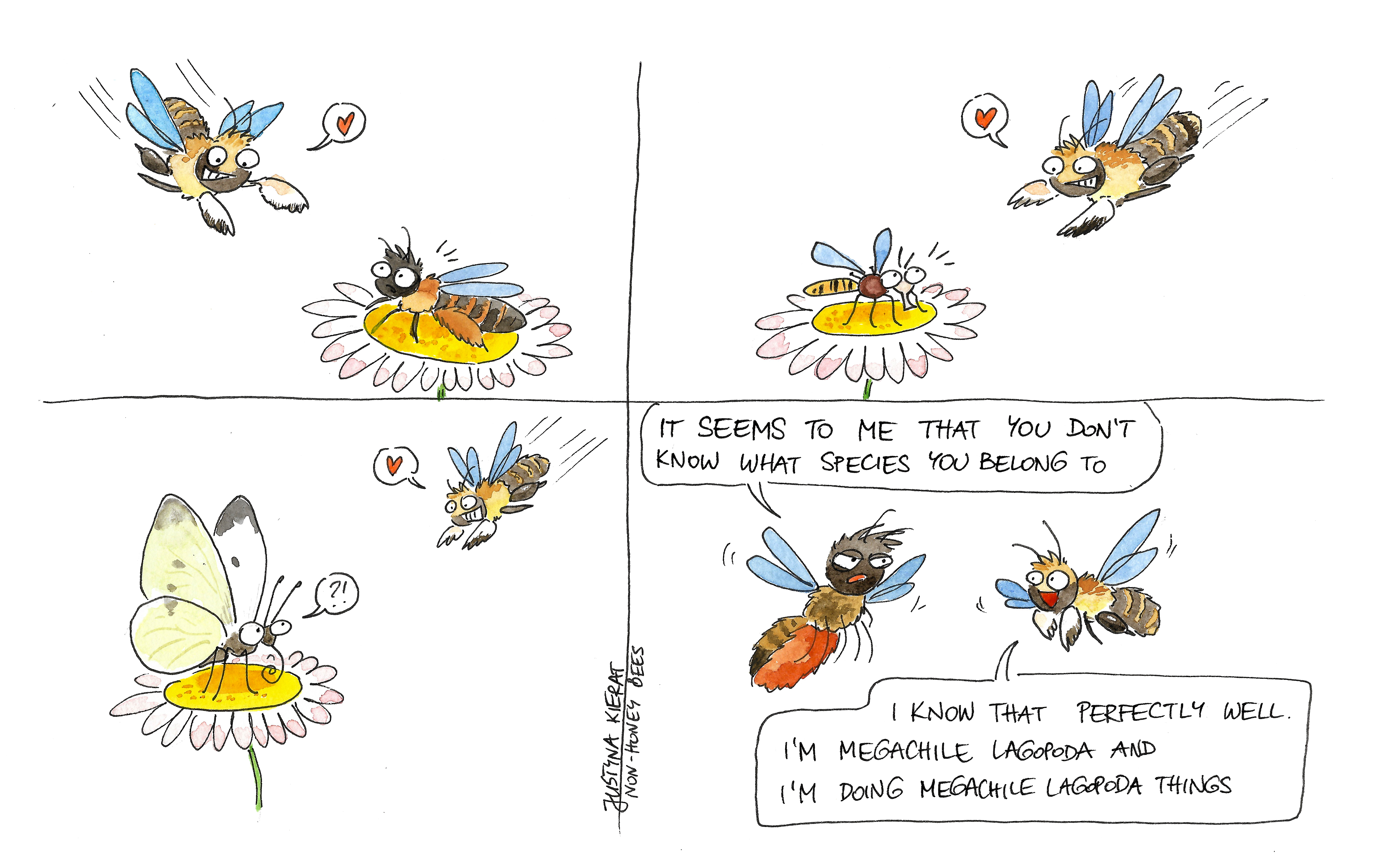
I was asked to draw a cartoon about a male Megachile lagopoda. Stephanie Rübenach, a wild bee photographer, told me that she likes these bees because of their habit of rushing at everybody sitting on a flower – be it another bee, or a fly, or even a butterfly… Yes, male bees can be little bullies. Some of them aggressively defend their little territories (have I ever told you about Anthidium manicatum?) but often it is rather curiosity and eagerness to mate than aggression. They just have to make sure this butterfly over there is not a female of their own species.
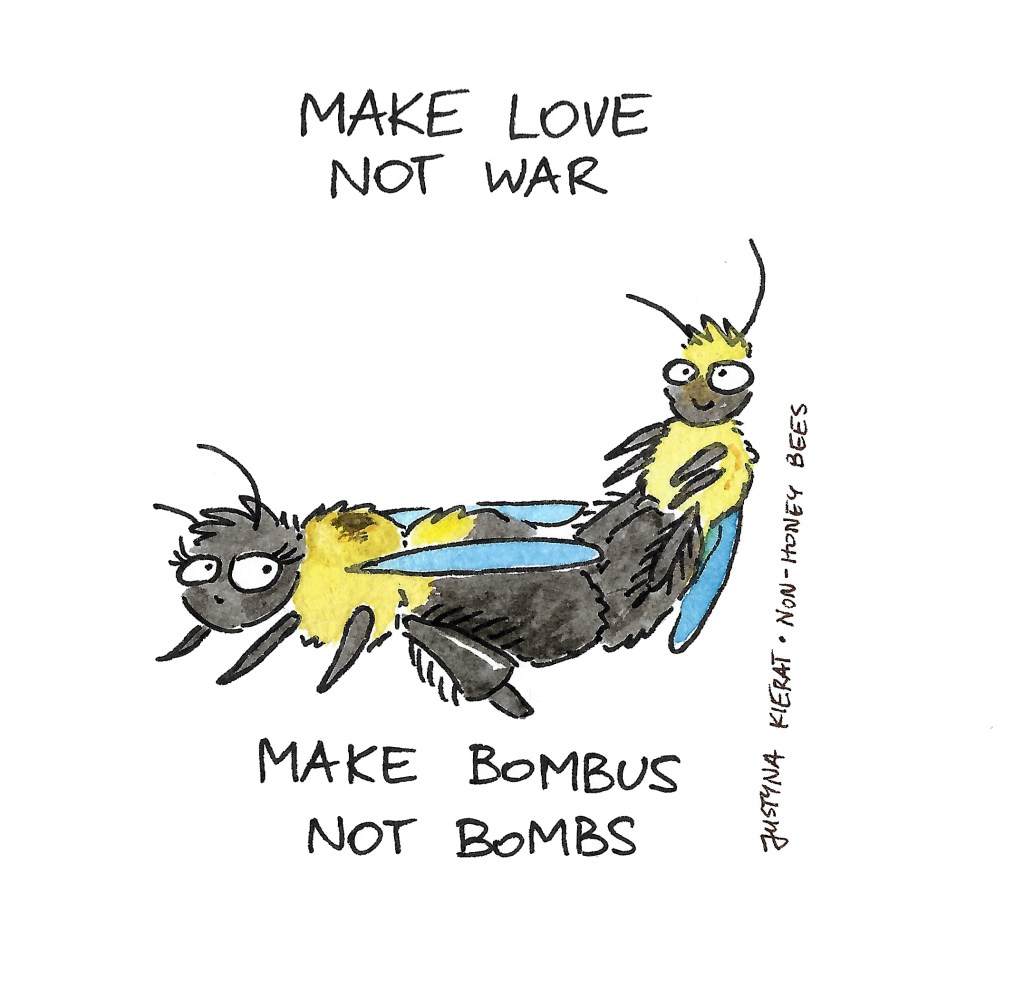
Being active in various fb groups taught me that many people don’t know what bees look like when they are making love. If you also didn’t know that, you do now, thanks to this cartoon.
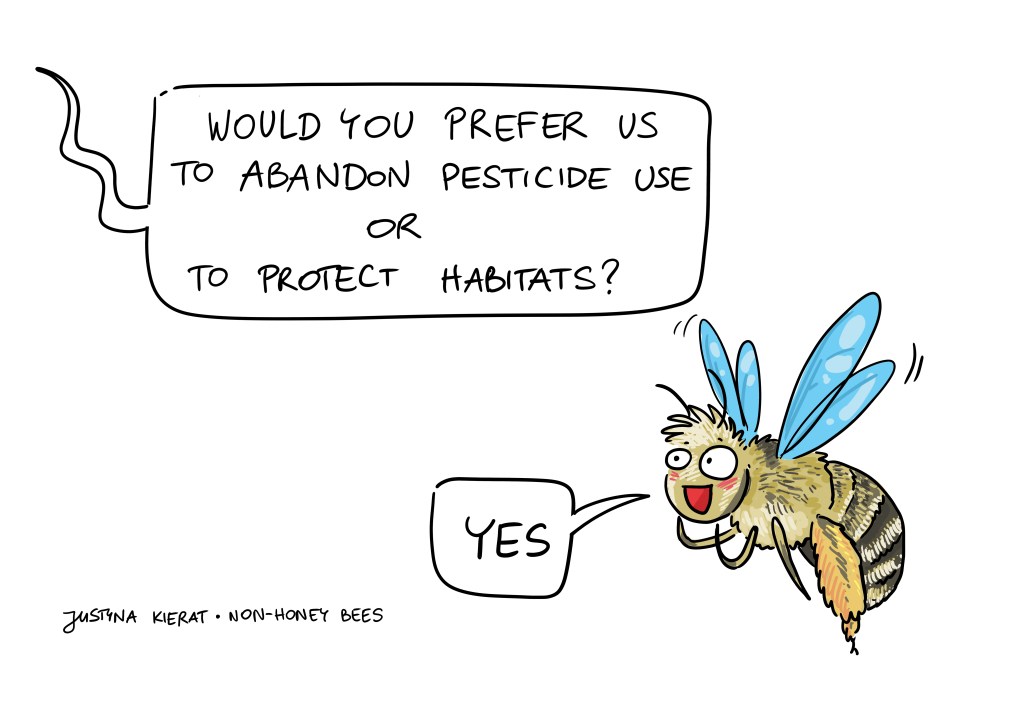
Today’s cartoon is a slightly changed version of one I posted on my Polish blog some time ago. I remembered about it after reading a paper entitled “Pesticides and habitat loss additively reduce wild bees in crop fields” by Anina Knauer et al. (2025). It is a huge analysis of data collected from nearly 700 crop fields, aiming to answer the question of how pesticide use and habitat loss impact bee numbers and species diversity.
Unsurprisingly, it turned out that both these factors have important effects on wild bees. But what was less expected, pesticides and availability of semi-natural habitat act additively. It means that, for example, pesticides aren’t less harmful if we provide the bees with more semi-natural habitat in places where they are used. To help bees, we must address both these issues.
It doesn’t mean that action aimed at solving one of the bees’ problems alone is useless. Every small step can help and is important to do. But we should not assume that solving only one problem is enough to save our pollinators.
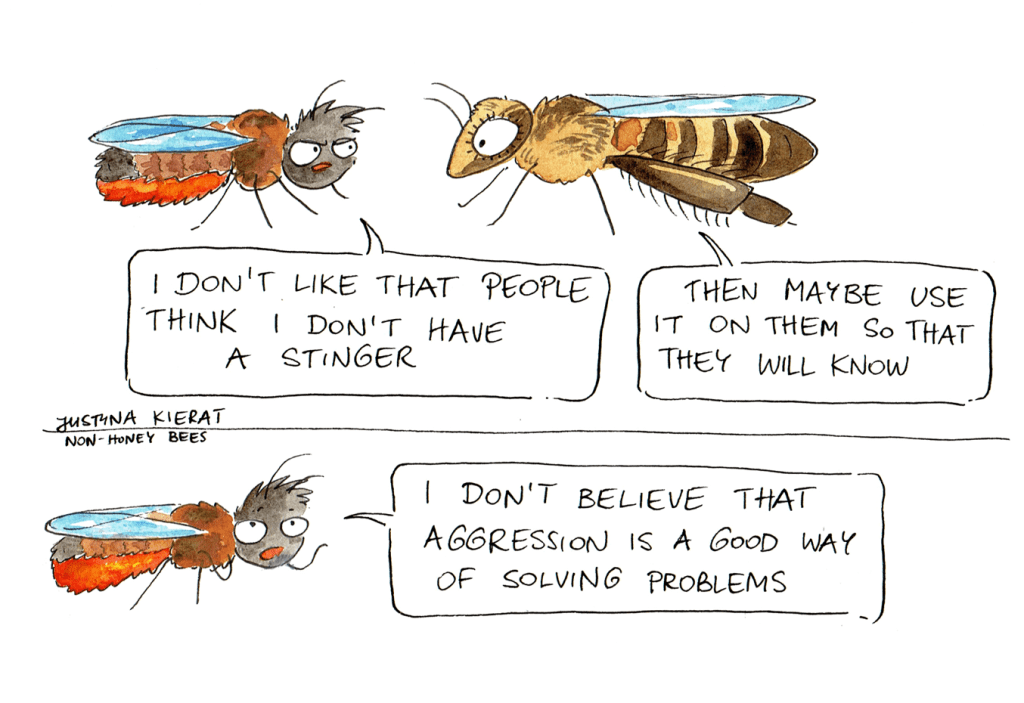
I’ve heard many misconceptions about bees. Among them, there are two beliefs which are contradictory to each other… and both are false. On one hand, many people are afraid of all bees because they believe that there is high risk of being stung by any bee species. On the other hand, there is a popular belief that solitary bees, for example mason bees, are harmless because they do not have a stinger. What are the facts?
Females of almost all bee species in the world have stingers. The only group of bees I know of with reduced stingers are stingless bees, which live in the tropics and subtropics (if you know of any other examples, please let me know!). In contrast, males never have stingers.
Despite having a stinger, most bee species are very unlikely (or sometimes unable) to sting us. Why is it so? Most bees (not only solitary, but also social, as is the case in many halictid bees) do not defend their nests against large intruders like me, you, your children or pets. Even when their nest is being destroyed, they will flee rather than fight. They will make use of their sting when they cannot escape – like, held in hand or squeezed. Some species, however, have too minute stingers to pierce human skin so they pose no risk at all (I tested this on several Andrena females – they tried to sting me when held in hand, but didn’t succeed).
Summing up, most bees have stingers, but usually are unlikely to use it against us. The funny thing is, the stingless bees which I mentioned earlier, can effectively defend their colonies even though they can’t sting. They bite, pull hairs and sometimes produce secretions irritating skin of an intruder.
Stingless bees are a constant source of inspiration. I’ve already shown you the cartoons about them getting entangled in intruder’s hairs as a form of nest defense, and about tear-drinking species. Now the time has come for Partamona helleri, which practises crash-landing.
Usually, the stingless bees slow down when they approach the narrow nest entrance. But not Partamona helleri! When they are about 20 cm from the nest, they speed up and fly inside like tiny bullets, crashing into the hind wall of the nest and then falling to the bottom. In a few cases, researchers studying the landing behaviour of these bees observed individuals that crashed with such a force that they bounced back and fell out of the nest.
Why do Partamona helleri act so strangely? It is a way to avoid ambush predators, which are sitting at the nest entrance, attempting to catch returning bees. It was shown that when a bee saw a predator, she increased her speed even more.
You can read more about this fascinating strategy in the paper by Shackleton et al.
If monolectic bees could talk, would they be monotematic? Monolecty means that a bee species uses pollen from only one species of plant or, in the broader sense proposed by Cane, from only one genus of plants. Species which collect from more species/genera, but all belonging to only one plant family, are called oligolectic. Other bees, more generalised in their pollen choices, are called polylectic.
Bees from the genus Macropis collect pollen (and floral oils) from Loosestrife (Lysimachia), which makes them, depending on which definition you use, narrowly oligolectic or monolectic.
This post was published on Instagram in cooperation with The Pollinator Academy. I’m happy to be involved in this initiative. If you are interested to learn about pollinators, in particular bees, hoverflies and butterflies, and recognizing them, check out the PA website!
I recently ran a workshop for a group of schoolchildren. We talked about bees and drew them in a cartoon style. The kids had lots of questions, one of which really stuck in my mind. They wanted to know what colours bees could be. I was able to tell them that there are black, brown, red, white, yellow, orange, green and even blue bees. But what about pink? I can’t recall any pink bee species. Are there none, or I just don’t know them, or have forgotten about their existence? Please help me if you know the answer!
Have you ever seen a bumblebee lift its leg as if to say hello or give you a high five? The bee looks as though she wants to be friends with you. In reality, however, it’s the opposite.
In bee language, raising a leg is a sign of discontent. This message can be directed towards humans or other insects. It’s a warning not to approach any closer if you don’t want to get stung. However, in the case of males, it’s only a bluff as they don’t possess a stinger.
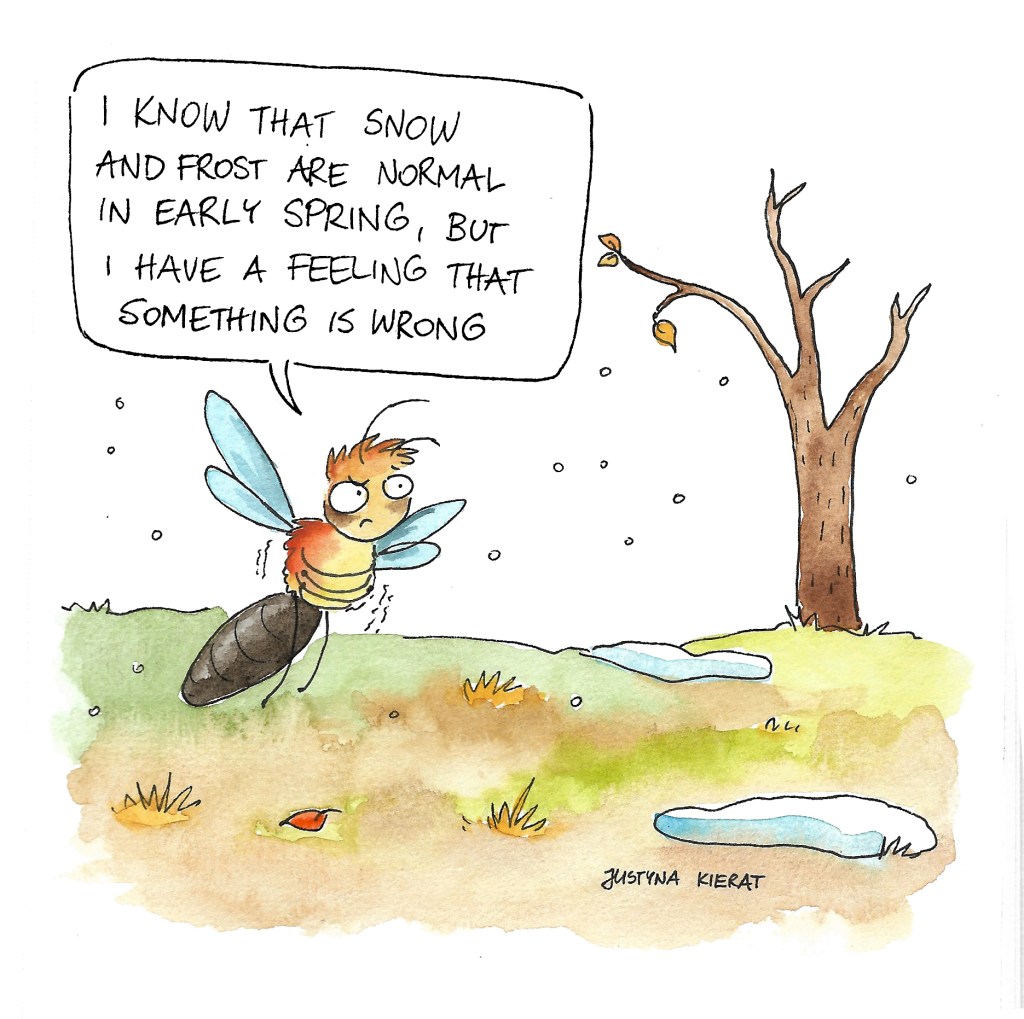
Many bee species only fly at a specific time of year. Sometimes, they are only active for a few weeks and you can’t see them at any other time… or can you?
Every autumn, occasional sightings of spring-active bees are reported. It is thought that these are either bees that were disturbed in their underground nests, e.g. by gardeners, or bees that simply made a mistake regarding to when to emerge. Sadly, their fate is pretty much sealed – they have little chance to live long, not to mention finding a mate of their own species and reproducing.
Rumour has it that the cases of spring bees active in autumn are becoming more frequent because of the climate change. However, I don’t know of any papers that explore this possibility. If you know of any, please post a link in the comments!
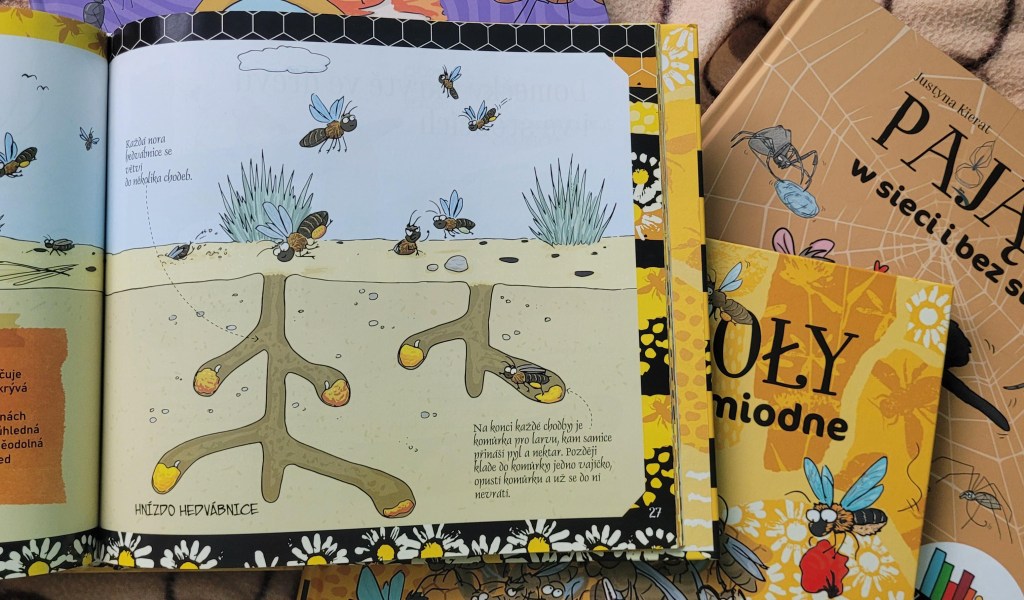
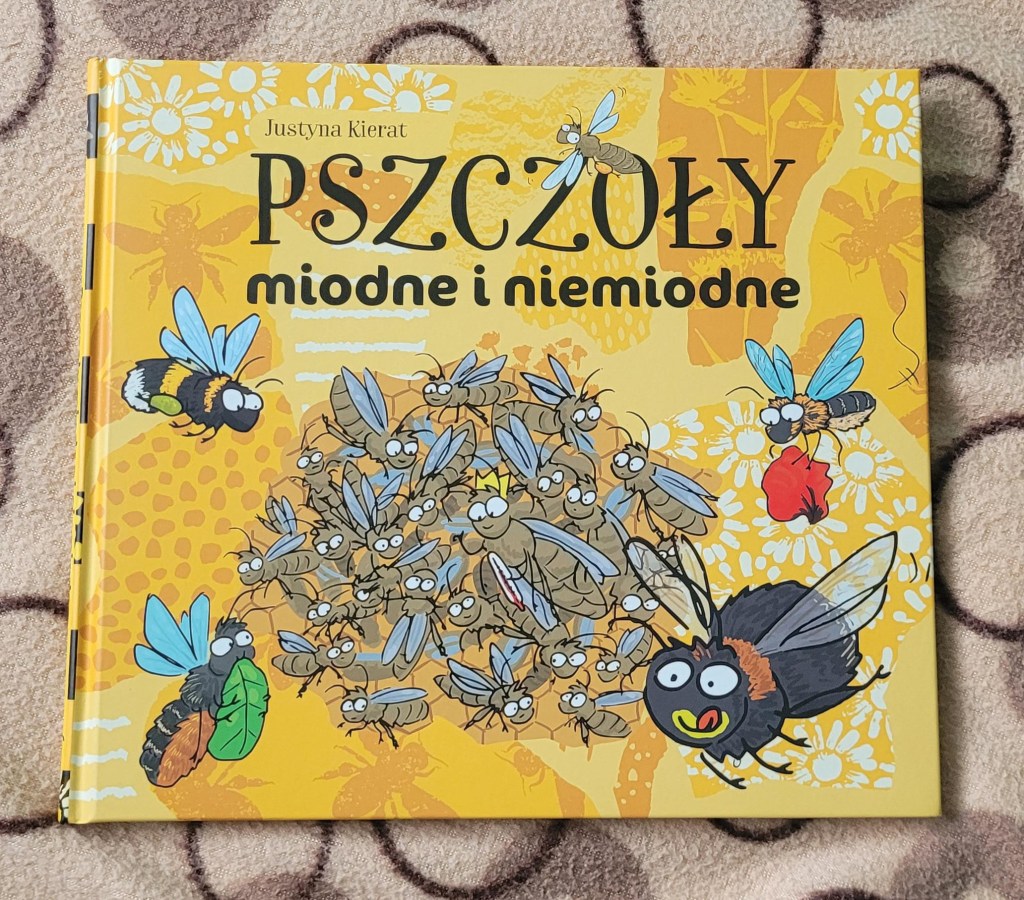
I’ve wanted to show you this for a long time. I’ve finally taken some good photos, so I can do it now. As you might know, I’m a biologist specialising in non-honey bees, an educator, and wildlife illustrator. The yellow books you can see in the photos are the result of combining these three things. The book is called “Honey- and Non-Honey Bees” (well, now you know where this page gets its name from:) ), and it presents the diversity of bee species and their lives. Although my cartoon drawings make it look like a children’s book, it’s not quite so – adults who are not yet familiar with bees can also enjoy it.
The book was originally published in Polish and was later translated into Czech and Slovak. I wish it could be published in more languages, but there’s not much I can do about that. However, if you know of any interested publishers, you can give them the contact details of the Polish publisher that owns the copyright to my book.
The violet and orange book are two more from the series that I wrote and illustrated: one about ants and another about spiders.





 Non-honey bees