Today I have a spring drawing for you. This is the common carder bumblebee (Bombus pascuorum), one of the most numerous bumblebees in the area where I live. It is by no means the easiest to identify, though. Its colouration is very variable and some colour forms are strikingly similar to other bumblebee species.
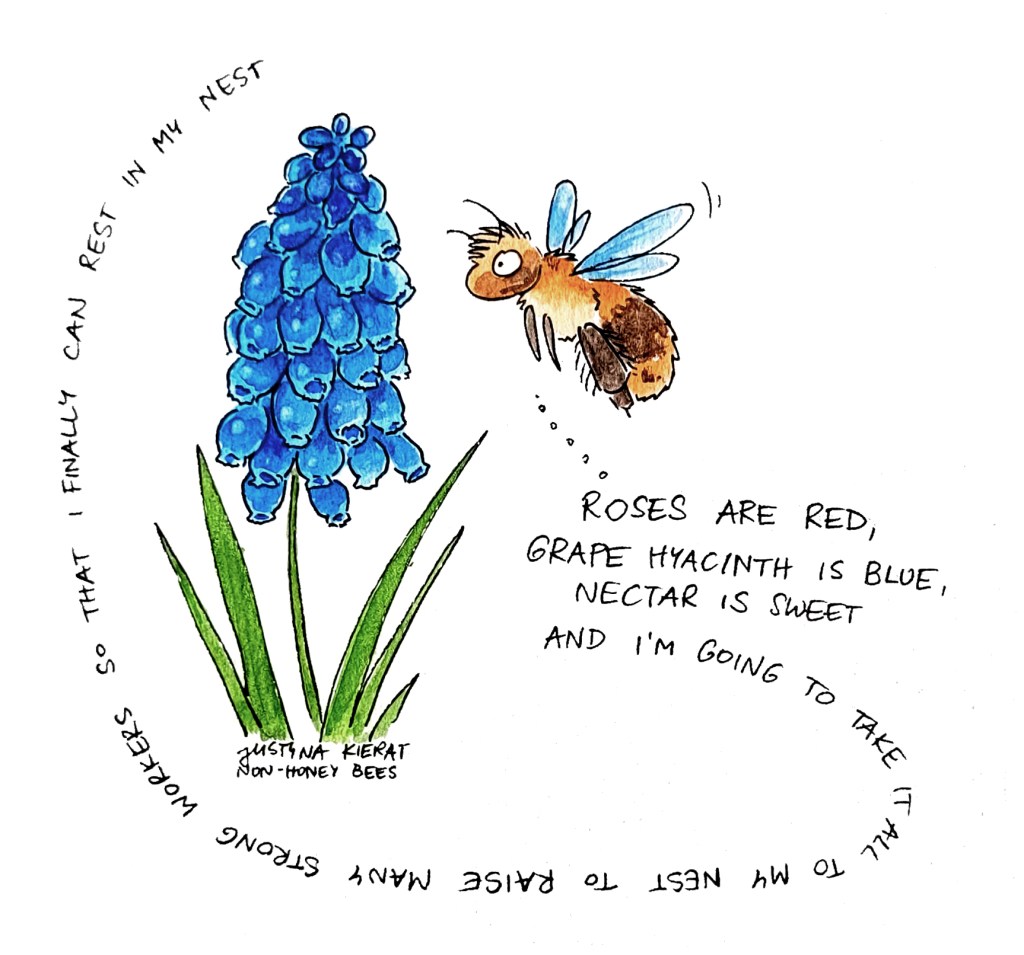
Bumblebees are said to have innate preference for blue colour. It means that a bumblebee that has never seen flowers before will be more attracted to blue ones. I don’t know how universal it is – I found research done only on a few species. What is interesting, there is some degree of individual variation in colour preference – not all bumblebees and all colonies of the same species like exactly the same colour.
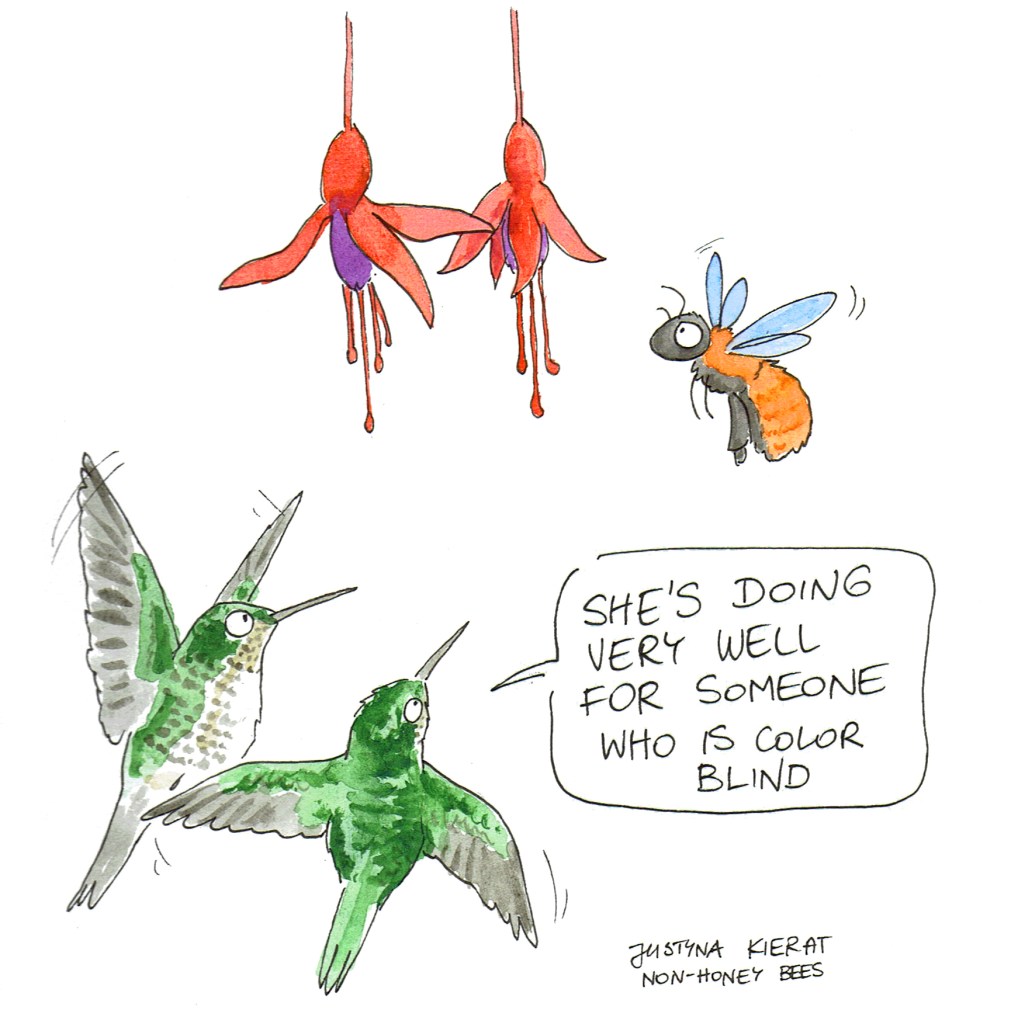
The innate preference can be quickly modified after a young bumblebee starts foraging, and learns which flowers are most rewarding in her environment. Therefore, we can see bumblebees foraging on all colours of flowers (even on red ones – see my previous post!)
Have you heard that bees can’t see the red color? I guess so. Maybe you even read that in some of my posts. Recently, I stumbled upon two papers, one by Chittka and Waser, published in 1997, and a bit more recent one, by Martinez-Harms et al. (2009). And these papers, especially the first one, have shown me that the issue of bee color vision isn’t so black and white (pun intended). Let me explain it a bit below, but I strongly recommend you reading the original papers.
Bees are trichromats, as we are, which means that they have three types of receptors in their eyes, each type sensitive to different light wavelengths. We can see the wavelengths from, basically, violet to red, whereas bees can also see UV, and they are less sensitive to the red part of the spectrum. However, they are not completely blind to red: one of the receptor types is sensitive to wavelengths which humans could well describe as red color. So, a monochromatic red object will not be black to bee.
But then, although bees can see the red light, they seem not to be able to see red as fully distinct color. If you show them monochromatic green, yellow, orange or red light, the bees will perceive them as the same or very similar hues, but they will differ in their brightness. As Chittka and Waser put it, “for example, a monochromatic red light of strong intensity will generate the same sensation as a green light of moderate intensity”. So, you can trick a bee into believing there is no color difference between the two stimuli if you cleverly choose wavelengths and light intensities for them.
But the story doesn’t end here! In real life, bees rarely have to do with monochromatic objects. What an eye perceives as a given color, is usually a mix of different wavelengths. Therefore, it is much less likely that a red flower will so perfectly match a green background that it will be invisible to bees. If it reflects light of some shorter wavelengths in addition to the red ones, it’s easy – a bee can distinguish its colors well. If it reflects only red light, however, she will rely on brightness contrast, which will be a bit more demanding but still possible. It was observed that bees foraging on “truly red” flowers take more time flying between distant inflorescences than between flowers of other colors, probably because locating them is more challenging.
And regarding the cartoon, the hummingbirds are quite justified in speaking about color-blindness of the bumblebee, as their color vision is amazing, better than bees’ and ours. The bumblebee in the cartoon is Bombus dahlbomii, the rare South American species which is known for its love of red flowers.
Being active in various fb groups taught me that many people don’t know what bees look like when they are making love. If you also didn’t know that, you do now, thanks to this cartoon.
This post was published on Instagram in cooperation with The Pollinator Academy. I’m happy to be involved in this initiative. If you are interested to learn about pollinators, in particular bees, hoverflies and butterflies, and recognizing them, check out the PA website!
Have you ever seen a bumblebee lift its leg as if to say hello or give you a high five? The bee looks as though she wants to be friends with you. In reality, however, it’s the opposite.
In bee language, raising a leg is a sign of discontent. This message can be directed towards humans or other insects. It’s a warning not to approach any closer if you don’t want to get stung. However, in the case of males, it’s only a bluff as they don’t possess a stinger.
Shortly after emerging from the nest and mating, young bumblebee queens start looking for a place to hibernate. Typically, a female will dig a hibernaculum in the ground — a relatively short tunnel with a small chamber at the end. I was surprised to read that when a digging female encounters an obstacle in her way, like a pebble, she doesn’t try to bypass it but leaves the burrow and starts a new one. What could be the adaptive significance of this? Or is there none? If you know, please tell me!
The honeybee is unimpressed. Their colonies can have about 50,000 workers. By comparison, bumblebee colonies range from several dozen to around 500 individuals. But this fanpage is about non-honeybees, so we don’t care about the honeybee’s opinion.
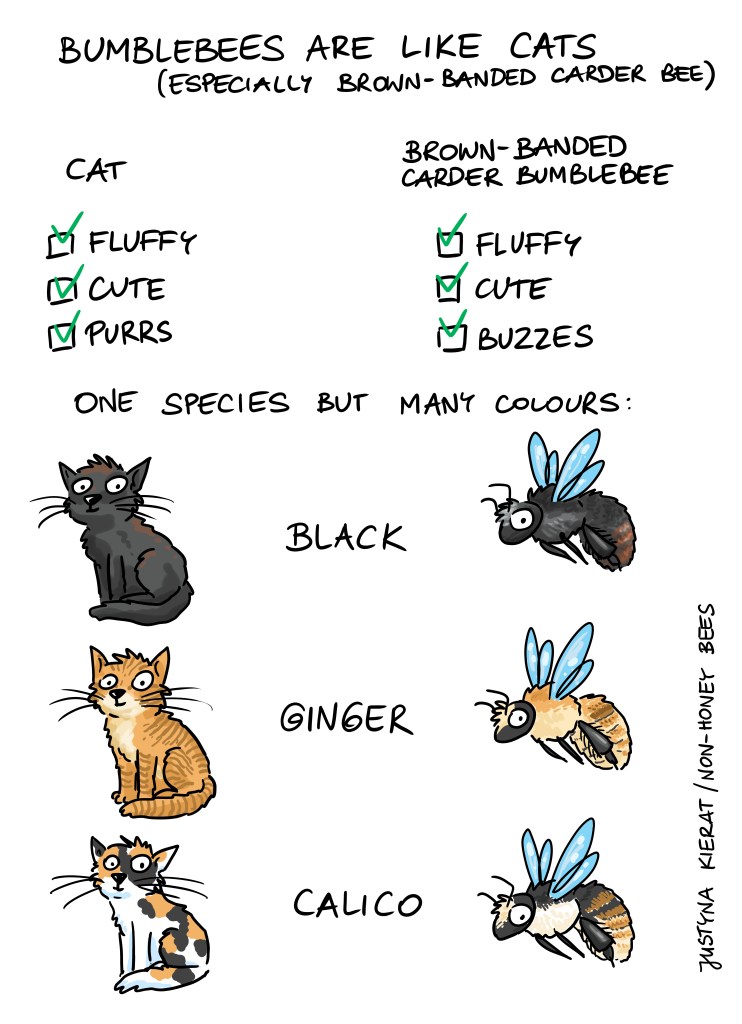
…and the most cat-like bumblebee is the brown-banded carder bee! It just struck me how similar they are. Bombus humilis is called “trzmiel zmienny” in Polish, which means “the variable bumblebee”. It’s really accurate name. This species can come in various colour forms, some of them so dissimilar that you could think they are different species. My favourite form is the one I nicknamed ‘calico’ on the cartoon below.
PS I set up an account on BuyCoffee. If you want to support my work and help me buy more books about bees, I’ll be very thankful. And, as always, I’m thankful for all your shares and likes on social media, and positive comments and messages!
Surely you saw bumblebees with small brownish “dots” in their hair. You might think that they are varroa but they’re not. Varroa is a parasite which attacks presently only honeybees. Those bumblebee “dots” are mites, too, but they don’t suck their haemolymph or do any harm – in this life stage they are just hitchhiking to the bumblebee nest. Inside a bumblebee colony, they often are harmless or even beneficial, eating debris or hunting for harmful mite species. So, you don’t need to worry about a bumblebee carrying mites on her.
I decided to take part in #inkober2024 and to make it a #beetober on my blog. The first drawing is a bit cheated, as I’m in a train and have only a gel pen with me, so it’s not exactly ink drawing. Topic of day 1 is: backpack. What can it have in common with bees? Some do carry tiny backpacks, thanks to the curious scientists who want to know where they are going! Larger species, like honeybee or bumblebees, can be equipped with little transponders which allow to track their movements with the radar. Scientists can follow each individual bee and see where and when it forages. Crazy, isn’t it? 🙂
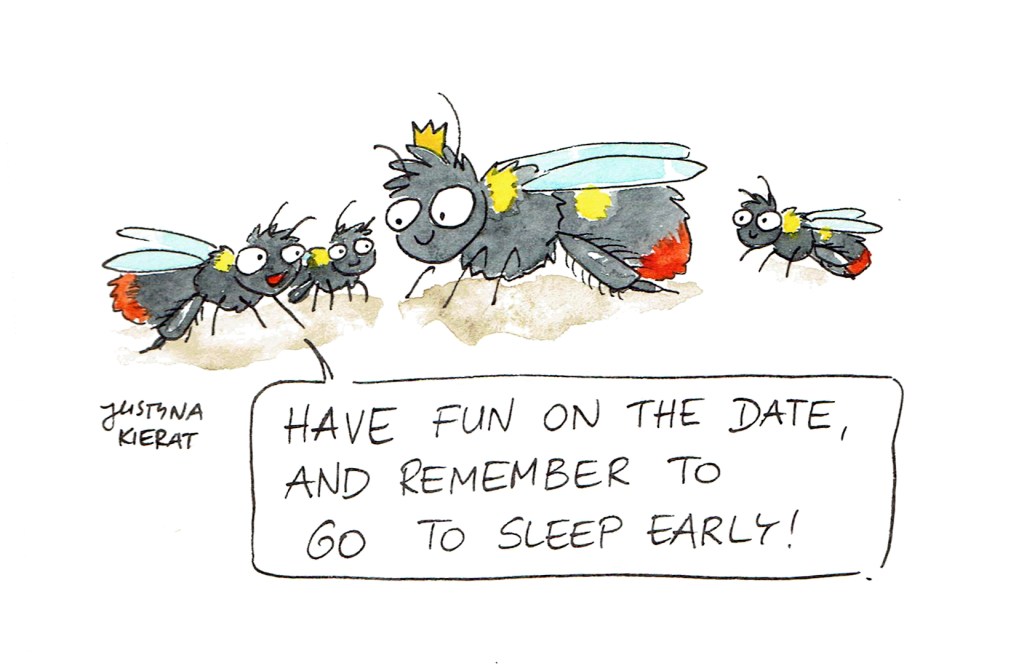
Young bumblebee queens spend a few days feeding and looking for a male to mate. Then, they don’t wait for winter to come but dig a hibernaculum and go to sleep – sometimes as early as June!
Bumblebees are animals of colder climates than most bees, and climate change can affect them negatively in various ways. One of dangers are heatwaves. They can not only simply kill the individuals but also impair their memory.





 Non-honey bees