Young bumblebee queens spend a few days feeding and looking for a male to mate. Then, they don’t wait for winter to come but dig a hibernaculum and go to sleep – sometimes as early as June!
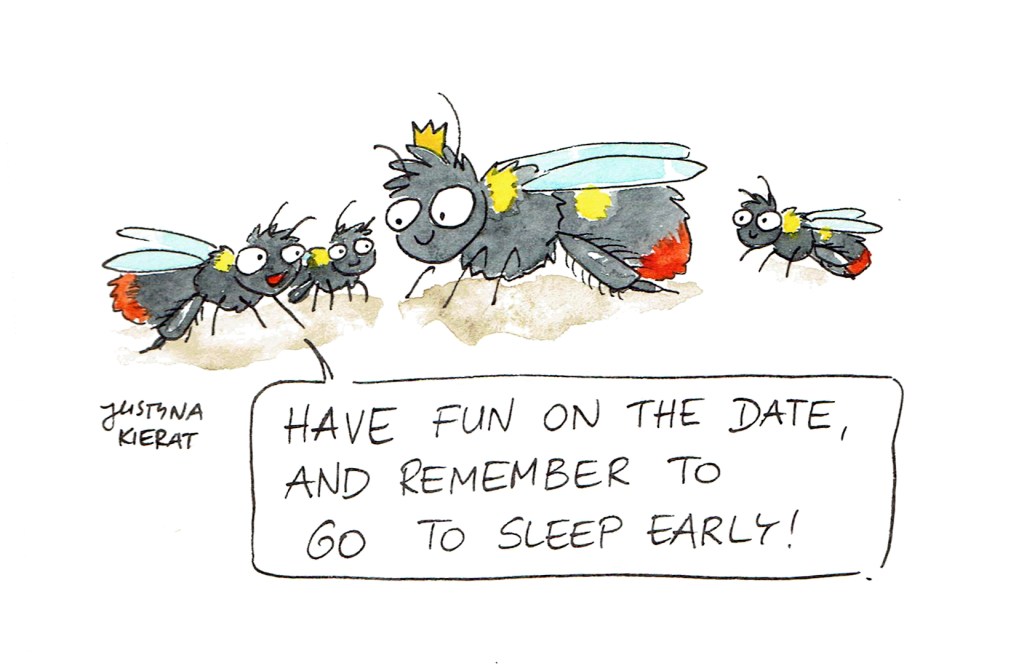
Young bumblebee queens spend a few days feeding and looking for a male to mate. Then, they don’t wait for winter to come but dig a hibernaculum and go to sleep – sometimes as early as June!
Bumblebees are animals of colder climates than most bees, and climate change can affect them negatively in various ways. One of dangers are heatwaves. They can not only simply kill the individuals but also impair their memory.

Flowers are the main (and in most cases, the only) source of food for bees. But it’s not their only role in bees’ lifes. They can have also a medicinal value, helping bees to get rid of various pathogens. One of examples is pollen of sunflowers. It helps bumblebees fight the infection by Crithidia bombi, their protozoan pathogen. The mechanism of this beneficial effect was unclear, as scientists could not identify any chemicals present in sunflower pollen which would kill the pathogens. It turned out that there might be none… but the pollen works like a laxative, cleaning the digestive tract from the pathogen’s spores.
Here you can read about the study: Adler, L. S., Fowler, A. E., Malfi, R. L., Anderson, P. R., Coppinger, L. M., Deneen, P. M., … & Stevenson, P. C. (2020). Assessing chemical mechanisms underlying the effects of sunflower pollen on a gut pathogen in bumble bees. Journal of chemical ecology, 46, 649-658.

The spring is there (at least in the area where I live!) and each day we can see more and more bees. One of the first thoughts of the freshly emerging males is… mating. They are looking for the virgin and receptive females of their species, alert to their pheromones and to their appearing on the horizon. However, sometimes they make spectacularly misdirected attempt of courtship. They can assault females of other bee species, male bees, and even insects other than bees.
There is an interesting project on iNaturalist.org named “Interspecies insect mating” where you can find a few bee observations. I recommend adding your own, if you are lucky to witness such situation!

In most bee species, there is not much size variation within one sex, and body size is often useful character in the process of species identification. Bumblebees belong to the exceptions from this rule. In females, there is huge size variation not only within a species but even within a single family. You can see this clearly in the spring – the first ones to emerge are queens which are big. Then very small wokers appear – these are the first brood reared by the queen herself. Then, the next “generations” of workers consist of both big and small ones, and the difference can be even tenfold!
In this paper, the effect of interaction between size of a bumblebee and size of a flower was studied. It turned out that there is not much effect of the sizes of the interacting parties on effectiveness of pollination. It is a good news because it allows us to assume that these interactions are resilient to size changes which might be a result of various environmental factors, like climate change. In the warmer temperatures, organisms tend to get smaller but not every species and population must change their size at the same pace.

I’m very fond of cuckoo bees. They don’t build their nests and have amazing adaptations to make other bee species raise their children. Many of them, “true” cuckoos, just lay their eggs in the nests of solitary bees, and their success depends on making it so that the nest owner doesn’t know of the parasite’s egg in her nest. Others, like the cuckoo bumblebee pictured on the cartoon you see, invade nests of social species and usurp the title of the queen. After succesfully establishing its position in the nest, the cuckoo bumblebee female begins laying her eggs and host workers care for them like for their own sisters. The cuckoo keeps discipline by biting and dominating the workers (and the old queen, if she survived) but usually doesn’t kill the workers, as they are precious workforce for her young.
On the cartoon you can see the Field cuckoo bumblebee (Bombus campestris) in the nest of the Common Carder bumblebee (Bombus pascuorum). The cuckoos are picky when it comes to host choice, and usually parasitize only one or a few host species.

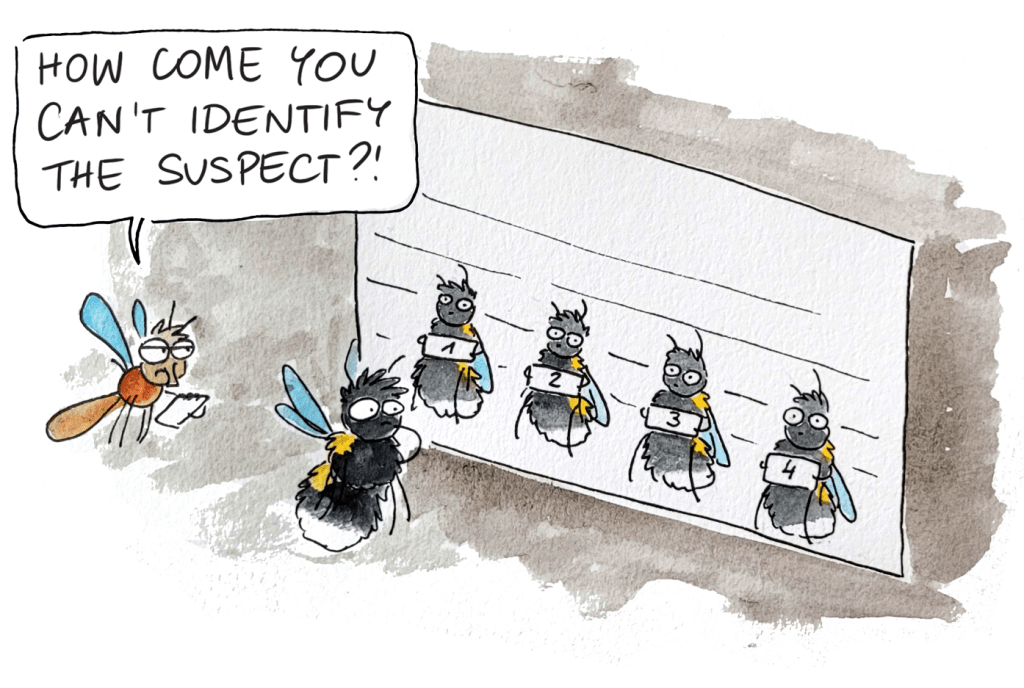
Bee species identification is considered quite a hard job. There are some easily distinguishable species, but others demand looking closely at the specimen under a magnification. Some bumblebees take it to an even higher level. Bombus terrestris, B. lucorum, B. cryptarum and B. magnus are four closely related species living in my area, whose males and queens are often very difficult to separate, and workers, especially old and worn ones, are considered inseparable in many cases, and I mean inseparable at all by the means of looking at a specimen – even if you take it to the laboratory and look under the microscope. How on earth do these bumblebees recognize each other?! Well, they have more senses than just vision at their disposal. For example, males’ pheromones differ between these four species. When scientists are very determined to be sure which species they caught, they can do chemical analyses of these substances, or just do genetic analysis.
Fun fact: if you are eg from UK or Iberian Peninsula, you might have far less trouble recognizing your Bombus terrestris than me in Central Europe. In UK it tends to have more or less buffish tail (instead of pure white), and in Iberian Peninsula the corbiculae of females are reddish.
Yesterday I read a very interesting article by Andreas Müller and Paul Westrich about Andrena lathyri, a mining bee species specialized in nectar robbing. I learned from this paper, among other things, that there is more than one way of obtaining nectar without pollination. Two of them I portraited on the cartoon. The first method, nectar robbing, involves damaging a flower, eg. piercing a hole in its side, like Bombus wurflenii, the famous nectar robber, is doing. On the other hand, nectar thiefs don’t damage flowers but are so small that they sneak past the reproductive organs straight to the nectaries, and as they don’t touch stamens or pistil, it doesn’t pollinate.
If you want to read the paper about Andrena lathyri, which I recomend, here you have the citation: Müller, A., & Westrich, P. (2023). Morphological specialisation for primary nectar robbing in a pollen specialist mining bee (Hymenoptera, Andrenidae). Journal of Hymenoptera Research, 95, 215-230.

I’ve just began drawing a series of little portraits of bee species living in Poland. The drawings are referring to distinctive features of the species or their Polish names (or both  ). Meet the pretty Bombus humilis, “trzmiel zmienny” in Polish, which translates into “the variable bumblebee and refers to extreme colour variability of this species.
By the way, have you known that “nacked” bumblebees (ie, under their fur) are glossy black?
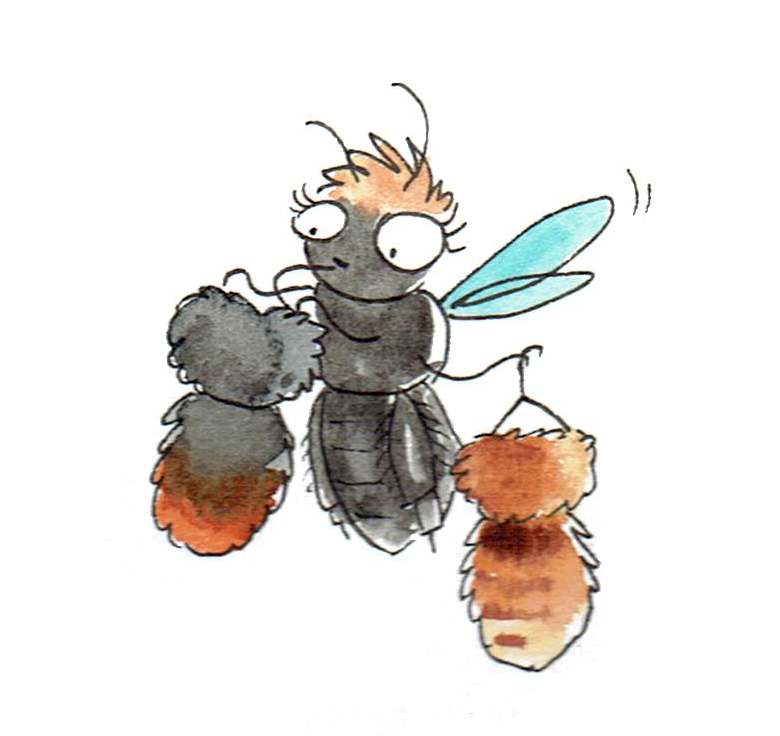
Anyone who ever tried to learn bumblebee identification, knows that there are species which are very similar in colouration to each other. Moreover, there are some strange species where one colour morph is similar to one species, and another morph – to a different species. Bumblebees form mimicry rings, which are groups of species which are visually similar and live in more or less the same area. The advantage of this similarity is that predators more quickly learn which insects are not worth attacking (bumblebee females have stings which makes them a rather unpleasant lunch).

Bumblebees don’t dance like honeybees and can’t communicate a precise location of food. However, they can recruit nestmates to the flowers. The worker who found a good food source is running excitedly, bumping into other bees in the nest and presenting samples of collected food to them.


