Bumblebees don’t dance like honeybees and can’t communicate a precise location of food. However, they can recruit nestmates to the flowers. The worker who found a good food source is running excitedly, bumping into other bees in the nest and presenting samples of collected food to them.
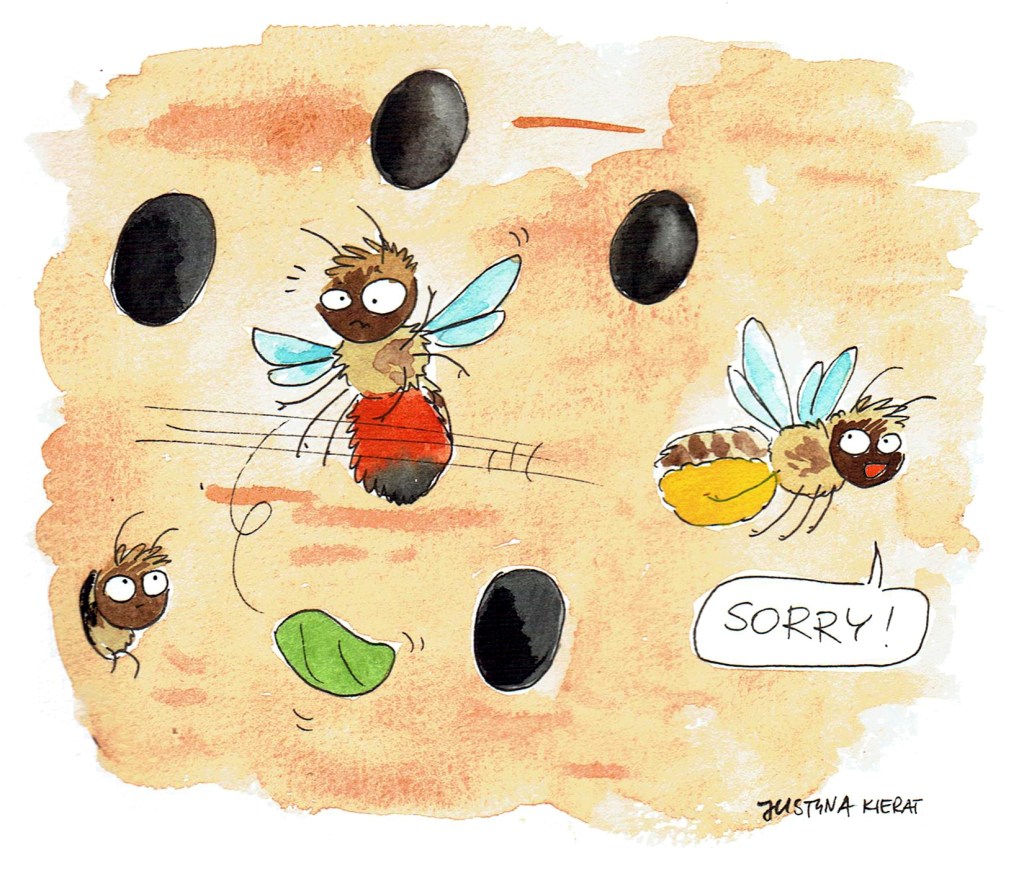
Leafcutter and mason bees can be bred in artificial trap-nests, for example for experimental purposes or for pollination of crops. When the density is high, and nest entrances to each other, females can get lost or engage in quarrels with their neighbours. Leafcutters can lose the leaf pieces they carry, and when a piece falls to the ground, it is not picked up but the poor bee must fly to cut another one.
Here is a citation of the paper which inspired this cartoon – one of research tasks was to weigh the dropped leaves
Guรฉdot, C., Bosch, J., James, R. R., & Kemp, W. P. (2006). Effects of three-dimensional and color patterns on nest location and progeny mortality in alfalfa leafcutting bee (Hymenoptera: Megachilidae). Journal of economic entomology, 99(3), 626-633.
I’m currently reading about mining bees (Andrena) and their cuckoos (Nomada), and I feel so sorry for them. The mining bees are being constantly watched. Sometimes Andrena and Nomada sit opposite to each other for several minutes, the mining bee in her nest, the cuckoo a few centimeters apart. But the cuckoo has plenty of time, and the mining bee has to collect pollen for her progeny, so it will be Nomada who wins this war of nerves.
An old recycled (and translated) cartoon from my Polish fanpage. Most bees which emerged from their nests this year, must die before winter, leaving their progeny which will leave their nests the next season. However, not all of them. Females of Ceratina, Xylocopa, Halictus or Lasioglossum (I’m not sure if all species in these genera but surely a number of them!), and of course bumblebee queens, go for the overwintering to their natal nests or some other hiding places, to emerge the next spring and start their nesting activities.
There are many mites associated with bees. When we see some on the bee’s body, we often assume that they are harmful. But actually, they might be not harmful or even benficial for them. Many species of mites live in bee nests and they might forage on the pollen or larvae (thus being harmful), on leftovers (being neutral – or beneficial as they are cleaning the nest) or hunting other, harmful mites (being certainly beneficial). The individuals which we see on bees, are usually dispersing life stages, which aren’t parasites sucking bee haemolymph or don’t hurt it in any way – unless they are in so large number that they make flight difficult.
In some bees, the connection with mites is so tight that they even have special places on their bodies where mites are transported.
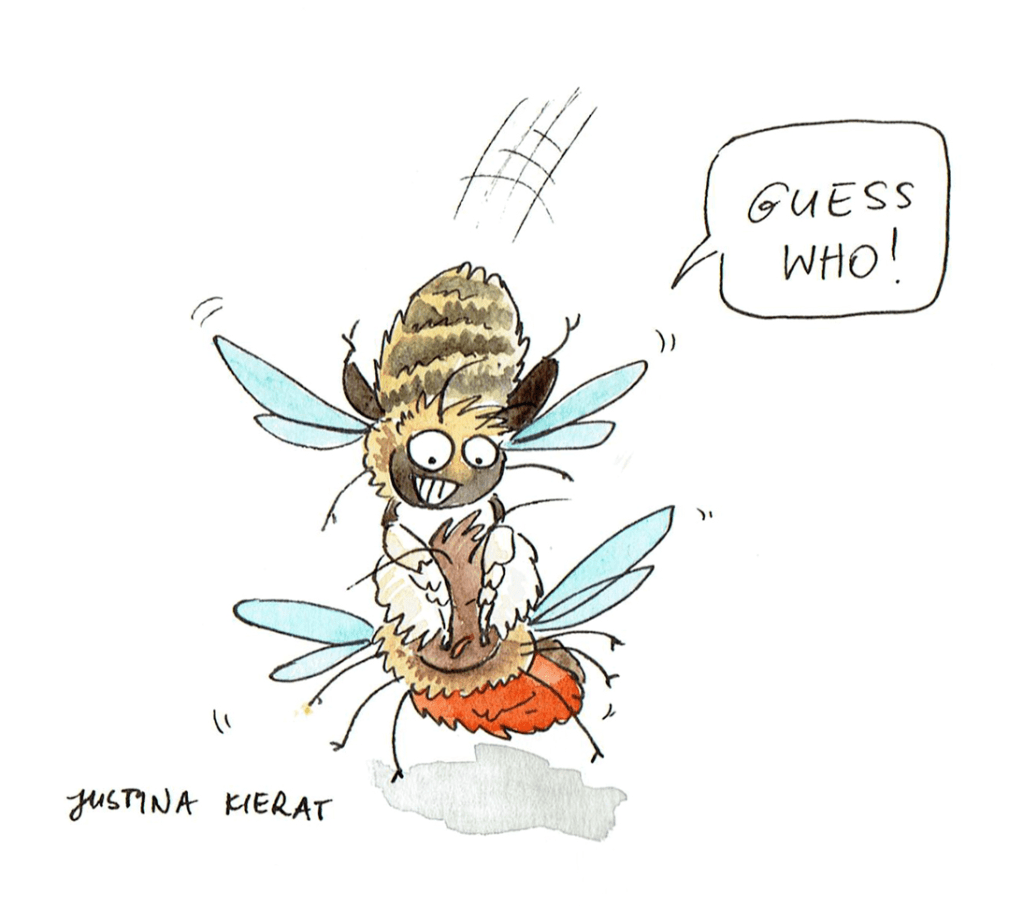
In some species of bees males have expanded fore tarsi, shaped so that they can serve as blindfolds. Their use as such is important part of courtship. Interestingly, expanded forelegs which are used in mating can be found in some distantly related bee species, like in some species of Megachile and Xylocopa, and also in some digger wasps.
Sleeping bees have always fascinated me. Females usually spend nights inside their nests (unless they are cuckoo bees and don’t have one), but males look for various sleeping places. In some species, they like spending the night in a sleeping aggregation of a few (or sometimes quite many) individuals, gathered on a plant stem or inflorescence. They are in plain sight and it’s uncertain what advantages this behaviour has.
Halictus scabiosae and H. sexcinctus are two related species, and quite similar in appearance. There are two particular differences, among others, between them*. First, H. sexcinctus (but not scabiosae) females have acarinarium on their first tergite, which is a cozy place for mites of a specific species, Anoetus halicticola. Second, H. scabiosae increases its range quite fast in recent decades. In Poland this species was first observed in 2020, and a few days ago we published a short note about its further dispersal. It travels fast!
*I don’t know about causal relationship between presence of acarinarium and dispersal, don’t treat the cartoon scenario too seriously ๐