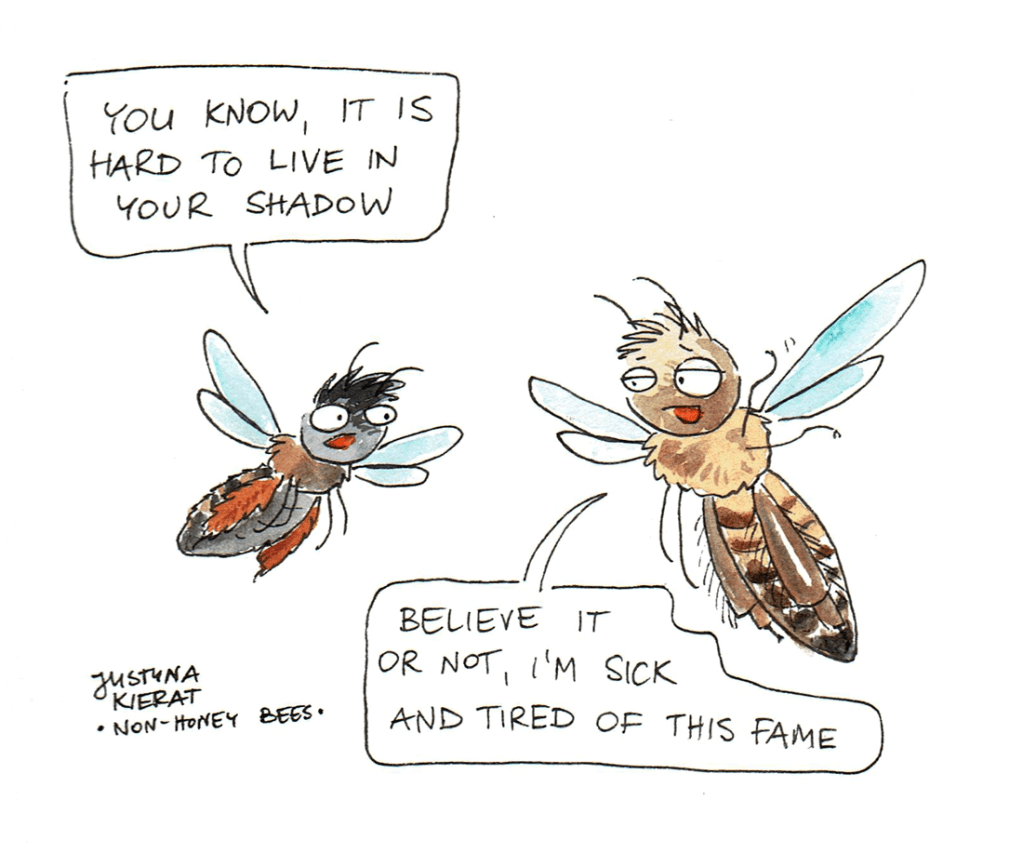
Money? Love? Adventures? The first three words you see will describe your 2025!

It’s quite early but I’d like to wish you merry Christmas and loads of bees in 2025!
The bee celebrating on my cartoon is Megalopta genalis – one of few bees well equipped to go to the New Year’s Eve party – it is active year-round (so, 31st December, too) and stays up late.

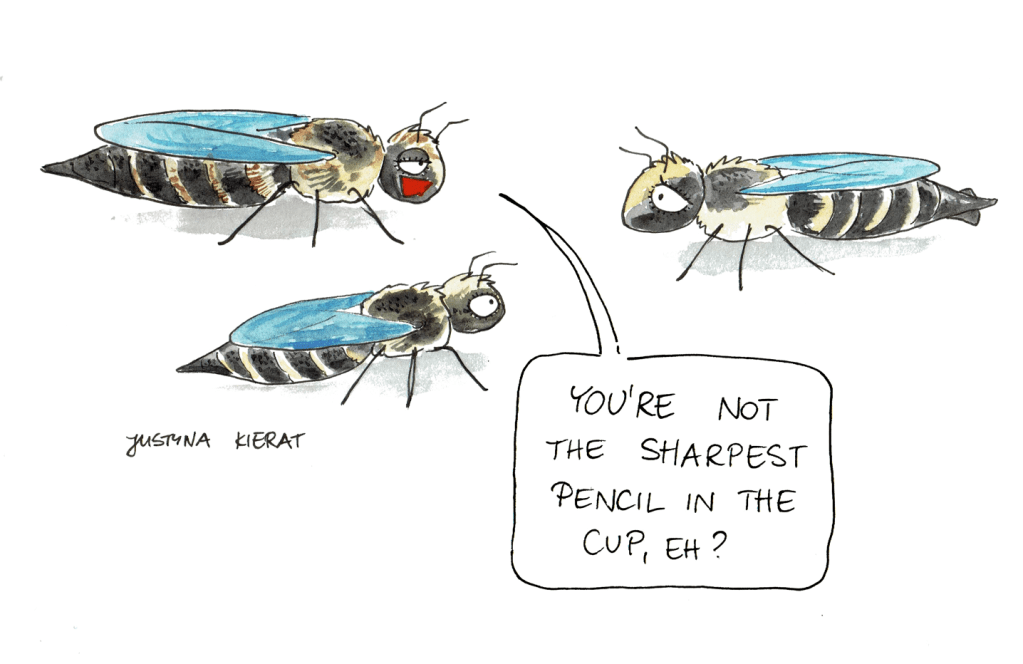
Sharp-tailed bees (genus Coelioxys) owe their common name to the shape of the ending of the abdomen. In females, the abdomen usually ends in narrow, sharp spine. But it’s not always the case. For my cartoon I chose Coelioxys alatus but the other candidate I was considering was Coelioxys obtusiventris ![]()
Sharp-tailed bees are cuckoos, laying their eggs in other species’ nests. They share an interesting trait with the honeybee – their eyes are hairy.

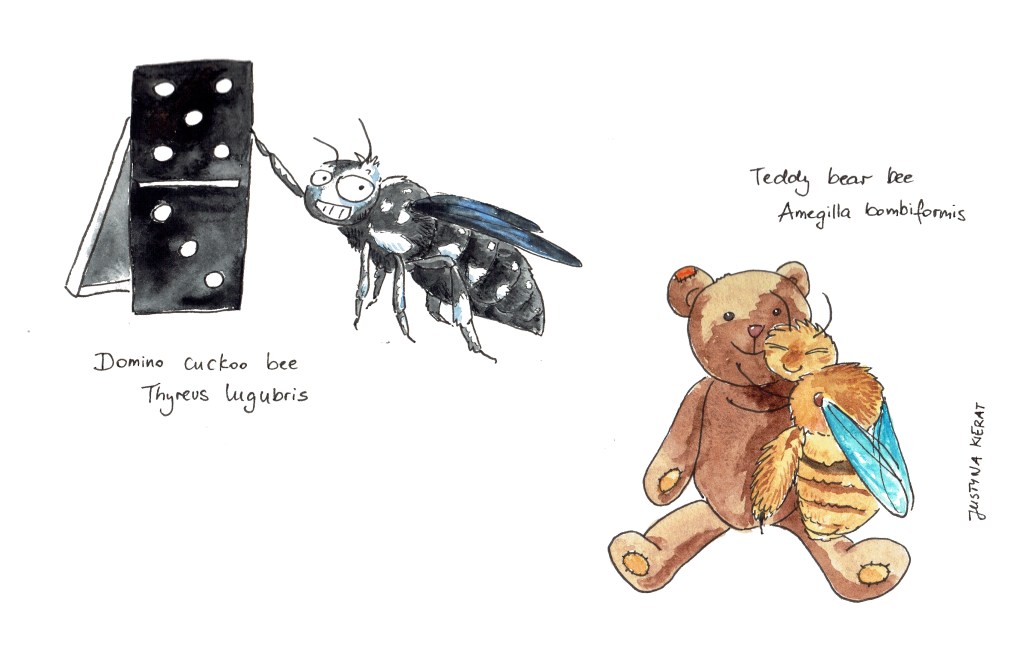
Don’t know what to buy for Christmas? Let the Australian bees help you!
Yes, these are really common names of two bee species. And, believe it or not, the domino cuckoo bee is a brood parasite of the teddy bear bee!

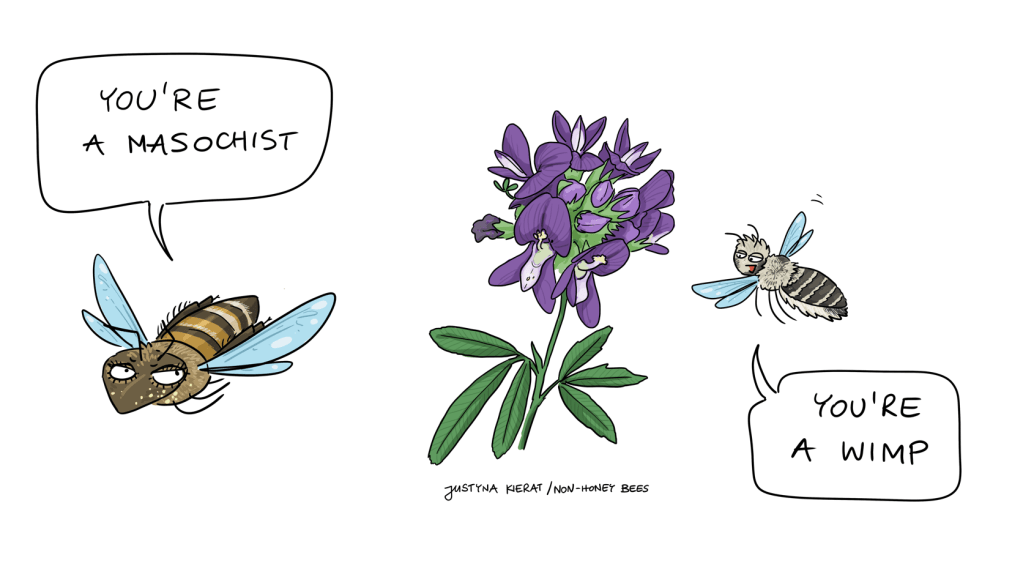
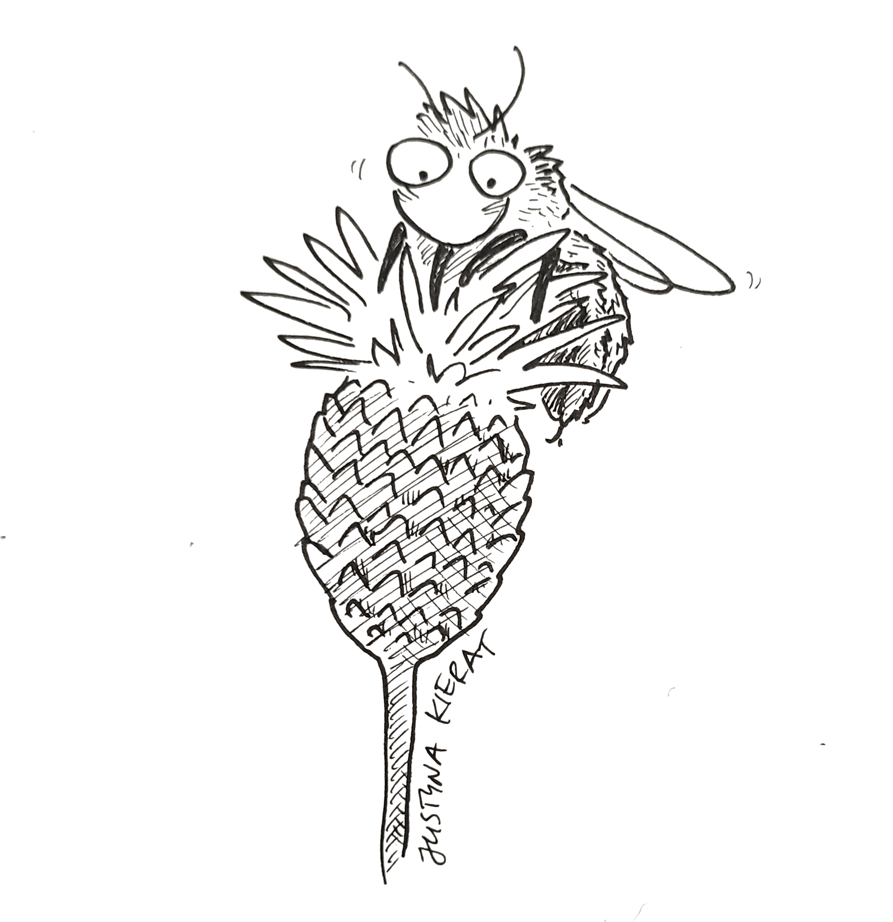
Honeybee can visit many plant species all over the world – but it doesn’t make it the best pollinator for them all. For example, it doesn’t like visiting alfalfa (Medicago sativa). In order to be pollinated, alfalfa flower has to be tripped by a bee, and it hits it in the head with its stamens in the process. The honeybee doesn’t like such a mistreating but there are other species, like the alfalfa leafcutter bee (Megachile rotundata) or the alkali bee (Nomia melanderi) who don’t care. Both of them are bred as pollinators of alfalfa.
I’m not sure whether the plant on the drawing is alfalfa, or some related species but I hope you don’t mind.

Oh no, I’m so hopeless in challenges. I haven’t even made it to half of the #inktobee and not sure if I’ll ever catch up. Never mind, I have some absolutely amazing story for you.
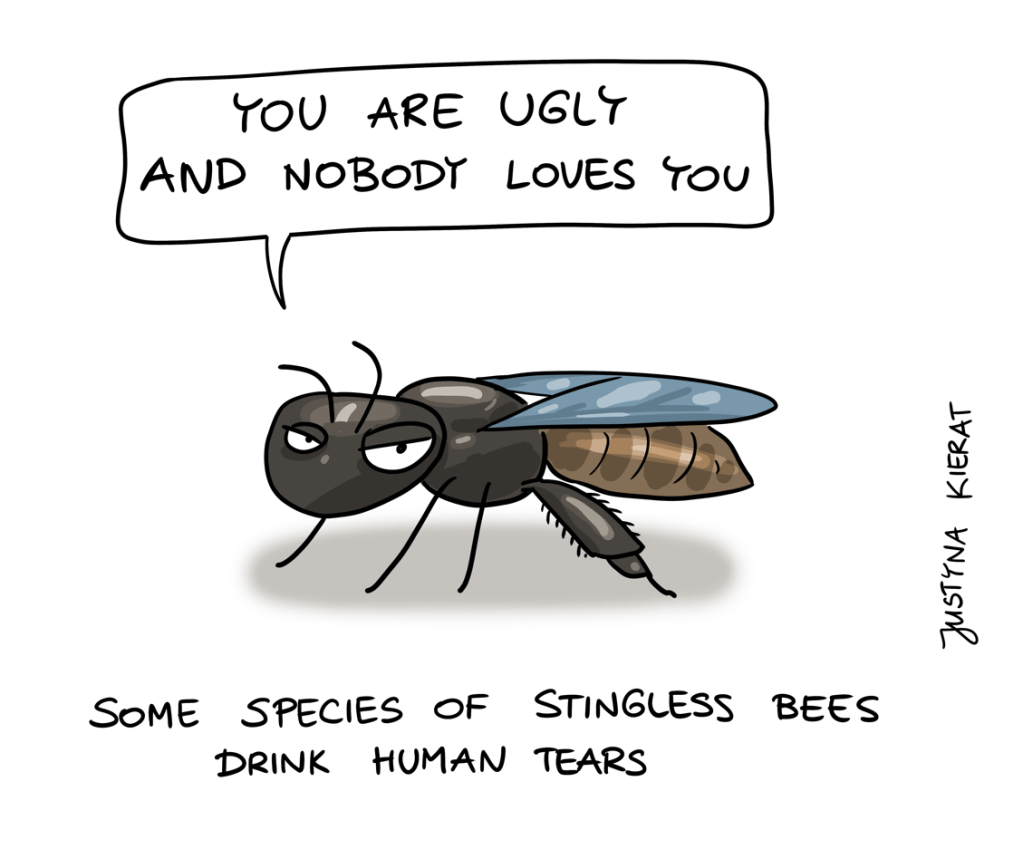
Stingless bees are very small social bees from the family Apidae which can be found in tropics and subtropics. Some of them have quite strange dietary habits – three famous species of “vulture bees” feed on carrion, some species come to humans to lick their sweat, and there are also a few species which… suck tears. According to the researchers, they are quite adept at collecting them. Experienced workers are so gentle that they almost don’t disturb their ‘victim’. I strongly recommend you read the recently published review article, the research on these bees is really interesting and there are photos of the bees in action. Hans Bӓnziger, the first author of the article, let the bees feed on his tears, and his dedication to research is impressive. I was amazed that he was marking these bees with spots of paint with the help of brush and mirror, when they were sitting at his eyes 😮 And these bees are tiny, only a few milimeters long!
I once read another paper about these bees, and the cartoon you see is a remake of a drawing I did in Polish for my other fanpage.

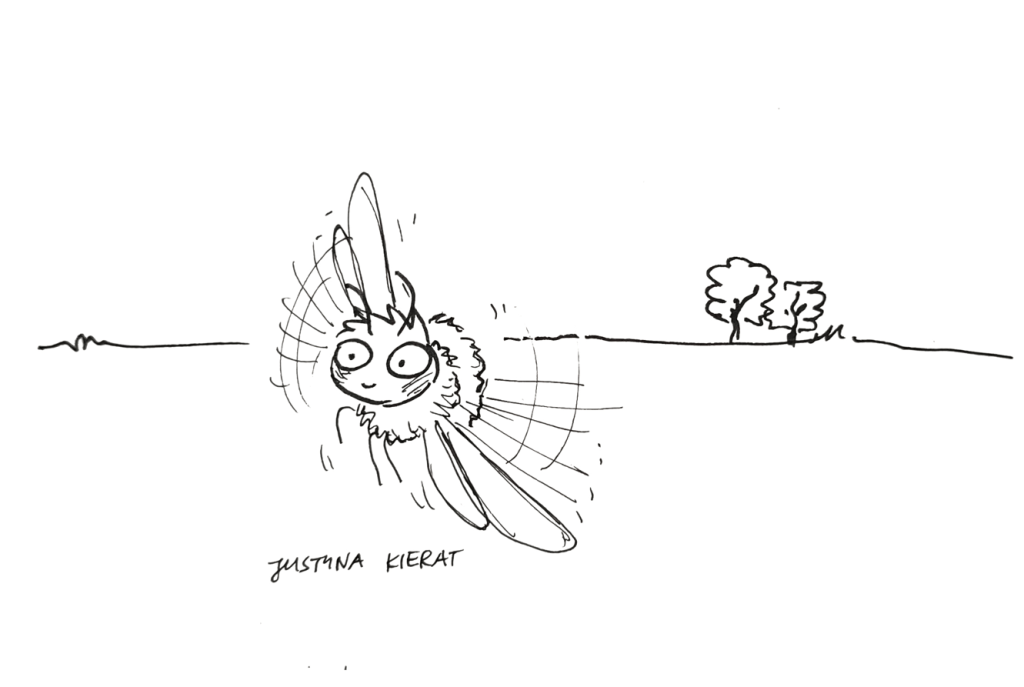
Have you seen any of these videos where a bird (eg a kestrel or a kingfisher, or even a hen) keeps its head still when flying or sitting on a moving branch? Bees also have this kind of optic stabilization. When they fly, their thorax might rotate but head keeps being oriented horizontally. Here you can find an example of studies on this topic.

My association with this topic was remote control. Well, this kind of control might be not exactly remote, as it’s about a parasite controlling behaviour of its host. Apocephalus borealis, a fly, makes its bee host into a kind of zombie. It is known to parasitize bumblebees but a paper from 2012 reported it parasitising also the honeybee.

What bees grab when they’re hungry and busy? Mostly nectar. In general, the majority of bees feed on nectar and pollen, but the latter is consumed mainly by developing larvae, as it contains much protein and other substances essential for growth. Adults need mostly sugars to get energy for flying and doing everything they need to do. They consume pollen, too (females need it for producing eggs!) but in smaller quantities than their kids.

There could be only one bee today!… Well, one of over 800 bees, in fact. This is the number of members of the genus Nomada. These bees are cuckoos, their progeny develops in the nests of other bee species, for example mining bees (Andrena). I’m quite not sure where does the genus name come from. Is it because the bees don’t have their own ‘homes’, as they don’t build nests?

Bees love sun, of course! If you want to go bee-watching, it’s best to choose a warm, sunny day without much wind.
But… do you remember that one bumblebee who likes rain? It was on the blog quite a while ago 🙂

In #beetober it will be (hitch)hike.
Surely you saw bumblebees with small brownish “dots” in their hair. You might think that they are varroa but they’re not. Varroa is a parasite which attacks presently only honeybees. Those bumblebee “dots” are mites, too, but they don’t suck their haemolymph or do any harm – in this life stage they are just hitchhiking to the bumblebee nest. Inside a bumblebee colony, they often are harmless or even beneficial, eating debris or hunting for harmful mite species. So, you don’t need to worry about a bumblebee carrying mites on her.