Click on cartoon to enlarge it
Some bees don’t emerge from their natal nests the next season. Especially in case of desert species, they can skip a year… or several years. As Danforth et al. mention in “The Solitary Bees”, Rozen once kept prepupae of Pararhophites in his desk drawer for five years! And it was not even the record because Amegilla dawsoni can wait for ten years for emergence.

There is great paper by Andreas Muller in Alpine Entomology published this year, about food preferences of Hylaeus. Members of this genus were believed to be polylectic, with a few exceptions. As it turned out, many of them are in fact specialized or at least have marked preferences for certain types of pollen.

Do you remember that amazing photo by Karine Aigner, the winner of Wildlife Photographer of the Year competition in 2022? Here’s how it was made (at least I think so!
)

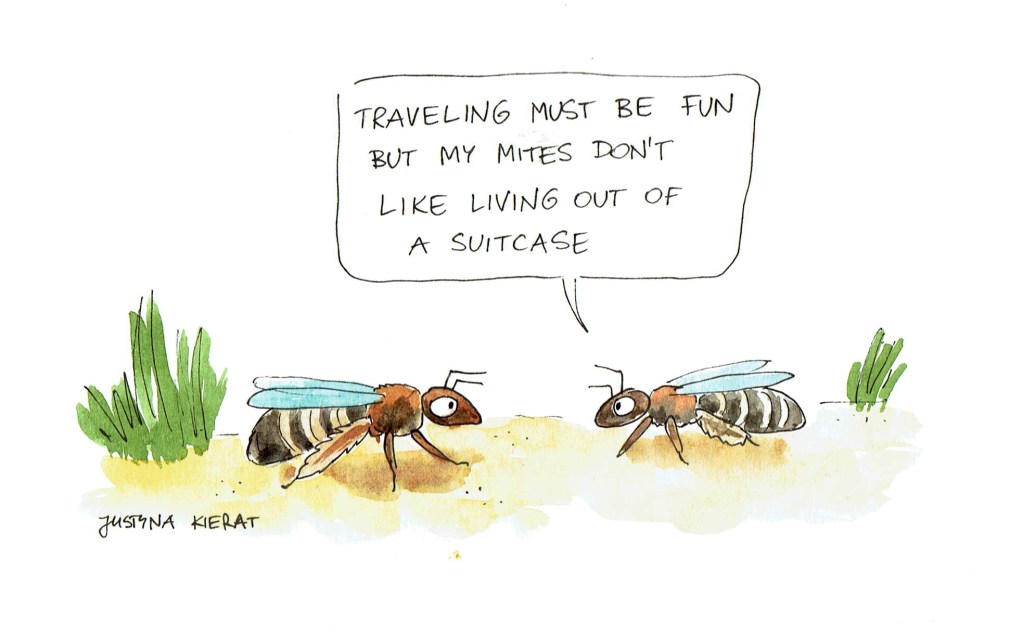
Cuckoo bees don’t build their own nests but lay their eggs in other bees’ nest cells. Some bees aggresively chase their cuckoos but others seem not to care. Rust and Thorp studied Stelis chlorocyanea and Osmia nigrifrons and concluded that Osmia reportedly don’t care about their parasite. If Stelis is discovered by the host inside the nest, it simply backs out and goes its way, and both species can be observed resting peacefully next to each other. Why is that?
I read the abovementioned story, which was inspiration to the cartoon, in the review paper by Jessica Litmann entitled “Under the radar: detection avoidance in brood parasitic bees”. And if you want to read more plausible hypotheses explaining the described phenomenon than this proposed on my cartoon, I strongly recommend this paper!
I didn’t manage to find good photos of neither of the species described, so the characters probably don’t resemble the bees from the original research. But I’m pretty sure that they are not the only host-cuckoo pair which lives peacefully next to each other.
Here I am presenting you the CAPTCHA in entomo- and melitto- version. Feel free to solve them and put the effects in comments! ![]()


As you probably well know, bees don’t see red colour.
The main character of this cartoon is the poppy bee, Hoplitis papaveris. This species lines its nest with flower petals and especially fond of using poppy for this purpose.
Not a bee stuff but I’m curious if you recognize the bird ![]()

In some Nomada (nest parasite bee) species, it was shown that males release pheromone which is very similar to Dufour glands secretions of their Andrena host. The significance of this similarity is not clear, it is hypothesized that males transfer the pheromones to females who use them as chemical camouflage during invasion of host nest. I propose another hypothesis – the smell of Andrena brings to the females good memories about their time in natal nest, and being in good mood, they are more receptive to males.

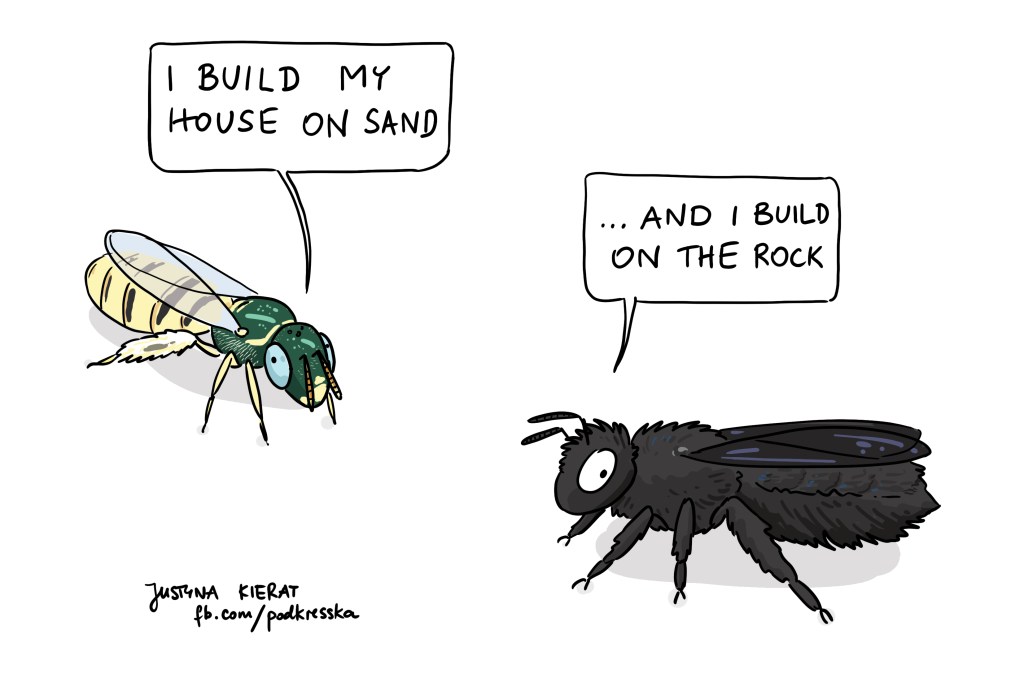
Featuring: Nomioides minutissimus and Megachile parietina. I also hope you recognize the Biblical reference ![]()

Some solitary bees leave their nests open when they go foraging, but others cover the entrance before leaving. Grey-backed mining bee, Andrena vaga, not only covers the nest but also sometimes digs a false nest entrance a few centimeters away and leaves it open. It is a way to deceive its nest parasites which would like to lay their eggs in her nest. Sometimes not only cuckoo bee is fooled by this false nest, but also the returning mining bee itself flies straight to it, before realizing its mistake.