Tag: wild bees
-
Attenzione, pickpocket!
Have you heard of that recently published report of honeybees stealing pollen directly from scopa of wild bee species? Although competition between honeybee and wild bees is an often studied and debated topic, there are only few observations of direct agressive interactions. What is interesting, the victims of theft seem indifferent to what is happening to them, and only rarely try to resist in any way.
And by the way, this cartoon was inspired by a viral movie from Italy. I’m curious if you also saw it, or was it not as much viral as I thought?


-
Plagiarist
Anyone who ever tried to learn bumblebee identification, knows that there are species which are very similar in colouration to each other. Moreover, there are some strange species where one colour morph is similar to one species, and another morph – to a different species. Bumblebees form mimicry rings, which are groups of species which are visually similar and live in more or less the same area. The advantage of this similarity is that predators more quickly learn which insects are not worth attacking (bumblebee females have stings which makes them a rather unpleasant lunch).

-
Mating ball
It’s such fun to look at the bees in an aggregation at the beginning of their flight season – let’s say, Colletes cunicularius in early spring – when males are flying like crazy and looking for virgin females. When they spot one, a mating ball forms immediately around her, with numerous males trying to get their chance.
I must add, in the real life males rather can’t be so easily fooled like on this cartoon, but quick escape of the successful male with his mate can be practiced in some species.
-
Proudly announcing my little paper
As you might figured out already, my favourite bee is, for now at least, Nomioides minutissimus, one of smallest bees in my coutry. It is not only sooo small but also quite rare. The most recent published observations I could find were from 90s, and there were only three places in Poland where it was known to live. After actively looking for it, and collaborating with other scientists and citizen scientists in the process, I learned that there are more localities where Nomioides minutissimus was seen in last twelve years. We just published an article which you can read here, with photos of the beautiful bee and her habitat.

-
Recruiting
Bumblebees don’t dance like honeybees and can’t communicate a precise location of food. However, they can recruit nestmates to the flowers. The worker who found a good food source is running excitedly, bumping into other bees in the nest and presenting samples of collected food to them.

-
Leavesdropping
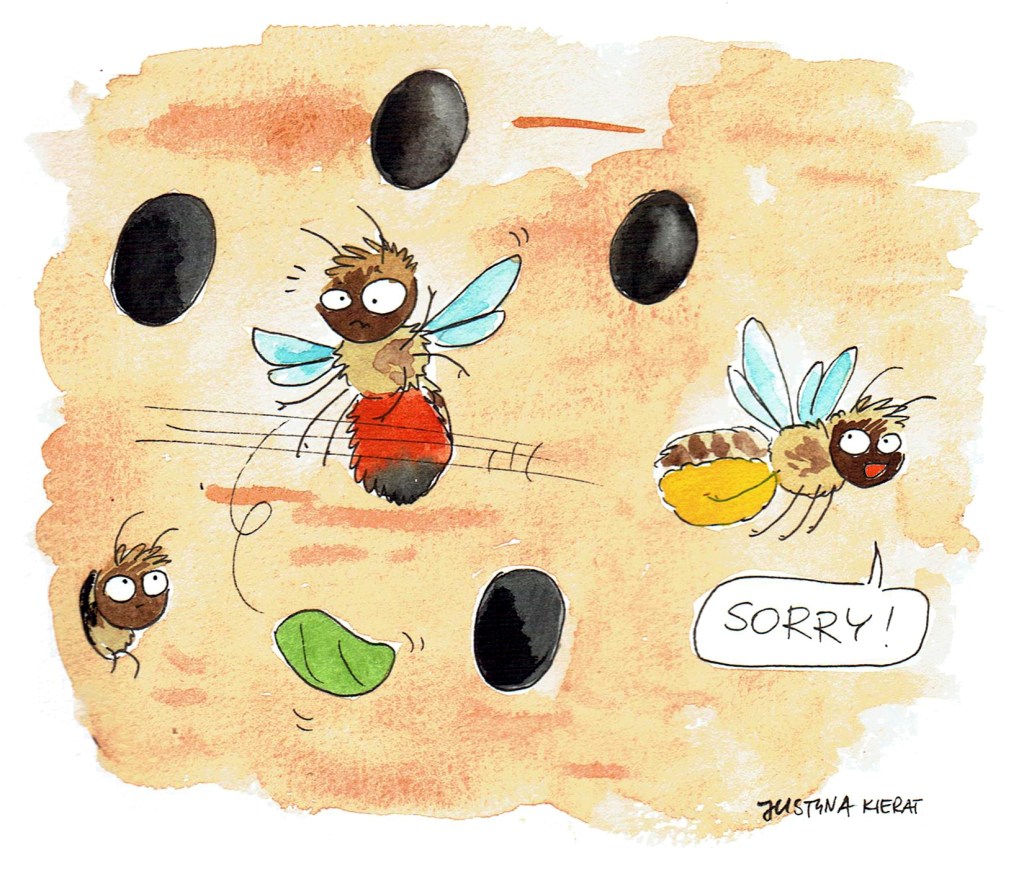
Leafcutter and mason bees can be bred in artificial trap-nests, for example for experimental purposes or for pollination of crops. When the density is high, and nest entrances to each other, females can get lost or engage in quarrels with their neighbours. Leafcutters can lose the leaf pieces they carry, and when a piece falls to the ground, it is not picked up but the poor bee must fly to cut another one.
Here is a citation of the paper which inspired this cartoon – one of research tasks was to weigh the dropped leaves

Guédot, C., Bosch, J., James, R. R., & Kemp, W. P. (2006). Effects of three-dimensional and color patterns on nest location and progeny mortality in alfalfa leafcutting bee (Hymenoptera: Megachilidae). Journal of economic entomology, 99(3), 626-633.
-
At a psychotherapist
I’m currently reading about mining bees (Andrena) and their cuckoos (Nomada), and I feel so sorry for them. The mining bees are being constantly watched. Sometimes Andrena and Nomada sit opposite to each other for several minutes, the mining bee in her nest, the cuckoo a few centimeters apart. But the cuckoo has plenty of time, and the mining bee has to collect pollen for her progeny, so it will be Nomada who wins this war of nerves.

-
Not that small
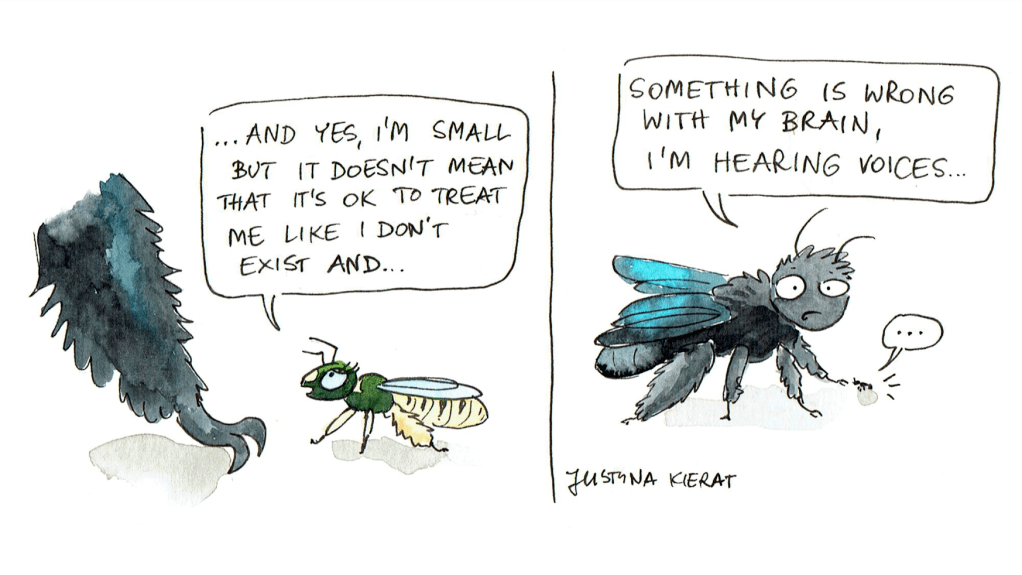
Nomioides minutissimus is one of the smallest bees found in central Europe. And currently my favourite one 🙂
-
Guess who
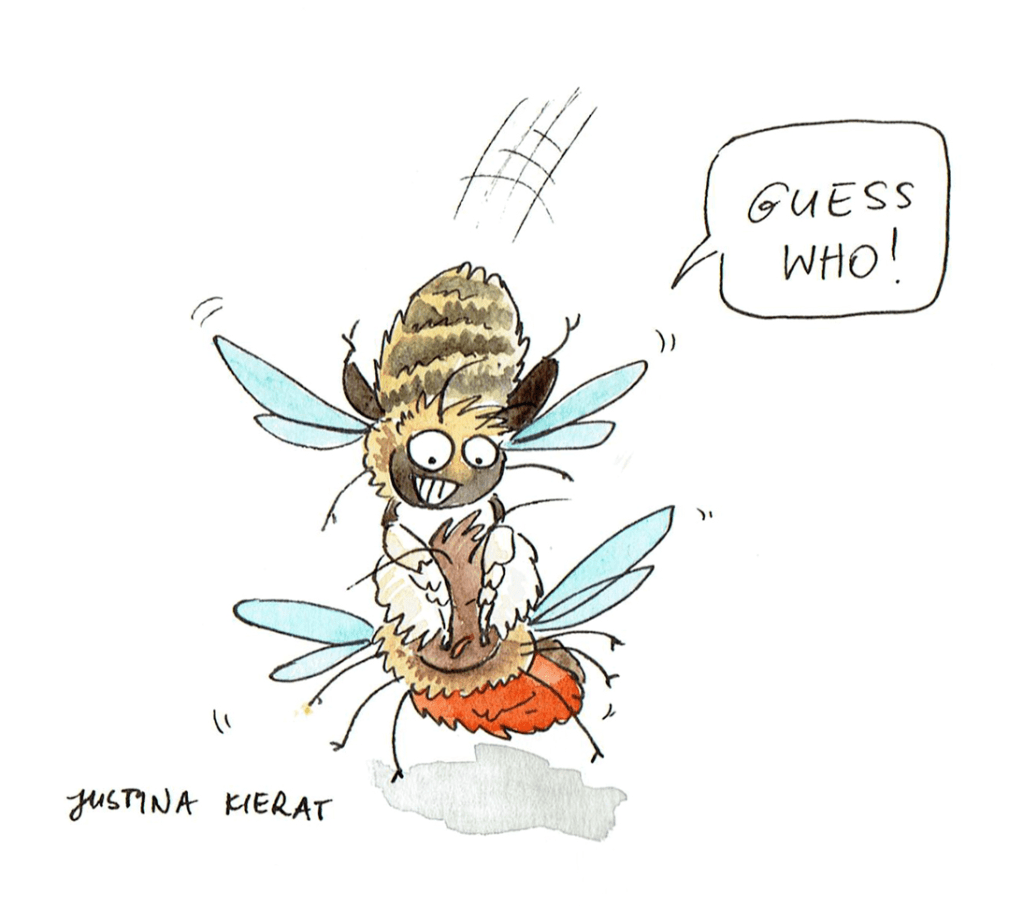
In some species of bees males have expanded fore tarsi, shaped so that they can serve as blindfolds. Their use as such is important part of courtship. Interestingly, expanded forelegs which are used in mating can be found in some distantly related bee species, like in some species of Megachile and Xylocopa, and also in some digger wasps.
-
Heriades
Bees from the genus Heriades have a very particular way to collect pollen – they repeatedly hit the surface of a flower with their scopa.

 Non-honey bees