Do you like to get up early, or prefer sleeping in and staying up late? In Poland, we call the first type of people “the skylarks” and the second – “the owls”. I’m definitely the latter.
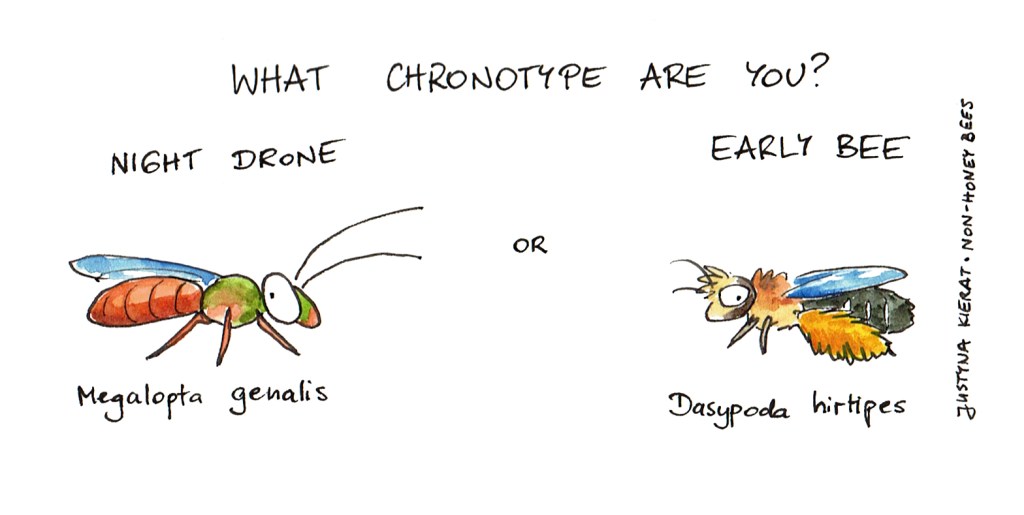
Bees usually are early risers, but you still can find a variability among them. The pantaloon bee, Dasypoda hirtipes, prefers flowers of common chicory, which usually open early and close already around noon. The bee also tends to finish her work early. At the other end of the spectrum are nocturnal bee species, which fly at dawn or dusk. They usually have large eyes and ocelli to catch as much light as possible. Probably the best known nocturnal species is Megalopta genalis (in the cartoon, I portrayed a male).
Mimicry is a phenomenon whereby different species resemble each other. One type of mimicry involves defenseless species resembling species that are somehow armed, e.g., poisonous or venomous. This is the case with defenseless hoverflies and stinging bees.The mimic gains protection when predators mistake it for the model and refrain from attacking.
Mimicry is not always perfect—sometimes the mimic only superficially resembles the model, but this is enough for it to gain benefits. A predator’s moment of hesitation can mean the difference between life and death. It is also important to remember that our perception of the world differs from that of other species, and what is different to us may be similar to a bird.
The honey bee is a unique species of bee, and we have made it even more so. It is bred in large numbers, even in places that it would never naturally reach. It is the best-known species — ask any child about bees and see which ones they describe! When people hear that bees are in danger and need protection, the honeybee is often the first species that comes to mind. Many people want to become beekeepers or support apiaries in order to help the bees. However, the honeybee is not a species threatened with extinction. Artificially increasing its population doesn’t help and can even endanger wild bee species — many of which are actually vulnerable! Honeybees can outcompete wild bees when collecting pollen and nectar, and their diseases can spread to wild bee populations. When honeybees’ densities are very large, they compete with each other and diseases spread more easily, which is not good for them either.
I believe that most of you reading this are familiar with the issue. What you can do is spread the word to others. Let people know that there are many bees in the world (and even more pollinators) that need food, a place to nest and a safe environment — not more honeybee hives.
Shortly after emerging from the nest and mating, young bumblebee queens start looking for a place to hibernate. Typically, a female will dig a hibernaculum in the ground — a relatively short tunnel with a small chamber at the end. I was surprised to read that when a digging female encounters an obstacle in her way, like a pebble, she doesn’t try to bypass it but leaves the burrow and starts a new one. What could be the adaptive significance of this? Or is there none? If you know, please tell me!
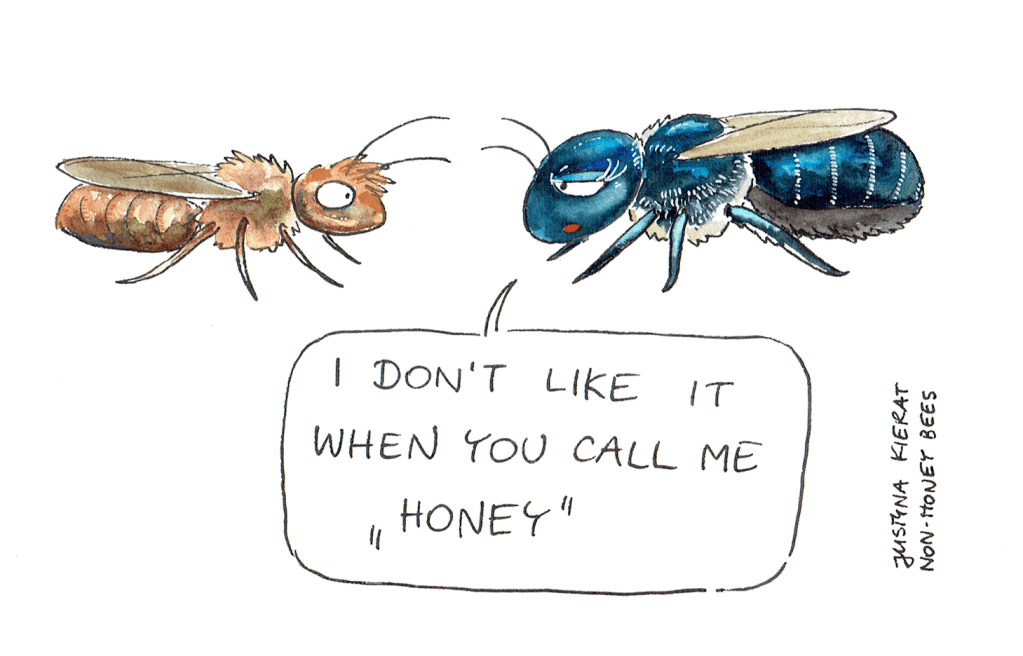
Did you know that the majority of bee species do not produce honey? But they all pollinate plants!
This is another post which was published on Instagram in cooperation with Pollinator Academy. By the way, I hope you remember that I’m also on Instagram and Facebook?
The honeybee is unimpressed. Their colonies can have about 50,000 workers. By comparison, bumblebee colonies range from several dozen to around 500 individuals. But this fanpage is about non-honeybees, so we don’t care about the honeybee’s opinion.
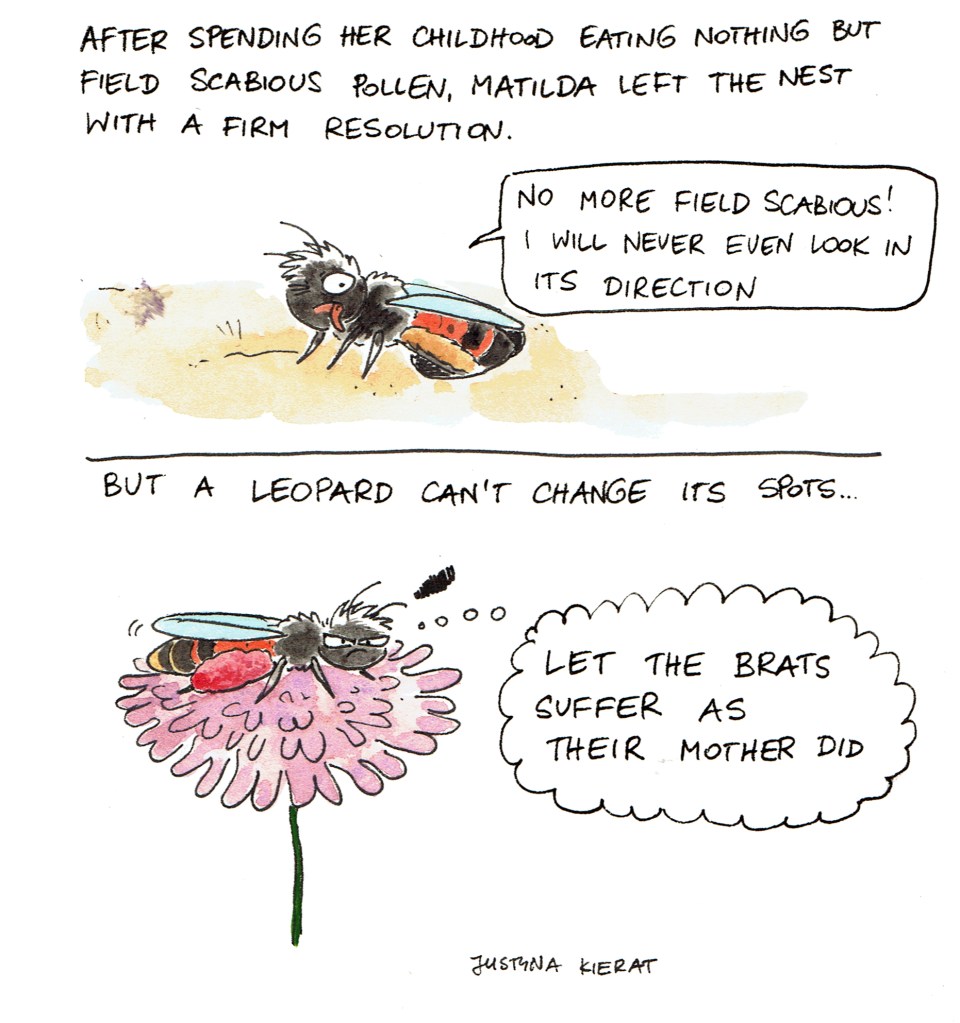
The females of some bee species collect pollen only from certain plants’ flowers. Those that collect pollen from a single plant species (or genus, according to some authors) are called monolectic, while those that can choose from a larger group of plants (but no larger than a single family) are called oligolectic. These bees can’t live in areas where their food plants are not present. If these plants are rare or endangered, so are the bees. There is no single plant group on which all oligolectic bees forage; some depend on members of the Asteraceae family, while others specialize on the Fabaceae, Ericaceae, Malvaceae or others. In the picture below you can see a large scabious mining bee (Andrena hattorfiana), which collects pollen almost exclusively from field scabious.
One could think that larvae of oligo- and monolectic bees can’t survive on other pollen types than those collected by their mothers. Surprisingly, it is sometimes the other way around. There are experiments showing that the larvae of specialists developed perfectly well on other pollen types. Conversely, generalist larvae may experience difficulties when fed a monodiet typical for oligolectic species. For example, bumblebees don’t develop well on Asteraceae pollen, whereas females of species such as Colletes daviesanus and Heriades truncorum feed their larvae almost exclusively on pollen from this very family.
It seems that being a larva of food specialist may be challenging and require special adaptations. Adult females of these species are limited in their pollen choice, which can cause problems if their preferred plant type becomes scarce. So what are the advantages of specialization? In the case of plant species which are hard to use (eg. those with structurally complicated flowers, or chemically protected pollen), specialists have fewer competitors. Also, mastering the art of foraging on one or a few species could make it quicker and more efficient.
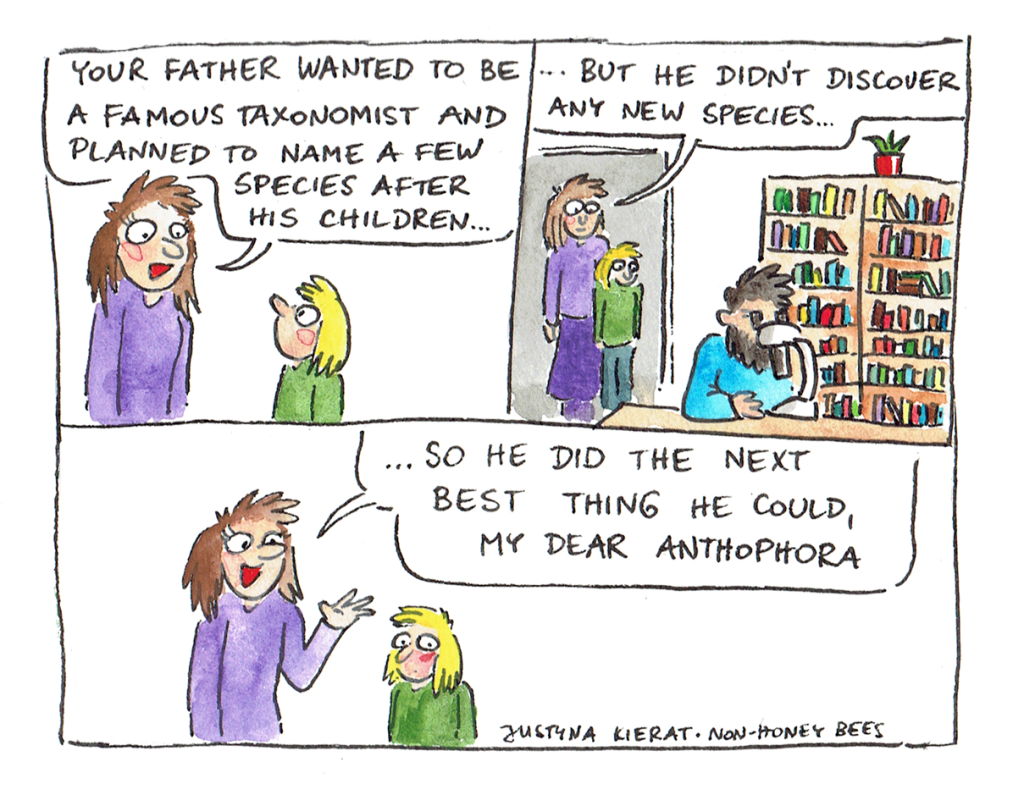
Taxonomists are scientists who study species. They seek to answer questions such as which traits distinguish one species from another, and how species evolve. When a taxonomist discovers a species that is new to science, they have the right to name it. Each scientific name has two parts: the first part is usually fixed, as it refers to the genus to which the species belongs. The discoverer is free to choose the second part. Provided they comply with the rules set out in the International Code of Zoological Nomenclature, they can choose anything. Some taxonomists name species based on their characteristic traits — for instance, ‘bicornis’ means ‘two-horned’ and refers to the small horns on the face of the female red mason bee (Osmia bicornis). Others honour important figures in science or people who are important to them. You can also find names that refer to popular culture or are humorous.
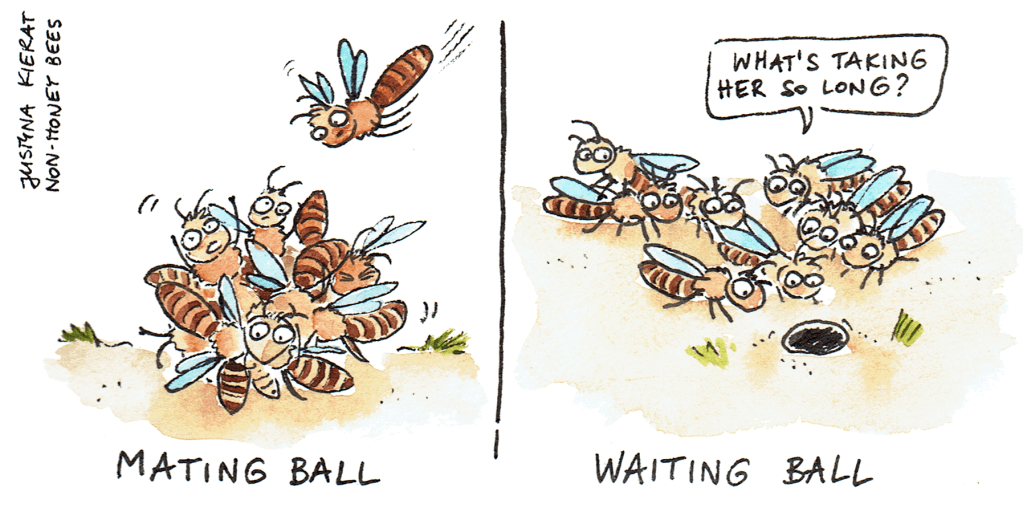
Recently, I had the pleasure of admiring a nesting aggregation of my beloved ivy bees in the company of other melittologists. At one point, I heard someone say, ‘Here’s the waiting ball.’ As you might have guessed, I misheard — it was actually the mating ball. But my imagination began to run: what should a waiting ball of bees look like? You can see my idea here.
I first posted this cartoon on my social media. I wasn’t sure if you would find it funny, but after receiving positive feedback, I decided to share it here as well. I drew this cartoon during a bee identification course. It was excellent… and intensive! We worked so much on identification keys that they became my first association with the word ‘key’ 😉
It’s a third year with the ivy bee (Colletes hederae) present in my country, and I’m still excited about it. I will be looking for them soon. Did you know that the ivy bee, which loves ivy so much that its flight period is fine-tuned to the flowering of this plant, is actually not a pollen specialist? In the absence of ivy flowers, it can visit heather or Asteraceae, for example. When foraging on these plants, I imagine it can quite easily be confused with other Colletes species, especially the closely related Heather Colletes (Colletes succinctus). The latter is also polylectic, with a strong preference for Ericaceae.
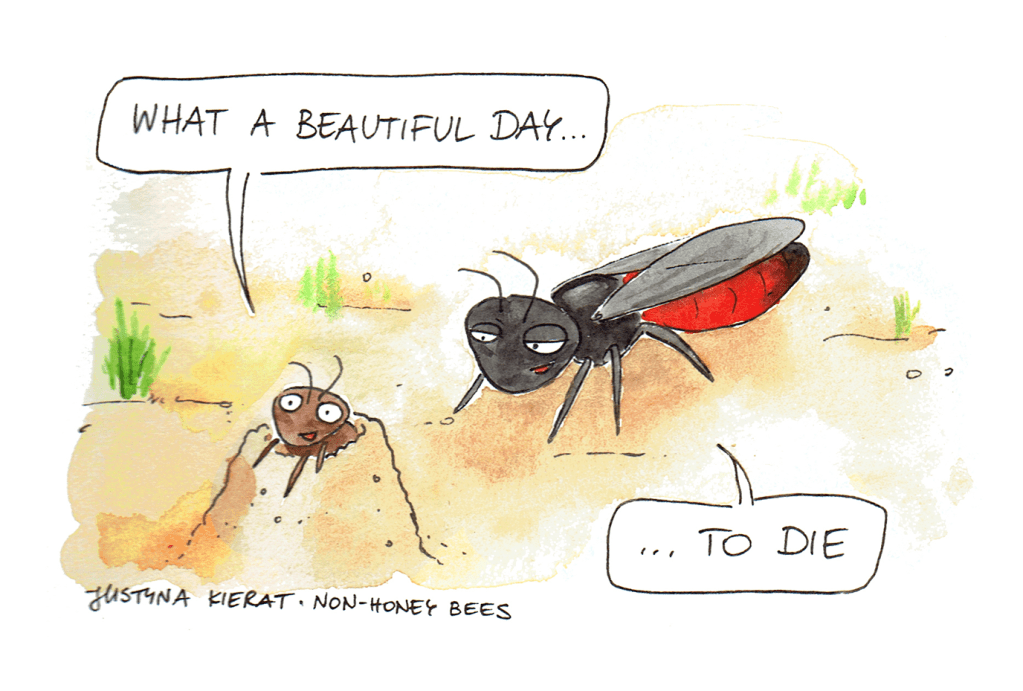
Parasitic bees are known as ‘cuckoos’ because they do not build nests or care for their offspring. Most of them sneak into the nests of other bee species when the owner bee is out collecting food, or open nests that have already been closed and are unguarded, and lay their own eggs there. With solitary bees, it is quite easy to find a moment when the mother is away. In colonies of social species, however, there is usually somebody home. Cuckoo bumblebees solve this problem by fighting and replacing the queen, making them more social parasites than classic “cuckoos”. Blood bees (genus Sphecodes) have another strategy that is even crueller, which Danforth and co-authors refer to as the “scorched earth attack” in their book The Solitary Bees. The female Sphecodes enters the nest of a social or communal host and kills or repels (probably using pheromones) as many bees as possible. Once the colony has been destroyed, the female blood bee can parasitise the brood cells undisturbed.





 Non-honey bees