I just read in some paper that female bees cache pollen and nectar for their offspring. Usually underground, of course.
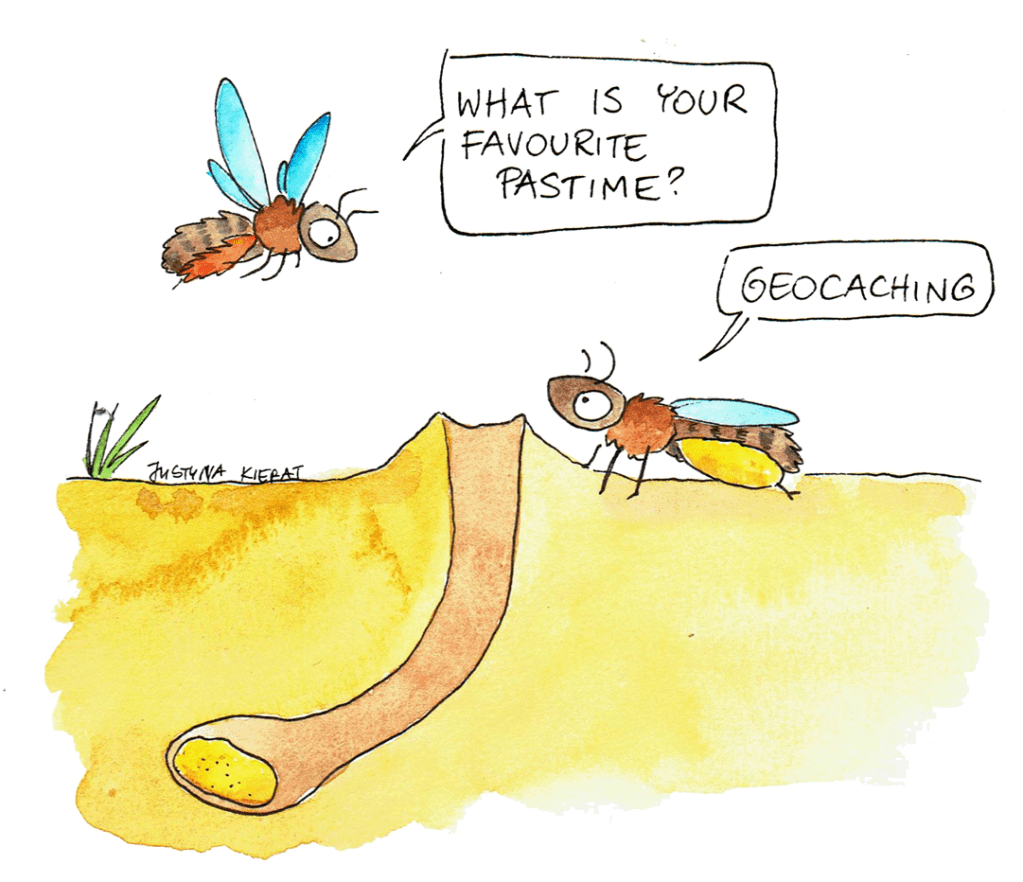
I just read in some paper that female bees cache pollen and nectar for their offspring. Usually underground, of course.
Another cartoon about pollen specialist bees, that is, species where females collect pollen exclusively from a certain group of plant species. Viper’s bugloss mason bees (Hoplitis adunca and H. anthocopoides) are examples of such specialists. They both are native to Europe and some neighbouring regions but H. anthocopoides can now be found also in North America where it was introduced.

Some bee species look very similar to each other, so much that sometimes it is difficult to tell them apart even by professionals. It’s interesting that sometimes they look alike but differ in their biology. For example, Andrena afzeliella and Andrena ovatula, thought to be one species until recently, have distinct food preferences. The former prefers flowers of Fabaceae but likes many different species of this family, the latter’s diet is restricted to bushes belonging to this family, like gorse.

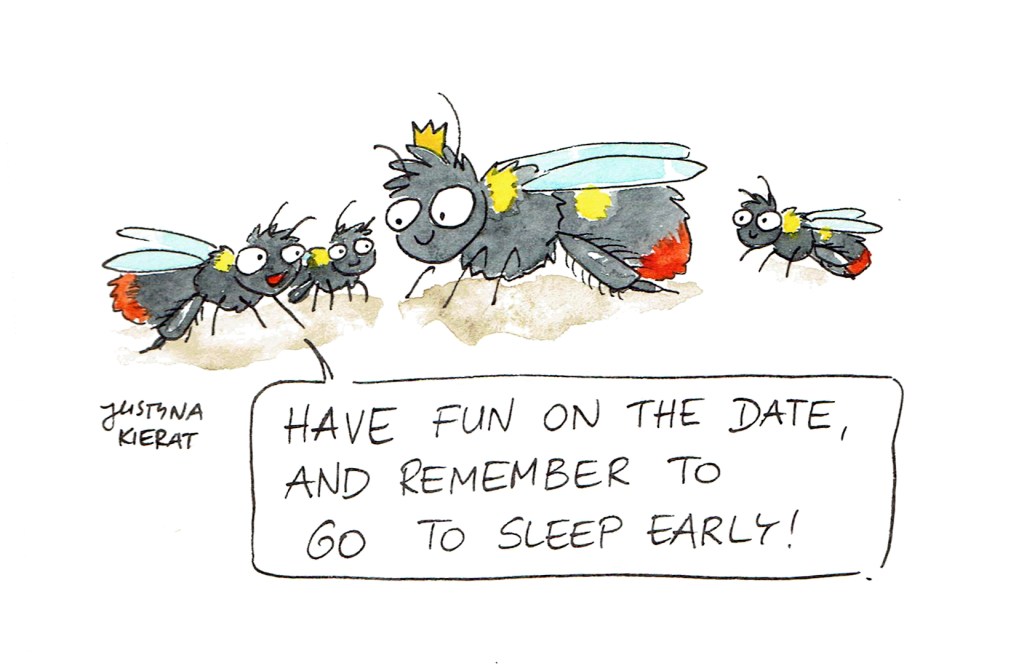
Young bumblebee queens spend a few days feeding and looking for a male to mate. Then, they don’t wait for winter to come but dig a hibernaculum and go to sleep – sometimes as early as June!
The European wool carder bee (Anthidium manicatum) lines her nest with hairs scrapped off the plants like Stachys byzantina or Helichrysum arenarium. Females can be seen with balls of wool under their abdomen, when they carry it back to the nest.

Bumblebees are animals of colder climates than most bees, and climate change can affect them negatively in various ways. One of dangers are heatwaves. They can not only simply kill the individuals but also impair their memory.

The majority of bee species nest in the ground. Sometimes a bee chooses a flower pot as her nesting site, digs a tiny burrow and lays her eggs inside. She doesn’t harm plants in the process. If you are a poor gardener, you still have chance for a potted bee – they often prefer pots without much plants and with bare earth inside. Of course they should also have access to some food plants nearby. In areas with seasonality, a pot inhabited by bees should be left outside for winter because they need low temperatures to develop and time their emergence properly.
In my own balcony flower pots the leafcutter bees (Megachile) have been nesting since a few years. Many members of this genus line their nests with cutted leaf parts, so I can see how they repeatedly come home with leaf pieces in their mandibles.

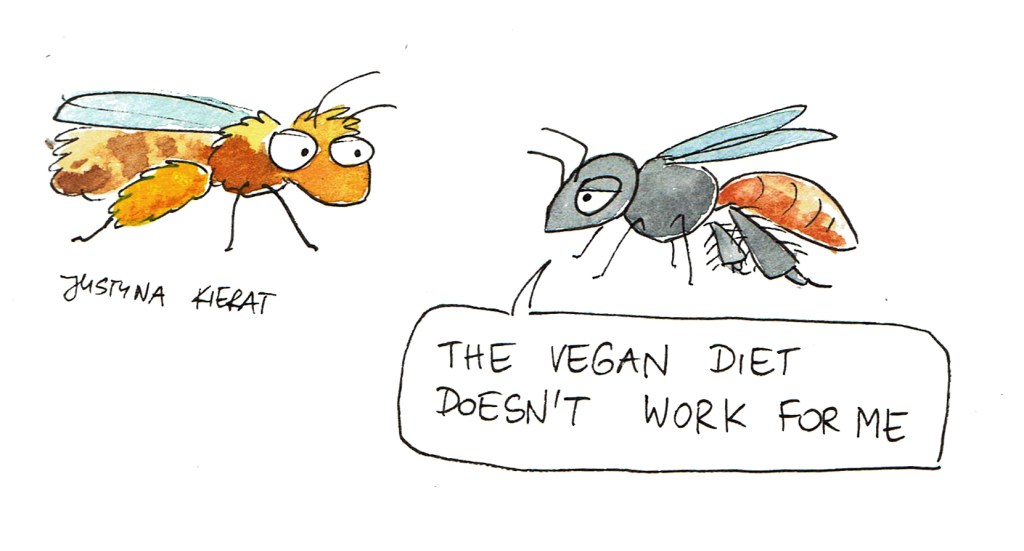
Can you believe that I couldn’t find a photo of the vulture bees which I would trust is properly identified?? So maybe the bee on the cartoon is not a proper necrophagous stingless bee, I apologize for that and if you have a photo of one of the necrophagous bee species, please share it with me!
The vast majority of bees can be considered vegans. Their food, both as larvae and as adults, come exclusively or almost exclusively from flowers. Of course, in biology exceptions are very common 😉 Probably the most notable exception from the vegan-bee-rule are three species of Trigona, called ‘vulture bees’, which feed on carrion. Their ancestors were “ordinary” bees visiting flowers but they specialized in this unusual type of food.
Bees might also feed on honeydew and human tears (which still would make them vegetarian, in contrast to the vulture bees), and maybe they’ll also be portrayed on Non-honey bees some day 🙂
Flowers are the main (and in most cases, the only) source of food for bees. But it’s not their only role in bees’ lifes. They can have also a medicinal value, helping bees to get rid of various pathogens. One of examples is pollen of sunflowers. It helps bumblebees fight the infection by Crithidia bombi, their protozoan pathogen. The mechanism of this beneficial effect was unclear, as scientists could not identify any chemicals present in sunflower pollen which would kill the pathogens. It turned out that there might be none… but the pollen works like a laxative, cleaning the digestive tract from the pathogen’s spores.
Here you can read about the study: Adler, L. S., Fowler, A. E., Malfi, R. L., Anderson, P. R., Coppinger, L. M., Deneen, P. M., … & Stevenson, P. C. (2020). Assessing chemical mechanisms underlying the effects of sunflower pollen on a gut pathogen in bumble bees. Journal of chemical ecology, 46, 649-658.

Pollen is a main food of bee larvae. Adult females and most likely also males need it, too, although in smaller quantities. Not every pollen is the same – they differ in chemical composition, nutritional value, size and shape. It’s not an easy food – the nutritious contents are enclosed inside a hard-to-break cover, and sometimes additionally protected. Asteraceae pollen is an interesting example. It is easily accessible on the flowers but hard to digest by bees. There are some specialist species, feeding exclusively on Asteraceae pollen, but generalists, like bumblebees, don’t develop well on Asteraceae diet. You can find two explanations of this in the literature – one is a chemical defence, ie. some components which are tolerated by specialist bees but harmful to the majority of the others, and the other hypothesis points to the little spines on the surface of the pollen grains which do mechanical damage to bees. I find the idea that pollen pricks the bees eating it, particularly funny.
Here is a paper which was an inspiration to this cartoon: Rivest, S., Muralidhar, M., & Forrest, J. R. (2024). Pollen chemical and mechanical defences restrict host-plant use by bees. Proceedings of the Royal Society B, 291(2018), 20232298.

The spring is there (at least in the area where I live!) and each day we can see more and more bees. One of the first thoughts of the freshly emerging males is… mating. They are looking for the virgin and receptive females of their species, alert to their pheromones and to their appearing on the horizon. However, sometimes they make spectacularly misdirected attempt of courtship. They can assault females of other bee species, male bees, and even insects other than bees.
There is an interesting project on iNaturalist.org named “Interspecies insect mating” where you can find a few bee observations. I recommend adding your own, if you are lucky to witness such situation!

In most bee species, there is not much size variation within one sex, and body size is often useful character in the process of species identification. Bumblebees belong to the exceptions from this rule. In females, there is huge size variation not only within a species but even within a single family. You can see this clearly in the spring – the first ones to emerge are queens which are big. Then very small wokers appear – these are the first brood reared by the queen herself. Then, the next “generations” of workers consist of both big and small ones, and the difference can be even tenfold!
In this paper, the effect of interaction between size of a bumblebee and size of a flower was studied. It turned out that there is not much effect of the sizes of the interacting parties on effectiveness of pollination. It is a good news because it allows us to assume that these interactions are resilient to size changes which might be a result of various environmental factors, like climate change. In the warmer temperatures, organisms tend to get smaller but not every species and population must change their size at the same pace.

 Non-honey bees