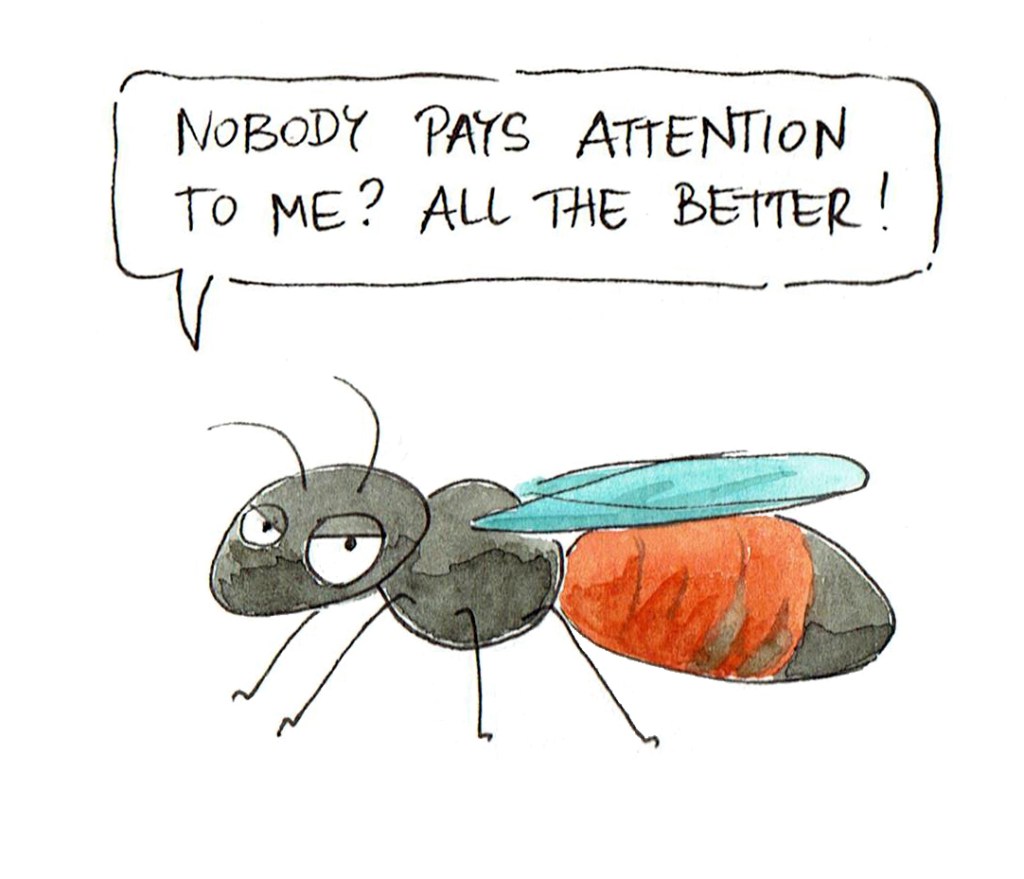
Blood bees (genus Sphecodes) owe their name to red colouration of metasoma. They are quite similar in colouration and shape but come in various sizes. Some of them are really small and inconspicuous, measuring about 5 mm. Is that bad? Well, I bet that blood bees would be happy to go unnoticed. They are cuckoo bees and lay their eggs in the nests of other bee species. Of course what is small to human eye, is not necessarily so to the bee host of Sphecodes, so the fight is often inevitable.
Yesterday I read a very interesting article by Andreas Müller and Paul Westrich about Andrena lathyri, a mining bee species specialized in nectar robbing. I learned from this paper, among other things, that there is more than one way of obtaining nectar without pollination. Two of them I portraited on the cartoon. The first method, nectar robbing, involves damaging a flower, eg. piercing a hole in its side, like Bombus wurflenii, the famous nectar robber, is doing. On the other hand, nectar thiefs don’t damage flowers but are so small that they sneak past the reproductive organs straight to the nectaries, and as they don’t touch stamens or pistil, it doesn’t pollinate.
If you want to read the paper about Andrena lathyri, which I recomend, here you have the citation: Müller, A., & Westrich, P. (2023). Morphological specialisation for primary nectar robbing in a pollen specialist mining bee (Hymenoptera, Andrenidae). Journal of Hymenoptera Research, 95, 215-230.
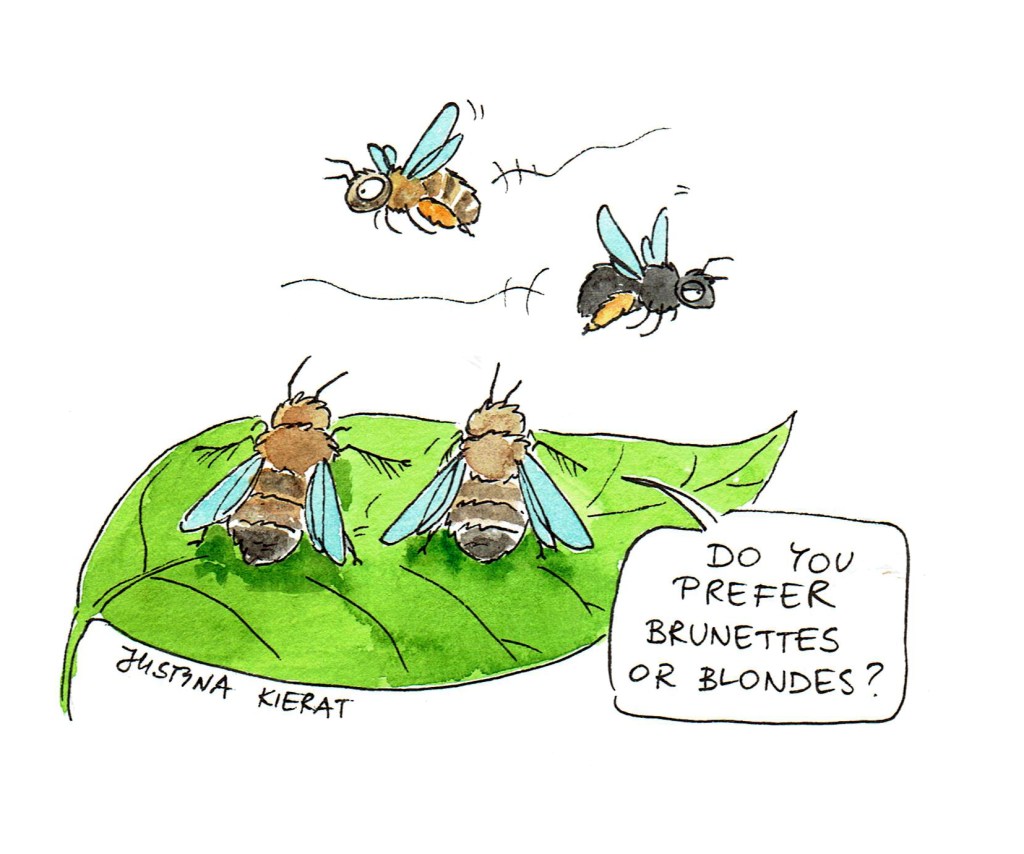
Do you have Anthophora plumipes or other bees with more colour forms in the area where you live?
In some species of bees, not all individuals look the same but there is some polymorphism. And I don’t mean sexual dimorphism, ie. males looking differently from females, but more than one morph in the same sex. Anthophora plumipes, a common European bee appearing in spring, is one of such species. All males look basically the same but females come in two forms – with brown and black fur. Interestingly, proportions of these two morphs may differ geographically. In Poland where I live, the brown morph is a more common one. In contrast, in UK the black form is more frequent.
I’ve just began drawing a series of little portraits of bee species living in Poland. The drawings are referring to distinctive features of the species or their Polish names (or both ). Meet the pretty Bombus humilis, “trzmiel zmienny” in Polish, which translates into “the variable bumblebee and refers to extreme colour variability of this species.
By the way, have you known that “nacked” bumblebees (ie, under their fur) are glossy black?
I spent last few days on a short vacation with friends. In the evenings we were solving crosswords. My fiancé came out with a great idea of a crossword for bee lovers – see for yourself!
I’d like to tell you about one of experiments I did during my PhD studies. I worked with the red mason bee (Osmia bicornis), a common solitary bee species. I was particularly interested in topics related to their reproduction. The red mason bees’ nests are linear, with individual cells in a row, which is common to many cavity nesters. Typically, there is only one entrance, and the other end of the nest is blind. The larvae must know the direction to the exit, and they do. Important source of information is the shape of mud partitions separating the individual cells. I pictured this on the cartoon – the nest entrance is to the right, and you can see that the side of the wall which should be chewed by the bee to go out is rough. The other side is smooth and concave. When you open the nest in winter, you can see the cocoons (each of them has a young adult bee inside) most of which are directed with bee’s head towards the exit. So, in the spring all that the bee has to do is to chew the cocoon wall, and then cell wall, all the time moving forward.
But my older colleagues from the lab observed that some cocoons are oriented in the other direction. Those misoriented bees are more often males than females. What happens to such individuals? Do they emerge from the cocoon and go forward, blocking and killing their siblings inside the nest, and eventually dying unable to exit? Or can they find out that they made mistake, and correct it? In order to check it, I prepared “artificial nest cells” which had the real cell walls attached, put the cocoons inside, and checked which way the misoriented bees will emerge.
The results were quite surprising. The majority of misoriented males turned around in the cell after emerging from cocoon, and exited their cells in the right direction. In contrast, most females didn’t turn around and got out the wrong way. Females are typically larger than males in the red mason bee but it was not the difficulty with maneuvering that prevented my females to choose the correct exit. The artificial cells were large enough for them to turn around – I checked.
It looks like the decision about which way to go out of the nest is made at the different moment by each of the sexes. Females position themselves already as larvae spinning their cocoons, and in spring they simply follow the chosen direction. Males are less rigorous in positioning their cocoons but before emergence they check where they should go. It’s quite reasonable strategy, as big females in real nests (in contrast to my artificial cells) can have difficulty with turning around as adults. If they postponed choosing direction for spring, it could turn out that they are not able to turn and are doomed. In contrast, smaller males don’t face such problems, so they can look for the correct exit later.
I did such a drawing of a bee (which was meant to be male Hoplitis cristatula, with his lovely bright blue eyes), and when I put it on my Facebook page, a friend of mine asked me if bees can hear.
Yes, they can! But not too well. They can receive frequencies between 20 and 500 Hz, so far narrower range than humans. Their hearing organs are located on their antennae, at the base of flagellum. These informations apply to honeybees, I don’t know about other bees being studied in this respect but I suppose it is pretty much the same between species.
Male bees usually don’t take part in any parental care. There is, however, an interesting exception. Males of Ceratina nigrolabiata guard nests when females forage. They defend it against parasites or small predators. What is interesting, males usually don’t stay in one nest forever but they switch between nests every couple of days.
Orchid bees (Euglossini) are unusual not only because of their metallic colouration. Males pollinate certain species of orchids, but visit them not for food but for fragrances. They use them to mix their own perfumes with which they court females. Not only orchid oils are used but even as unexpected sources of perfumes as… feces.
I like to think that females not always choose their mates on the basis of their perfume quality but sometimes they just fall in love 😀 (yes, just joking, but then, it’s a page with funny cartoons, isn’t it)
I read this interesting article about decision-making by honeybees. The research shows that bees are faster to accept a flower than to reject it. In other words, the bee hovers in front of the flower for short time before eventually landing on it, but making decision not to land requires (on average) more time. The decision about accepting flower is made with high accuracy: bees rarely land on a flower which is not rewarding (provided they can know about it, of course, that is, they have experience with this type of flower, which was the case in the study), but some rewarding flowers are “mistakenly” rejected. When they have difficulty with making a decision because of limited evidence available, they’ll rather reject a flower than accept it. I think that would make them quite good review editors!
I must add that the flowers in the experiments were artificial ones, but I don’t think it matters much for the results 😉

 ). Meet the pretty Bombus humilis, “trzmiel zmienny” in Polish, which translates into “the variable bumblebee and refers to extreme colour variability of this species.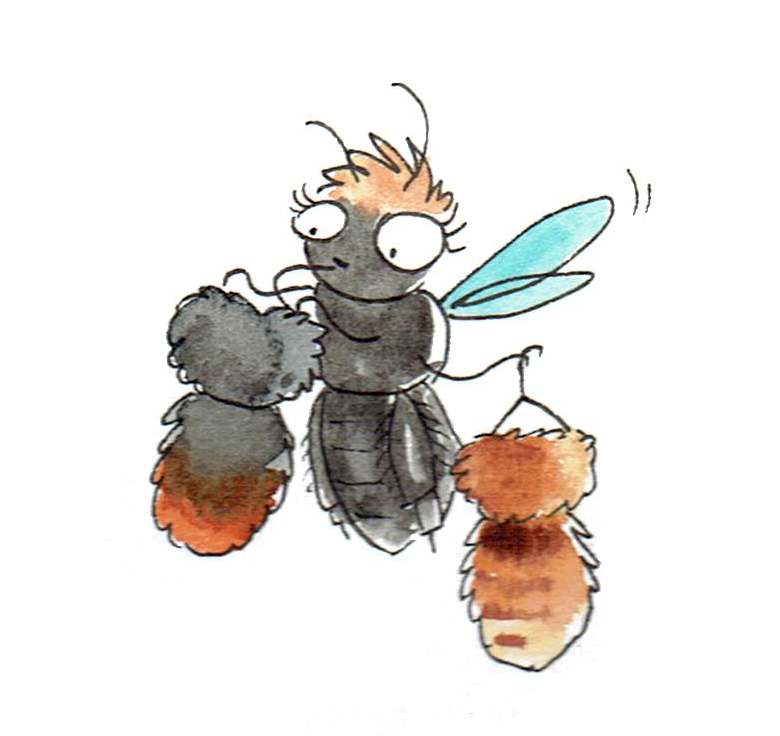




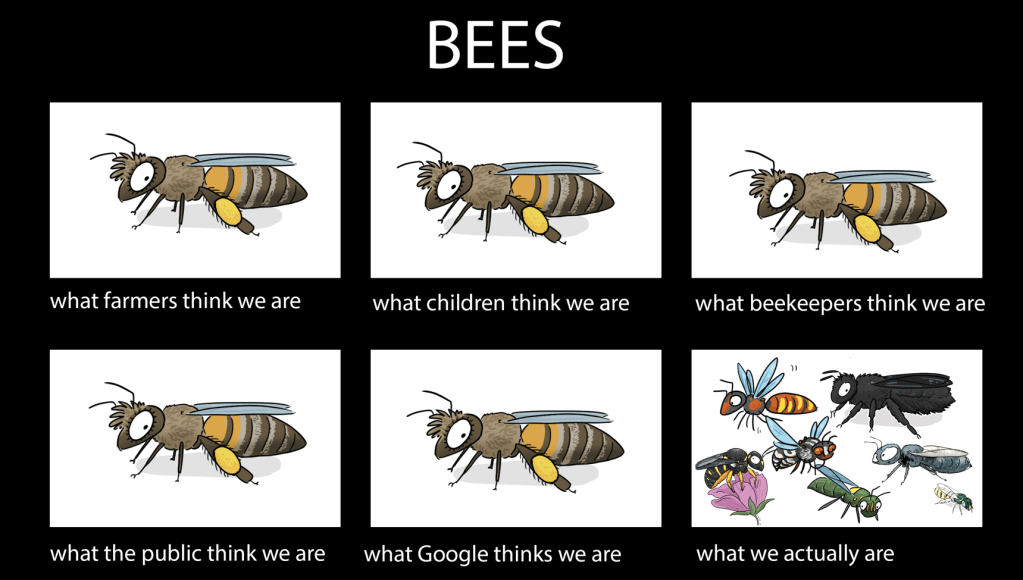
 Non-honey bees