The spring is there (at least in the area where I live!) and each day we can see more and more bees. One of the first thoughts of the freshly emerging males is… mating. They are looking for the virgin and receptive females of their species, alert to their pheromones and to their appearing on the horizon. However, sometimes they make spectacularly misdirected attempt of courtship. They can assault females of other bee species, male bees, and even insects other than bees.
There is an interesting project on iNaturalist.org named “Interspecies insect mating” where you can find a few bee observations. I recommend adding your own, if you are lucky to witness such situation!
In most bee species, there is not much size variation within one sex, and body size is often useful character in the process of species identification. Bumblebees belong to the exceptions from this rule. In females, there is huge size variation not only within a species but even within a single family. You can see this clearly in the spring – the first ones to emerge are queens which are big. Then very small wokers appear – these are the first brood reared by the queen herself. Then, the next “generations” of workers consist of both big and small ones, and the difference can be even tenfold!
In this paper, the effect of interaction between size of a bumblebee and size of a flower was studied. It turned out that there is not much effect of the sizes of the interacting parties on effectiveness of pollination. It is a good news because it allows us to assume that these interactions are resilient to size changes which might be a result of various environmental factors, like climate change. In the warmer temperatures, organisms tend to get smaller but not every species and population must change their size at the same pace.
Some bee species can use many various plants as their pollen sources (but still, they can have preferences) but there are others which are more or less specialized. The pollen specialists use plants belonging to only one family, sometimes their diet is restricted to just a few genera or a few species. They can’t live in areas where their food plants are absent. It shouldn’t surprise us, then, that pollen specialists are often rare or endangered.
On the drawing you see a pair of Clarke’s mining bee, Andrena clarkella, which collects pollen exclusively from willows.
Bees belonging to the genus Colletes are solitary, usually nest in the ground and line their nests with a cellophane-like substance which is an evolutionary achievement of their family, Colletidae. This family was once considered the most “primitive” of bee families but genetic analyses showed quite the contrary – they should be placed on the top of bees’ phylogenetic tree.
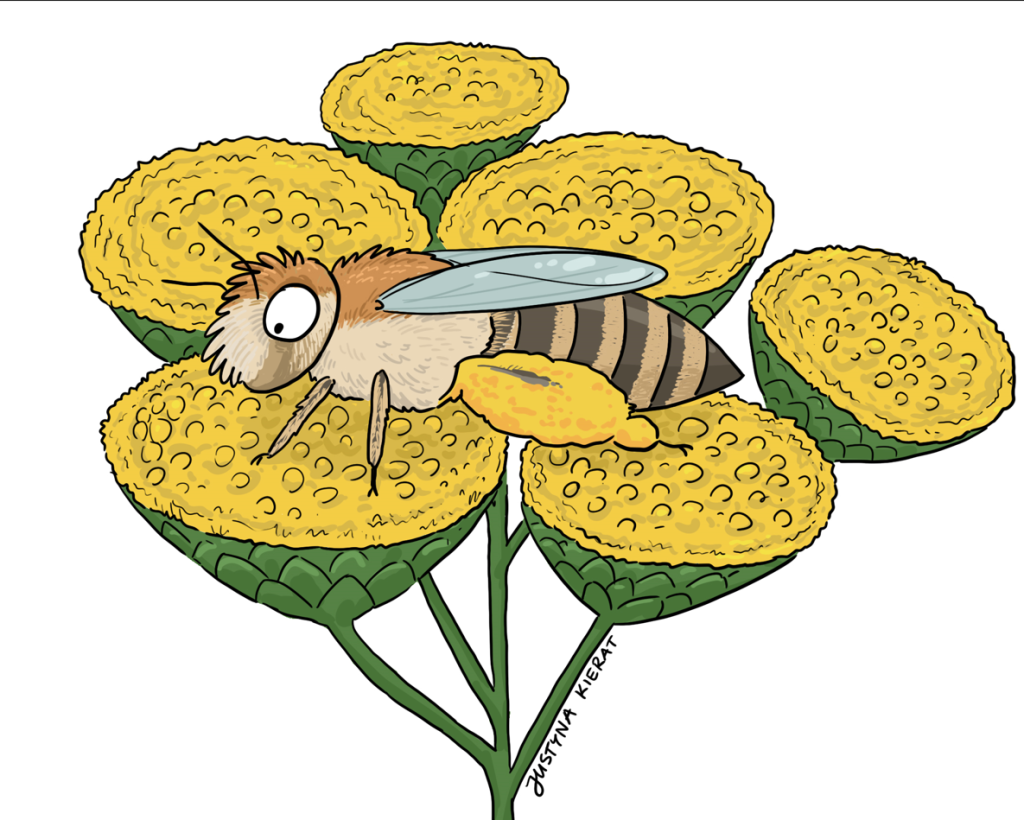
And here you can see a portrait of Colletes fodiens. It specializes in collecting pollen from plants belonging to Asteraceae family.
I’m very fond of cuckoo bees. They don’t build their nests and have amazing adaptations to make other bee species raise their children. Many of them, “true” cuckoos, just lay their eggs in the nests of solitary bees, and their success depends on making it so that the nest owner doesn’t know of the parasite’s egg in her nest. Others, like the cuckoo bumblebee pictured on the cartoon you see, invade nests of social species and usurp the title of the queen. After succesfully establishing its position in the nest, the cuckoo bumblebee female begins laying her eggs and host workers care for them like for their own sisters. The cuckoo keeps discipline by biting and dominating the workers (and the old queen, if she survived) but usually doesn’t kill the workers, as they are precious workforce for her young.
On the cartoon you can see the Field cuckoo bumblebee (Bombus campestris) in the nest of the Common Carder bumblebee (Bombus pascuorum). The cuckoos are picky when it comes to host choice, and usually parasitize only one or a few host species.
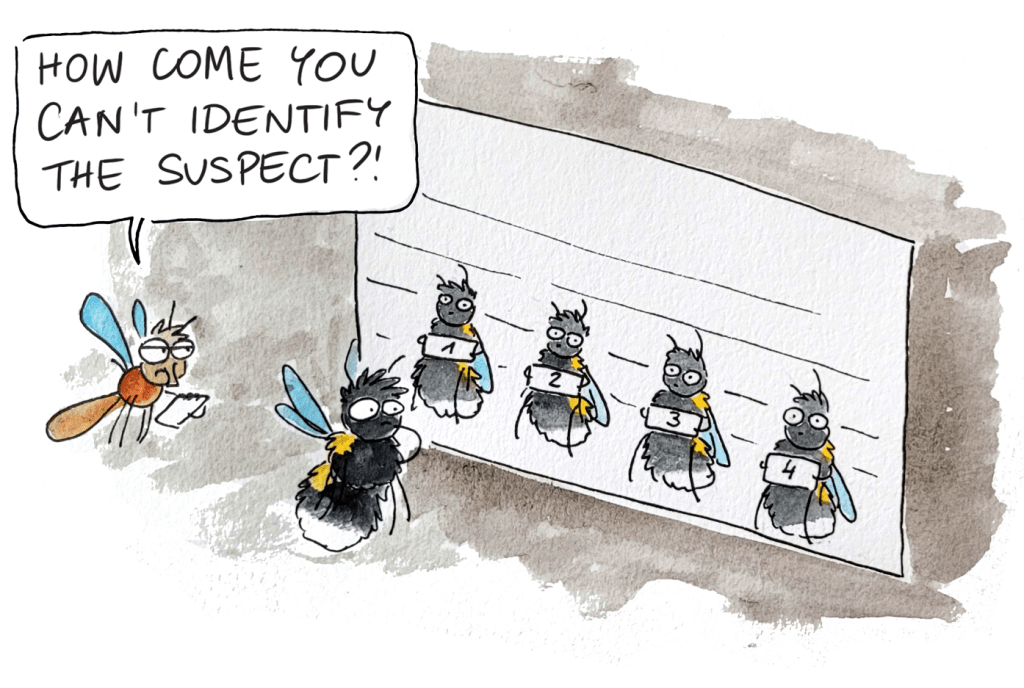
Bee species identification is considered quite a hard job. There are some easily distinguishable species, but others demand looking closely at the specimen under a magnification. Some bumblebees take it to an even higher level. Bombus terrestris, B. lucorum, B. cryptarum and B. magnus are four closely related species living in my area, whose males and queens are often very difficult to separate, and workers, especially old and worn ones, are considered inseparable in many cases, and I mean inseparable at all by the means of looking at a specimen – even if you take it to the laboratory and look under the microscope. How on earth do these bumblebees recognize each other?! Well, they have more senses than just vision at their disposal. For example, males’ pheromones differ between these four species. When scientists are very determined to be sure which species they caught, they can do chemical analyses of these substances, or just do genetic analysis.
Fun fact: if you are eg from UK or Iberian Peninsula, you might have far less trouble recognizing your Bombus terrestris than me in Central Europe. In UK it tends to have more or less buffish tail (instead of pure white), and in Iberian Peninsula the corbiculae of females are reddish.
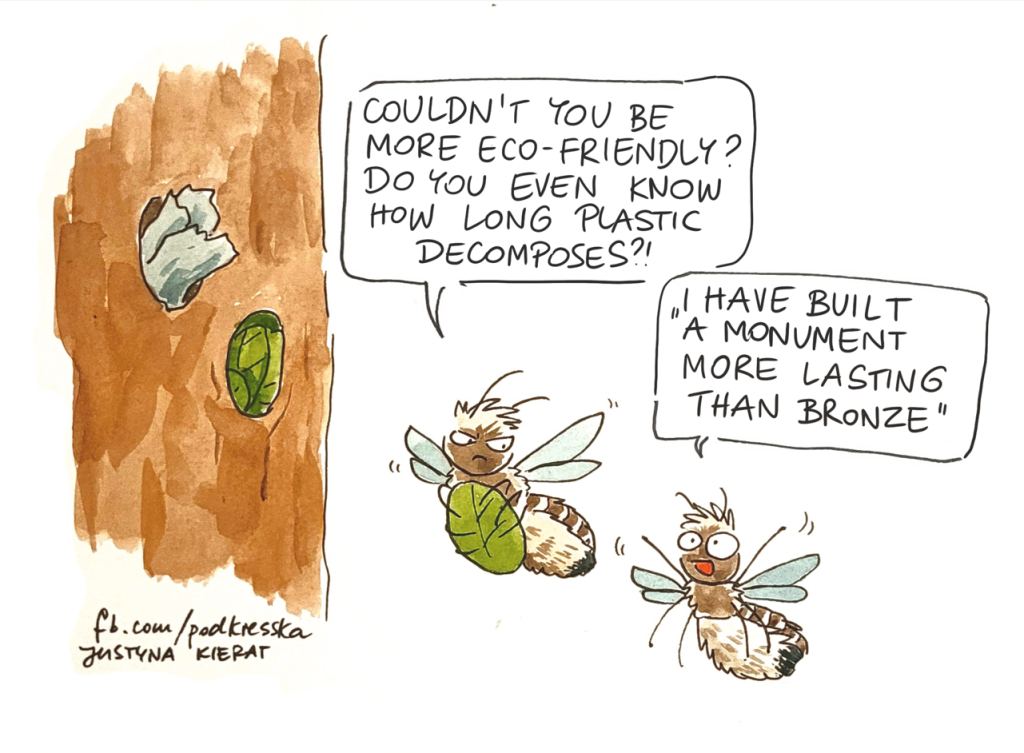
Many species of the genus Megachile build their nests, using plant leaves cut in round pieces (hence the common name of the genus: leafcutters). However, sometimes bees use… plastic instead of leaves. It is quite sad that they use rubbish, and they are not alone in this behaviour – birds also incorporate plastic bags, wires, cigarette butts and other things into their nests. It is not clear what effect has the plastic nest on the leafcutter larvae.
Here is the reference where you can read more: Allasino, M. L., Marrero, H. J., Dorado, J., & Torretta, J. P. (2019). Scientific note: first global report of a bee nest built only with plastic. Apidologie, 50, 230-233.
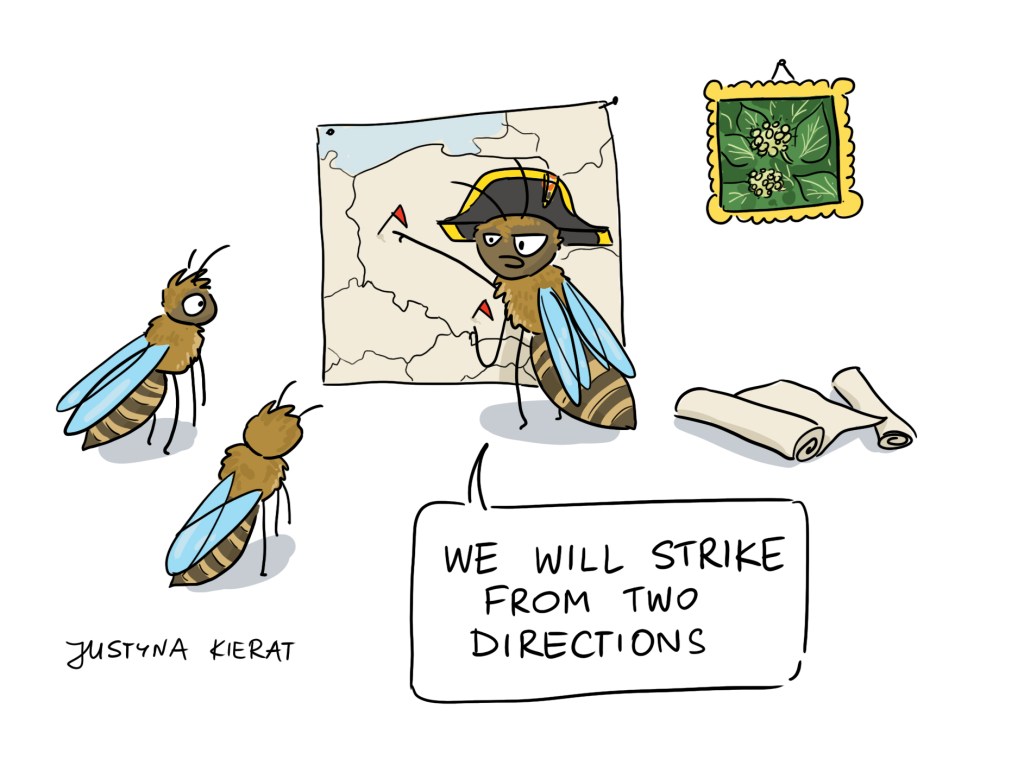
I’m excited to share with you a paper about my discovery In general, it’s nothing big, but it is for me We have officially added the ivy bee, Colletes hederae, to the checklist of species of Poland! It was expected for quite a while, and the question was only – who, when and where will find it? It seems that it was me last autumn… and what is even better, I found the ivy bees in two places, some 450 kilometers apart! One locality is at the western border of the country, and the other in Kraków, in southern Poland. I don’t believe the ivy bees came to the latter spot all the way from Germany, unobserved by anyone. They must have come another route, from the south. So it seems that we had an invasion from two directions! Of course, it’s not an invasion in the sense of an invasive alien species, because the ivy bee is native to Europe and increases its range without human involvement, apart from our part in the recent climate change. I must add here that the effect of climate change on bees is different depending on the species, and most of them are not as lucky as the ivy bee now, and the global changes are harmful for them. So, I’m happy that we have our ivy bees in Poland at last but at the same time I’m not happy about climate change.
I decided to look at my old cartoons in Polish, from Pod kreską, and translate some of the bee pieces. I hope you’ll like them.
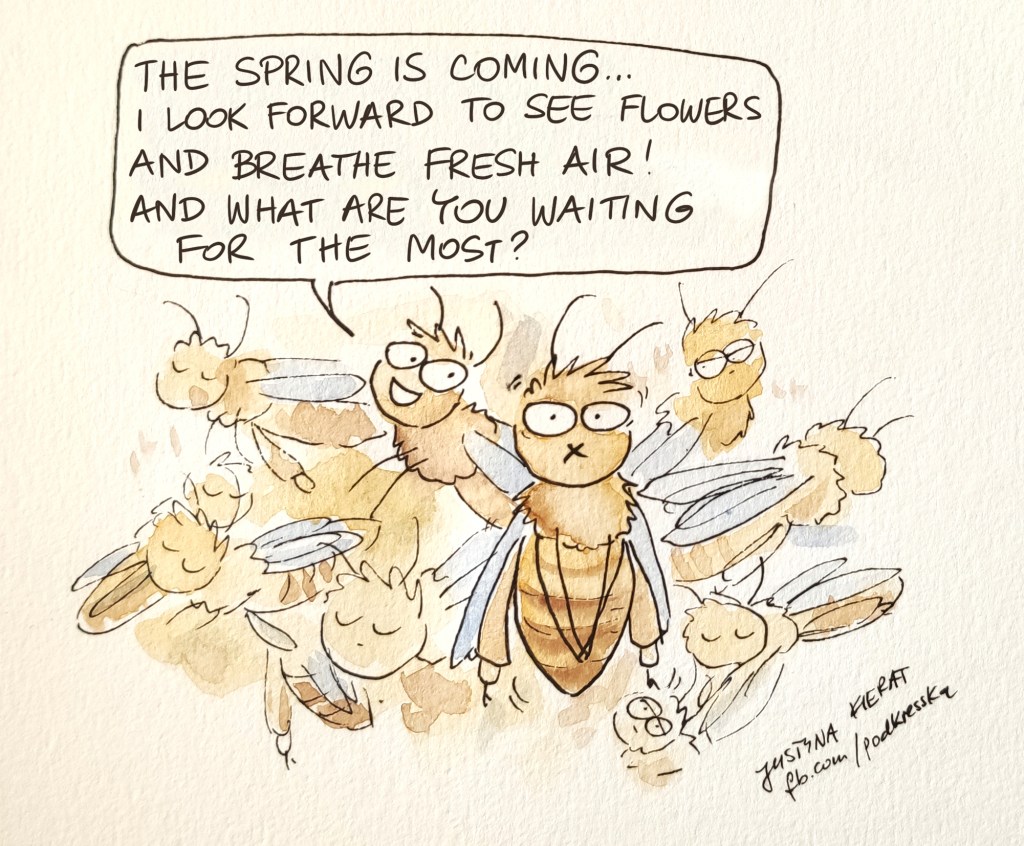
This cartoon is not quite consistent with the name of the site – it’s about yes-honey bees. As you might know, this species is quite unusual in many respects, and overwintering is one of them. Honeybees don’t hibernate like all wild bees in my area (and, I suppose, like the majority of bee species in the regions where there’s seasonality in climate) but they form a winter cluster in their nest, maintaining a temperature about 20 Celcius degrees or more. During the whole period of overwintering, the workers don’t defecate – they do it only outside the nest, when the weather is mild enough to come out.
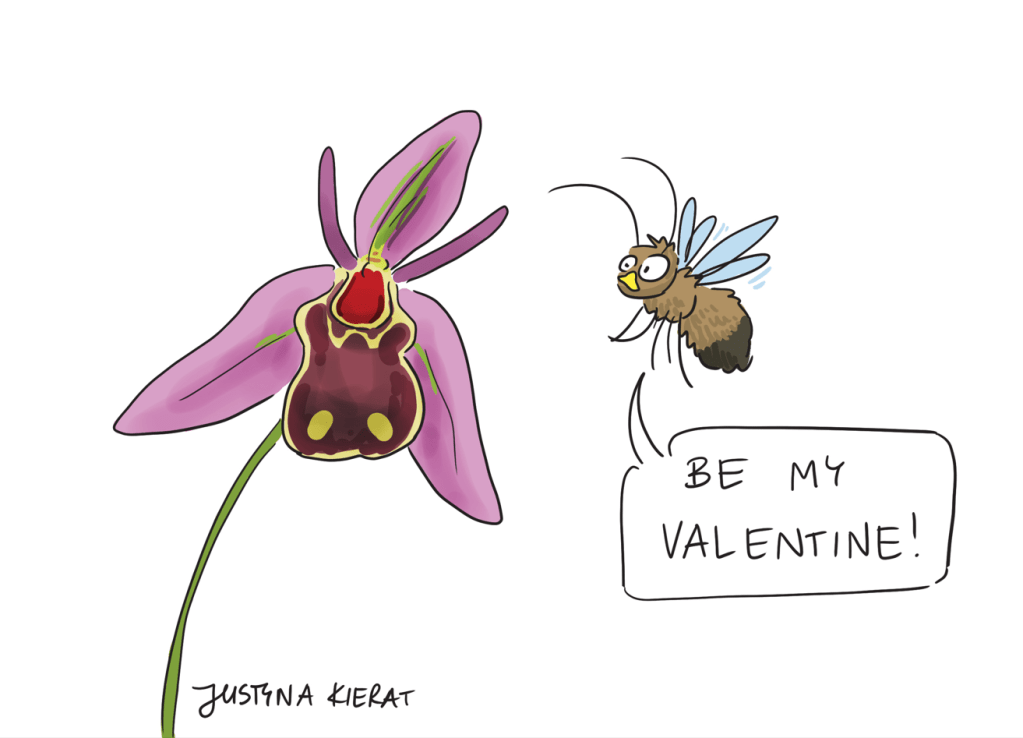
One more Valentine cartoon! If you are not familiar with orchid strategies of fooling pollinators, look at my previous post where I wrote a few words about this.
Today is a good day for a story about love. As you might know, some orchid species use males of bees or other insects as pollinators, making them think that their flowers are females ready to mate. They mimic pheromones of a given species, so the relationship is often very tight – there is only one insect species pollinating a given species of orchid. The plant has to be a real master of mimicry because the bee must be fooled more than once – only that way a transfer of pollen between individual flowers can occur. And it really is the case – it has been shown that for male Colletes cunicularius, a common European spring bee, that they prefer scent of the orchid, Ophrys exaltata, than of their own females!
If you want to read the original study about these Colletes males, here is the reference: Vereecken, N. J., & Schiestl, F. P. (2008). The evolution of imperfect floral mimicry. Proceedings of the National Academy of Sciences, 105(21), 7484-7488.
Blood bees (genus Sphecodes) owe their name to red colouration of metasoma. They are quite similar in colouration and shape but come in various sizes. Some of them are really small and inconspicuous, measuring about 5 mm. Is that bad? Well, I bet that blood bees would be happy to go unnoticed. They are cuckoo bees and lay their eggs in the nests of other bee species. Of course what is small to human eye, is not necessarily so to the bee host of Sphecodes, so the fight is often inevitable.