It is not uncommon to read in books and publications that bees are ‘vegetarian wasps’.

There is great paper by Andreas Muller in Alpine Entomology published this year, about food preferences of Hylaeus. Members of this genus were believed to be polylectic, with a few exceptions. As it turned out, many of them are in fact specialized or at least have marked preferences for certain types of pollen.

Do you remember that amazing photo by Karine Aigner, the winner of Wildlife Photographer of the Year competition in 2022? Here’s how it was made (at least I think so!  )
)

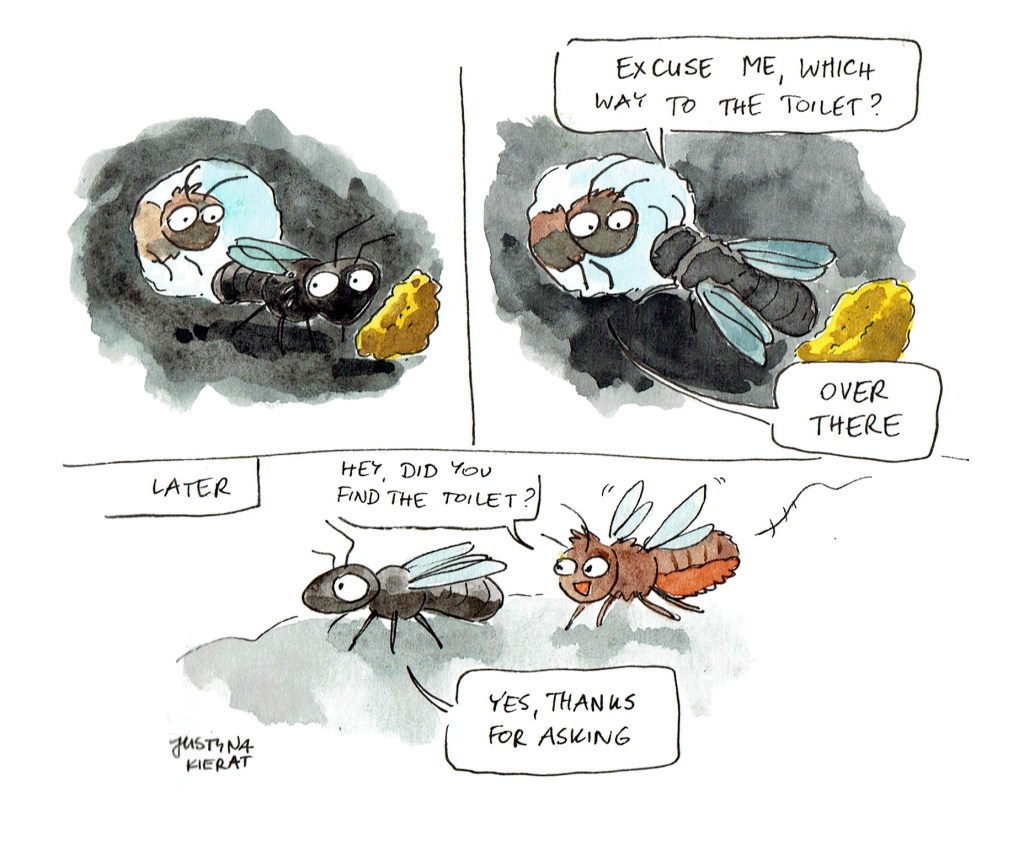
Cuckoo bees don’t build their own nests but lay their eggs in other bees’ nest cells. Some bees aggresively chase their cuckoos but others seem not to care. Rust and Thorp studied Stelis chlorocyanea and Osmia nigrifrons and concluded that Osmia reportedly don’t care about their parasite. If Stelis is discovered by the host inside the nest, it simply backs out and goes its way, and both species can be observed resting peacefully next to each other. Why is that?
I read the abovementioned story, which was inspiration to the cartoon, in the review paper by Jessica Litmann entitled “Under the radar: detection avoidance in brood parasitic bees”. And if you want to read more plausible hypotheses explaining the described phenomenon than this proposed on my cartoon, I strongly recommend this paper!  I didn’t manage to find good photos of neither of the species described, so the characters probably don’t resemble the bees from the original research. But I’m pretty sure that they are not the only host-cuckoo pair which lives peacefully next to each other.
Here I am presenting you the CAPTCHA in entomo- and melitto- version. Feel free to solve them and put the effects in comments!


 Non-honey bees