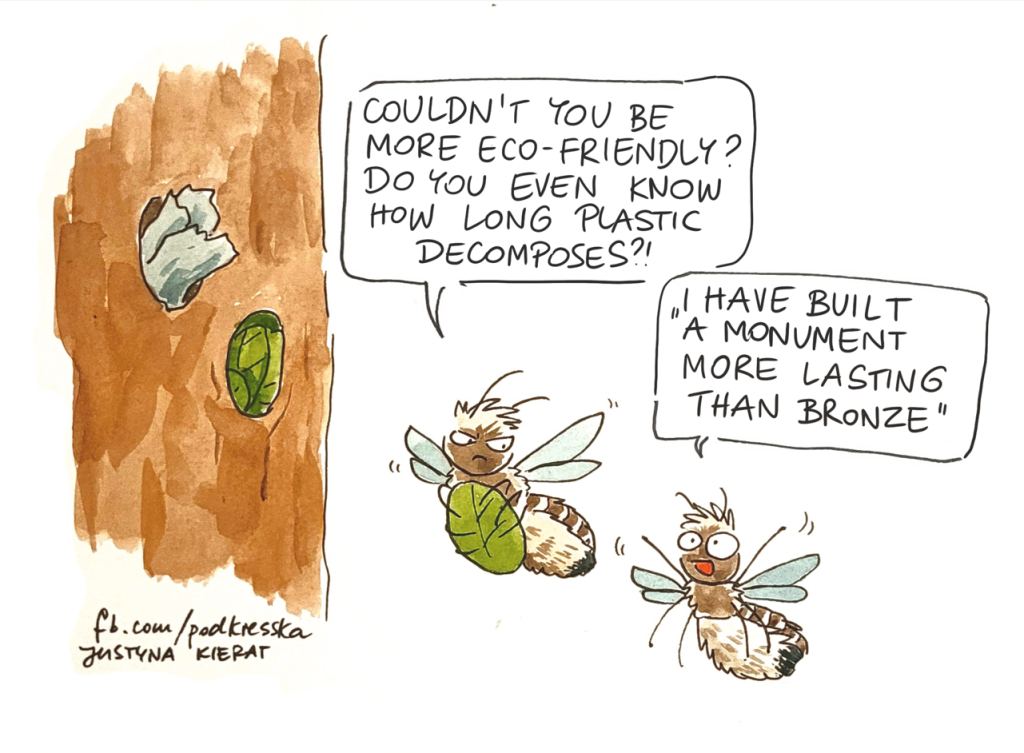
Many species of the genus Megachile build their nests, using plant leaves cut in round pieces (hence the common name of the genus: leafcutters). However, sometimes bees use… plastic instead of leaves. It is quite sad that they use rubbish, and they are not alone in this behaviour – birds also incorporate plastic bags, wires, cigarette butts and other things into their nests. It is not clear what effect has the plastic nest on the leafcutter larvae.
Here is the reference where you can read more: Allasino, M. L., Marrero, H. J., Dorado, J., & Torretta, J. P. (2019). Scientific note: first global report of a bee nest built only with plastic. Apidologie, 50, 230-233.
I’m excited to share with you a paper about my discovery In general, it’s nothing big, but it is for me We have officially added the ivy bee, Colletes hederae, to the checklist of species of Poland! It was expected for quite a while, and the question was only – who, when and where will find it? It seems that it was me last autumn… and what is even better, I found the ivy bees in two places, some 450 kilometers apart! One locality is at the western border of the country, and the other in Kraków, in southern Poland. I don’t believe the ivy bees came to the latter spot all the way from Germany, unobserved by anyone. They must have come another route, from the south. So it seems that we had an invasion from two directions! Of course, it’s not an invasion in the sense of an invasive alien species, because the ivy bee is native to Europe and increases its range without human involvement, apart from our part in the recent climate change. I must add here that the effect of climate change on bees is different depending on the species, and most of them are not as lucky as the ivy bee now, and the global changes are harmful for them. So, I’m happy that we have our ivy bees in Poland at last but at the same time I’m not happy about climate change.
I decided to look at my old cartoons in Polish, from Pod kreską, and translate some of the bee pieces. I hope you’ll like them.
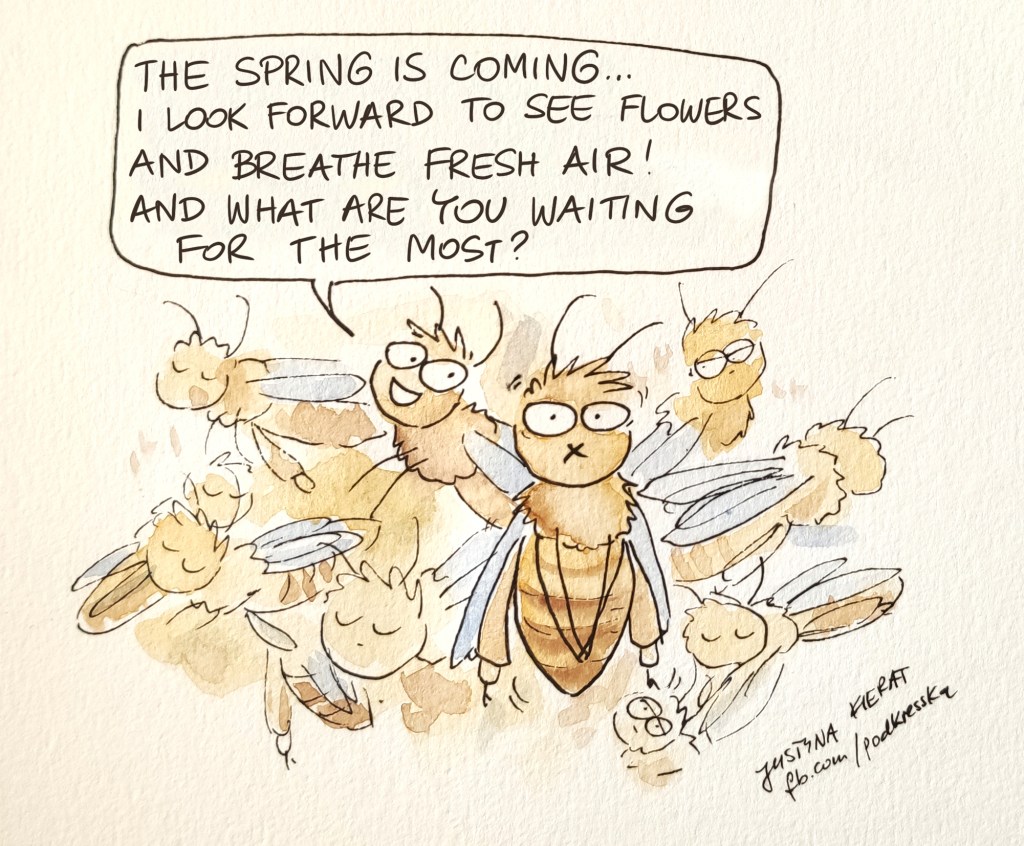
This cartoon is not quite consistent with the name of the site – it’s about yes-honey bees. As you might know, this species is quite unusual in many respects, and overwintering is one of them. Honeybees don’t hibernate like all wild bees in my area (and, I suppose, like the majority of bee species in the regions where there’s seasonality in climate) but they form a winter cluster in their nest, maintaining a temperature about 20 Celcius degrees or more. During the whole period of overwintering, the workers don’t defecate – they do it only outside the nest, when the weather is mild enough to come out.
Today is a good day for a story about love. As you might know, some orchid species use males of bees or other insects as pollinators, making them think that their flowers are females ready to mate. They mimic pheromones of a given species, so the relationship is often very tight – there is only one insect species pollinating a given species of orchid. The plant has to be a real master of mimicry because the bee must be fooled more than once – only that way a transfer of pollen between individual flowers can occur. And it really is the case – it has been shown that for male Colletes cunicularius, a common European spring bee, that they prefer scent of the orchid, Ophrys exaltata, than of their own females!
If you want to read the original study about these Colletes males, here is the reference: Vereecken, N. J., & Schiestl, F. P. (2008). The evolution of imperfect floral mimicry. Proceedings of the National Academy of Sciences, 105(21), 7484-7488.
Yesterday I read a very interesting article by Andreas Müller and Paul Westrich about Andrena lathyri, a mining bee species specialized in nectar robbing. I learned from this paper, among other things, that there is more than one way of obtaining nectar without pollination. Two of them I portraited on the cartoon. The first method, nectar robbing, involves damaging a flower, eg. piercing a hole in its side, like Bombus wurflenii, the famous nectar robber, is doing. On the other hand, nectar thiefs don’t damage flowers but are so small that they sneak past the reproductive organs straight to the nectaries, and as they don’t touch stamens or pistil, it doesn’t pollinate.
If you want to read the paper about Andrena lathyri, which I recomend, here you have the citation: Müller, A., & Westrich, P. (2023). Morphological specialisation for primary nectar robbing in a pollen specialist mining bee (Hymenoptera, Andrenidae). Journal of Hymenoptera Research, 95, 215-230.
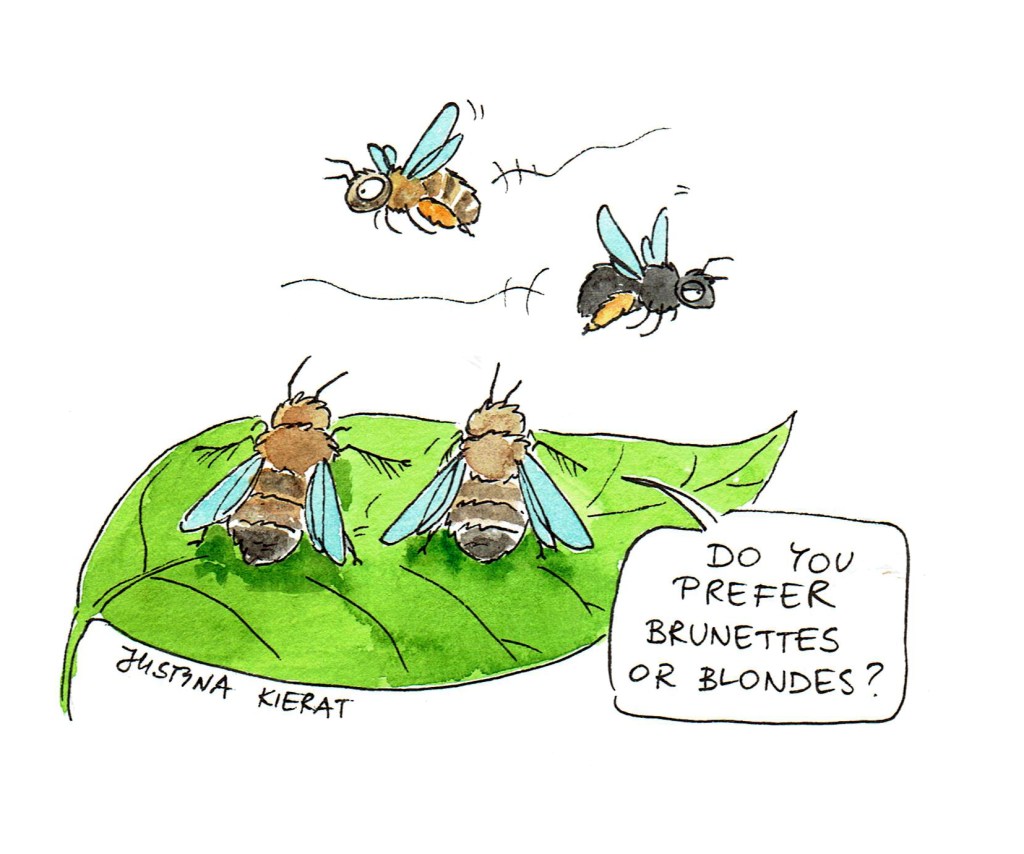
Do you have Anthophora plumipes or other bees with more colour forms in the area where you live?
In some species of bees, not all individuals look the same but there is some polymorphism. And I don’t mean sexual dimorphism, ie. males looking differently from females, but more than one morph in the same sex. Anthophora plumipes, a common European bee appearing in spring, is one of such species. All males look basically the same but females come in two forms – with brown and black fur. Interestingly, proportions of these two morphs may differ geographically. In Poland where I live, the brown morph is a more common one. In contrast, in UK the black form is more frequent.
As I told you, I’m preparing portraits of Polish bees, and here is another one which I’d like to show you. Epeoloides coecutiens and Macropis europaea are both cute, and their parasitic relationship is interesting (like every relationship between a cuckoo bee and its host!). Did you know that Epeoloides coecutiens was once told to be the rarest species of bee in Europe? It is not the rarest, in fact, but in general cuckoo bees tend to be quite uncommon because of their lifestyle.
And fun fact: the Polish names of these bees are real tongue-twisters: skrócinka białonoga and mamrzyk skrócinkowiec I just checked that if you paste these names into Google Translate, it can read it properly. So if you are courious how to pronounce these names, you can check there
I’ve just began drawing a series of little portraits of bee species living in Poland. The drawings are referring to distinctive features of the species or their Polish names (or both ). Meet the pretty Bombus humilis, “trzmiel zmienny” in Polish, which translates into “the variable bumblebee and refers to extreme colour variability of this species.
By the way, have you known that “nacked” bumblebees (ie, under their fur) are glossy black?
I spent last few days on a short vacation with friends. In the evenings we were solving crosswords. My fiancé came out with a great idea of a crossword for bee lovers – see for yourself!
I’d like to tell you about one of experiments I did during my PhD studies. I worked with the red mason bee (Osmia bicornis), a common solitary bee species. I was particularly interested in topics related to their reproduction. The red mason bees’ nests are linear, with individual cells in a row, which is common to many cavity nesters. Typically, there is only one entrance, and the other end of the nest is blind. The larvae must know the direction to the exit, and they do. Important source of information is the shape of mud partitions separating the individual cells. I pictured this on the cartoon – the nest entrance is to the right, and you can see that the side of the wall which should be chewed by the bee to go out is rough. The other side is smooth and concave. When you open the nest in winter, you can see the cocoons (each of them has a young adult bee inside) most of which are directed with bee’s head towards the exit. So, in the spring all that the bee has to do is to chew the cocoon wall, and then cell wall, all the time moving forward.
But my older colleagues from the lab observed that some cocoons are oriented in the other direction. Those misoriented bees are more often males than females. What happens to such individuals? Do they emerge from the cocoon and go forward, blocking and killing their siblings inside the nest, and eventually dying unable to exit? Or can they find out that they made mistake, and correct it? In order to check it, I prepared “artificial nest cells” which had the real cell walls attached, put the cocoons inside, and checked which way the misoriented bees will emerge.
The results were quite surprising. The majority of misoriented males turned around in the cell after emerging from cocoon, and exited their cells in the right direction. In contrast, most females didn’t turn around and got out the wrong way. Females are typically larger than males in the red mason bee but it was not the difficulty with maneuvering that prevented my females to choose the correct exit. The artificial cells were large enough for them to turn around – I checked.
It looks like the decision about which way to go out of the nest is made at the different moment by each of the sexes. Females position themselves already as larvae spinning their cocoons, and in spring they simply follow the chosen direction. Males are less rigorous in positioning their cocoons but before emergence they check where they should go. It’s quite reasonable strategy, as big females in real nests (in contrast to my artificial cells) can have difficulty with turning around as adults. If they postponed choosing direction for spring, it could turn out that they are not able to turn and are doomed. In contrast, smaller males don’t face such problems, so they can look for the correct exit later.
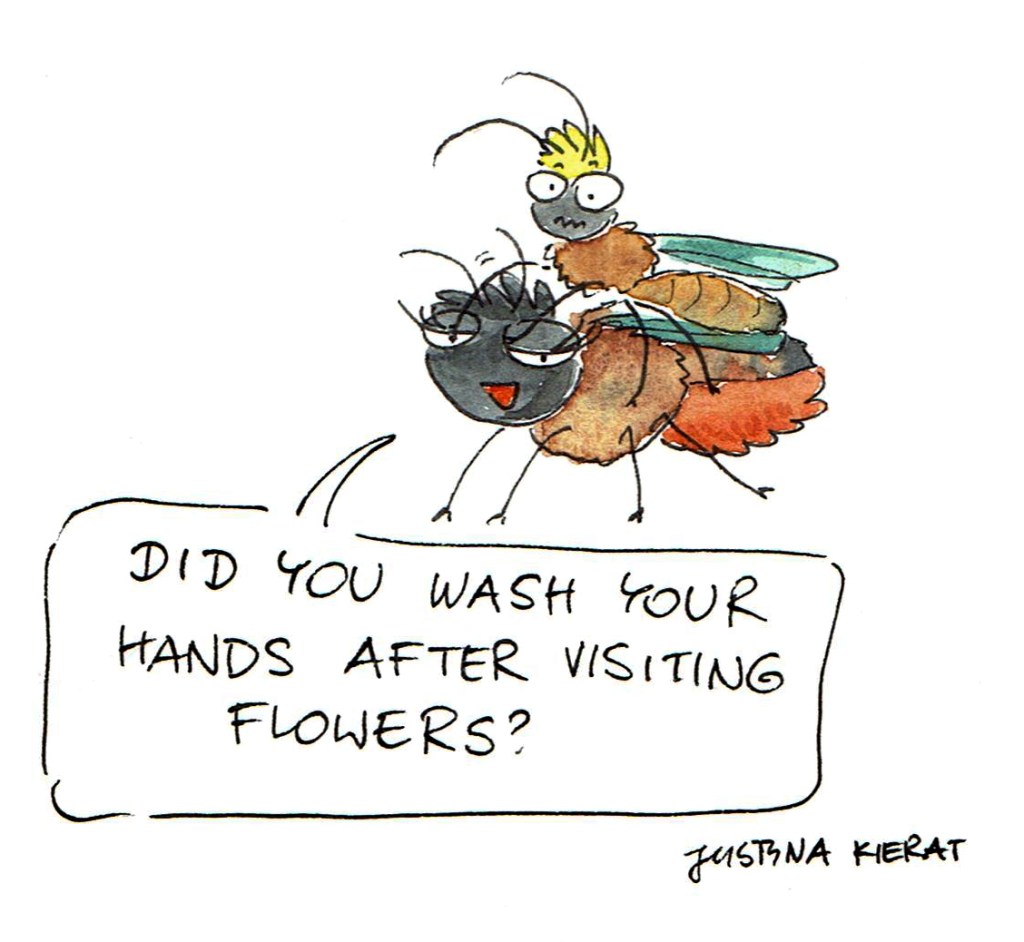
Bees, like all other organisms, suffer from various diseases. Among the causes are RNA viruses, which can evolve fast and thus quickly change host species (between bees but sometimes also to other insects). These viruses can be transmitted via flowers, the latter compared to “dirty doorknobs” by Burnham et al. in their article from 2021.
On the cartoon you can see a pair of red mason bees (oops now I see that I forgot to picture horns on female’s face!). Males in this species have quite sophisticated courtship, involving stroking of mate’s eyes with front legs. One would assume they should wash their hands before doing that. Oh wait…
Transmission of RNA viruses, and also other pathogens, to the wild bees is one of the risks associated with mass breeding and transport for large distances (eg between countries or continents) of the honeybee, bumblebees and other bees.

 In general, it’s nothing big, but it is for me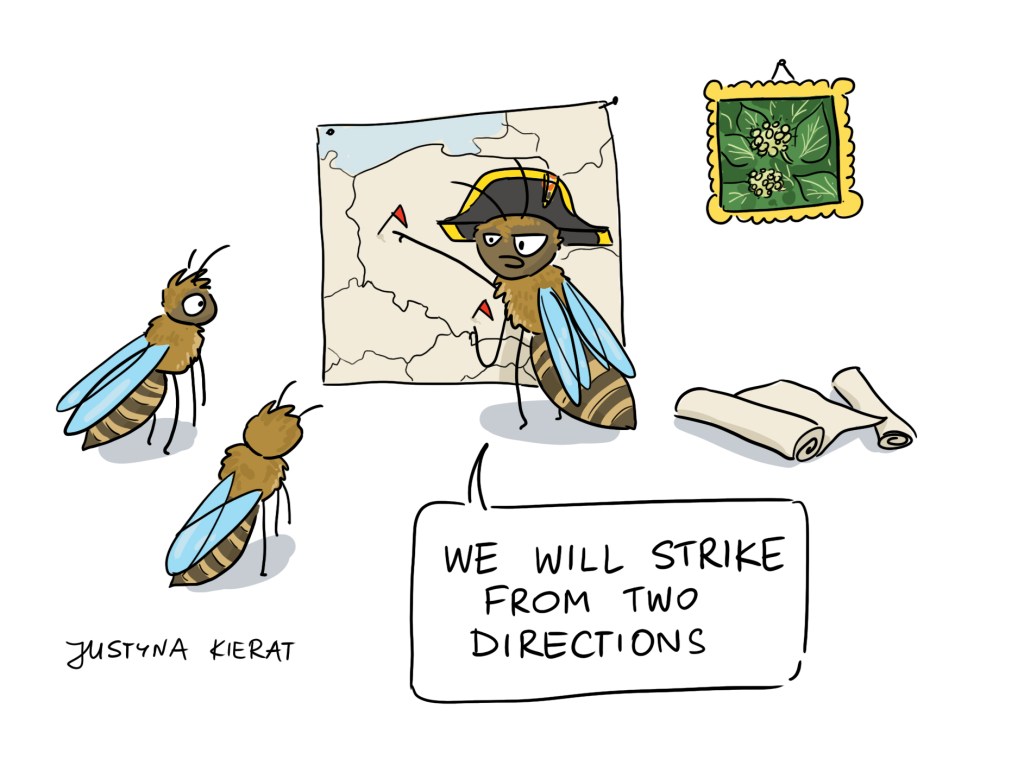


 I just checked that if you paste these names into Google Translate, it can read it properly. So if you are courious how to pronounce these names, you can check there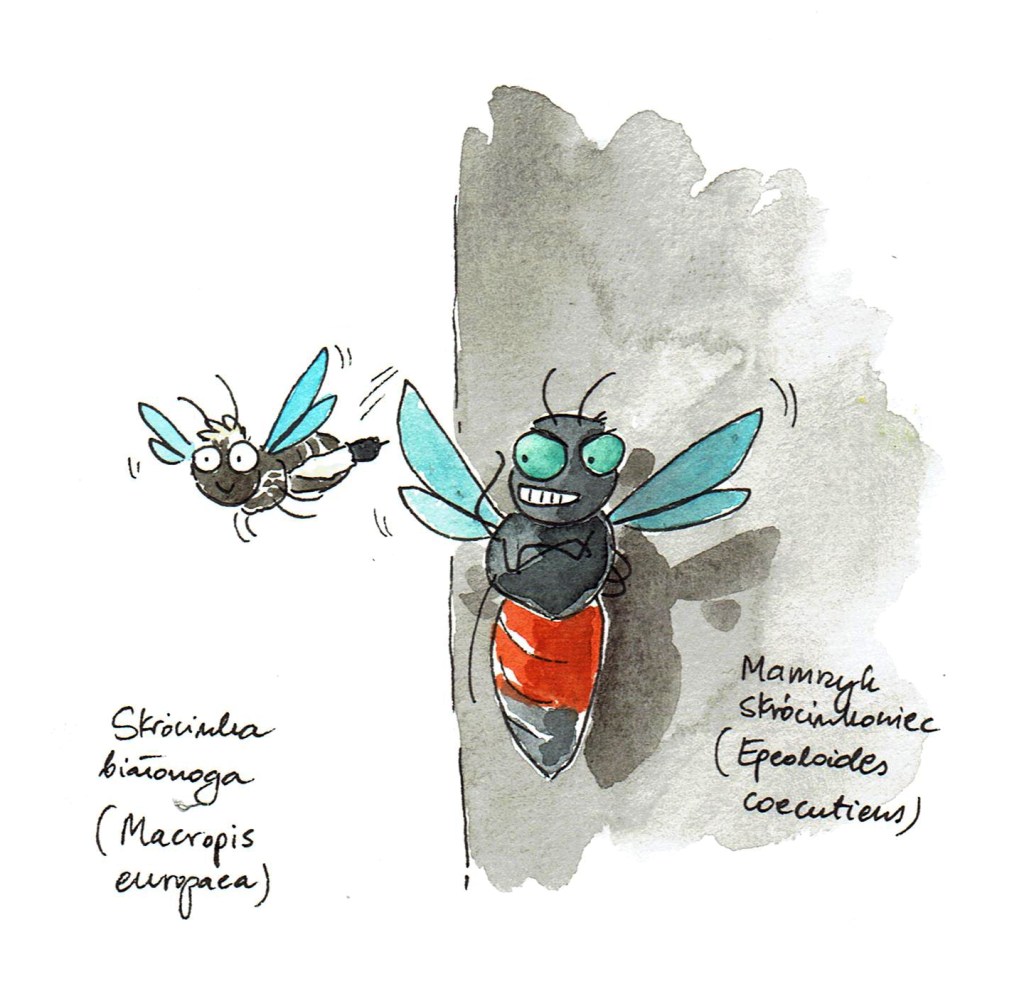
 ). Meet the pretty Bombus humilis, “trzmiel zmienny” in Polish, which translates into “the variable bumblebee and refers to extreme colour variability of this species.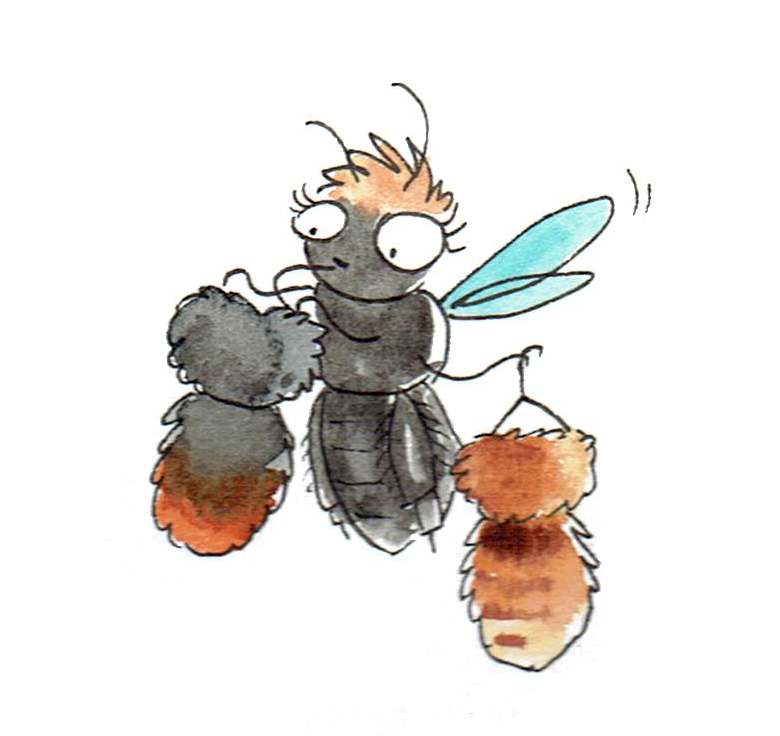


 Non-honey bees