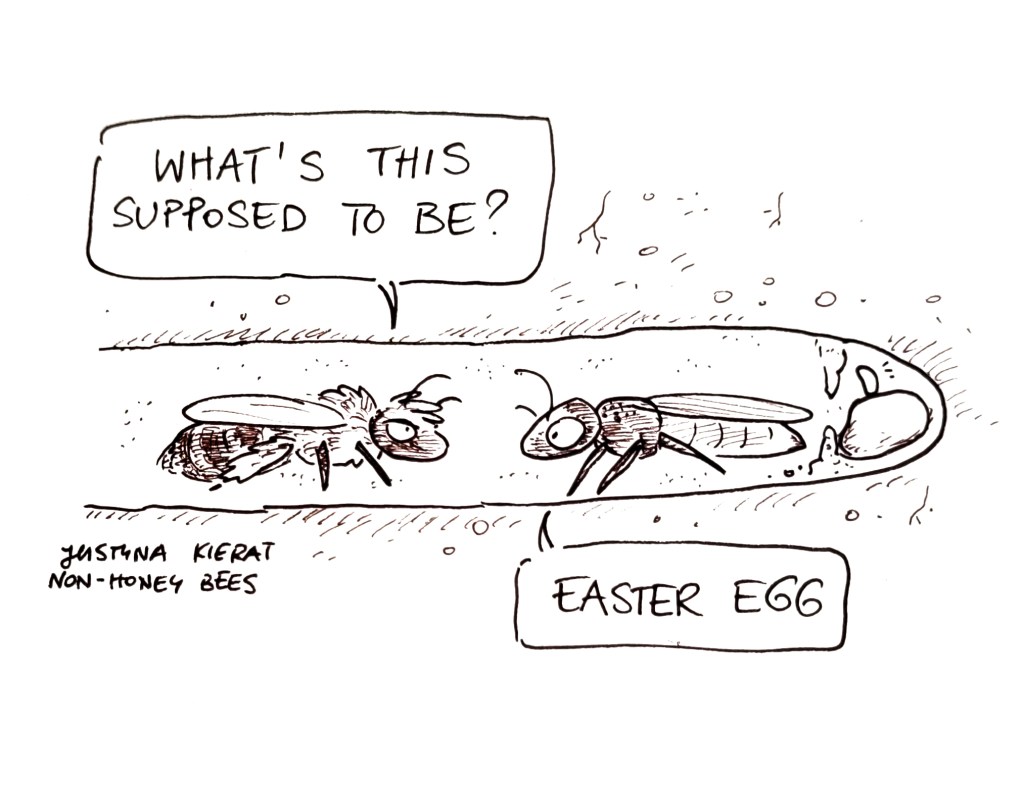
As on a black-and-white cartoon it may be hard to tell the species, I’ll tell you that it’s Colletes cunicularius – a spring solitary bee common in Europe, and Sphecodes albilabris – its cuckoo.
Many species of cuckoo bees sneak into the host’s nest when it’s open, to lay their eggs inside. If they encounter their host, it may pay no attention to the intruder (I had a cartoon about it) or a fight may start. Sphecodes are quite aggressive and they often kill the host.
I’m very fond of cuckoo bees. They don’t build their nests and have amazing adaptations to make other bee species raise their children. Many of them, “true” cuckoos, just lay their eggs in the nests of solitary bees, and their success depends on making it so that the nest owner doesn’t know of the parasite’s egg in her nest. Others, like the cuckoo bumblebee pictured on the cartoon you see, invade nests of social species and usurp the title of the queen. After succesfully establishing its position in the nest, the cuckoo bumblebee female begins laying her eggs and host workers care for them like for their own sisters. The cuckoo keeps discipline by biting and dominating the workers (and the old queen, if she survived) but usually doesn’t kill the workers, as they are precious workforce for her young.
On the cartoon you can see the Field cuckoo bumblebee (Bombus campestris) in the nest of the Common Carder bumblebee (Bombus pascuorum). The cuckoos are picky when it comes to host choice, and usually parasitize only one or a few host species.
Cuckoo bees don’t build their own nests but lay their eggs in other bees’ nest cells. Some bees aggresively chase their cuckoos but others seem not to care. Rust and Thorp studied Stelis chlorocyanea and Osmia nigrifrons and concluded that Osmia reportedly don’t care about their parasite. If Stelis is discovered by the host inside the nest, it simply backs out and goes its way, and both species can be observed resting peacefully next to each other. Why is that? I read the abovementioned story, which was inspiration to the cartoon, in the review paper by Jessica Litmann entitled “Under the radar: detection avoidance in brood parasitic bees”. And if you want to read more plausible hypotheses explaining the described phenomenon than this proposed on my cartoon, I strongly recommend this paper! I didn’t manage to find good photos of neither of the species described, so the characters probably don’t resemble the bees from the original research. But I’m pretty sure that they are not the only host-cuckoo pair which lives peacefully next to each other.

 I didn’t manage to find good photos of neither of the species described, so the characters probably don’t resemble the bees from the original research. But I’m pretty sure that they are not the only host-cuckoo pair which lives peacefully next to each other.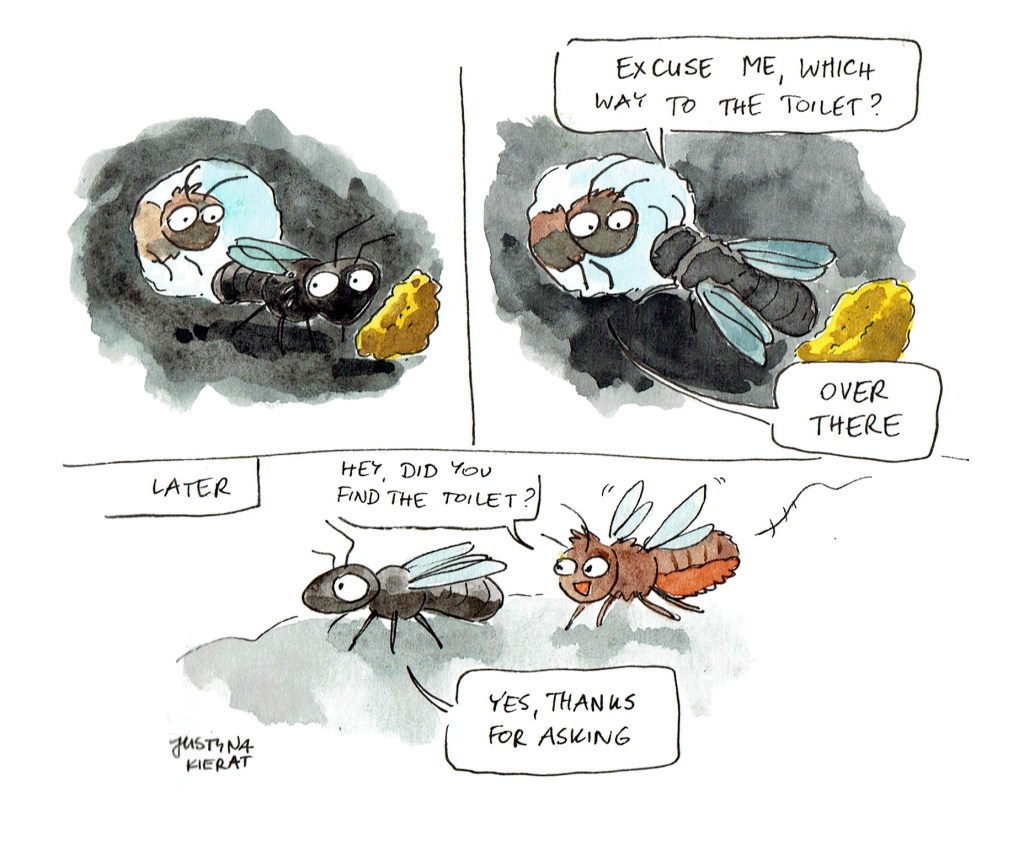
 Non-honey bees