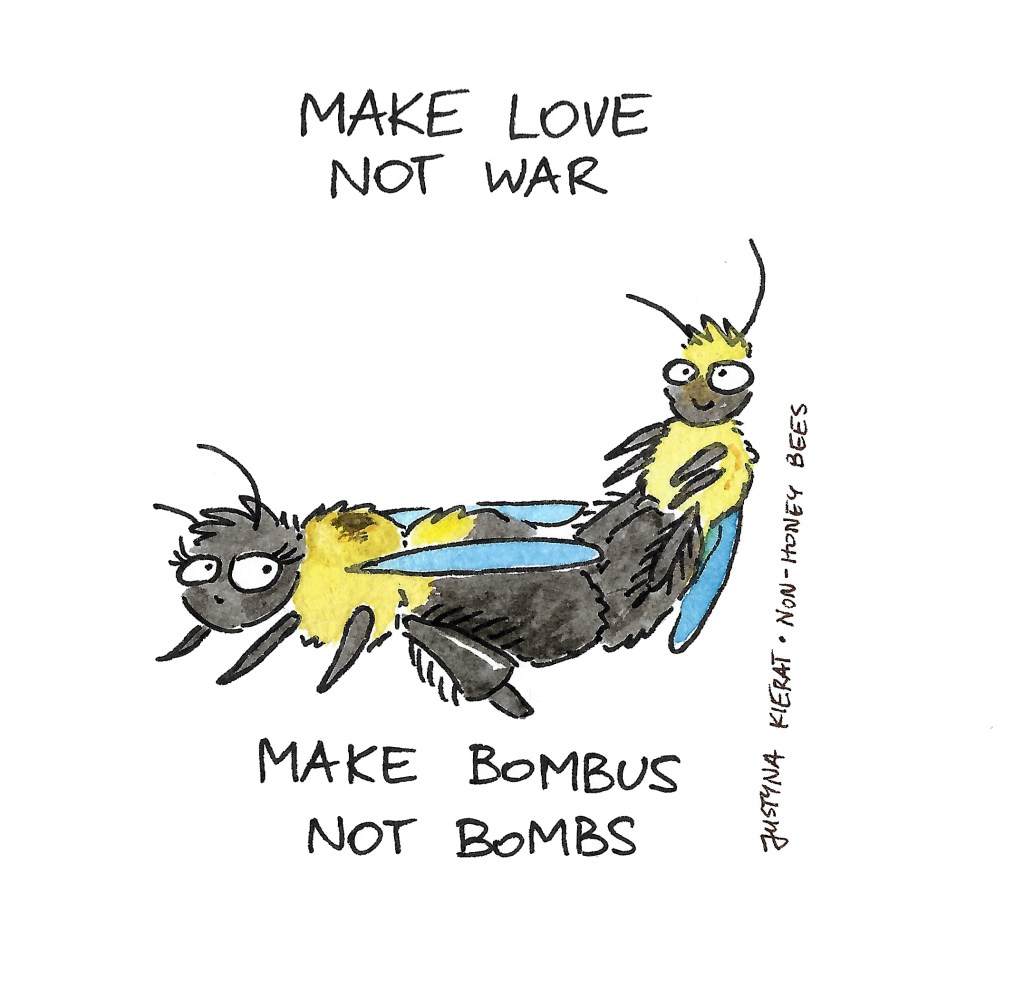
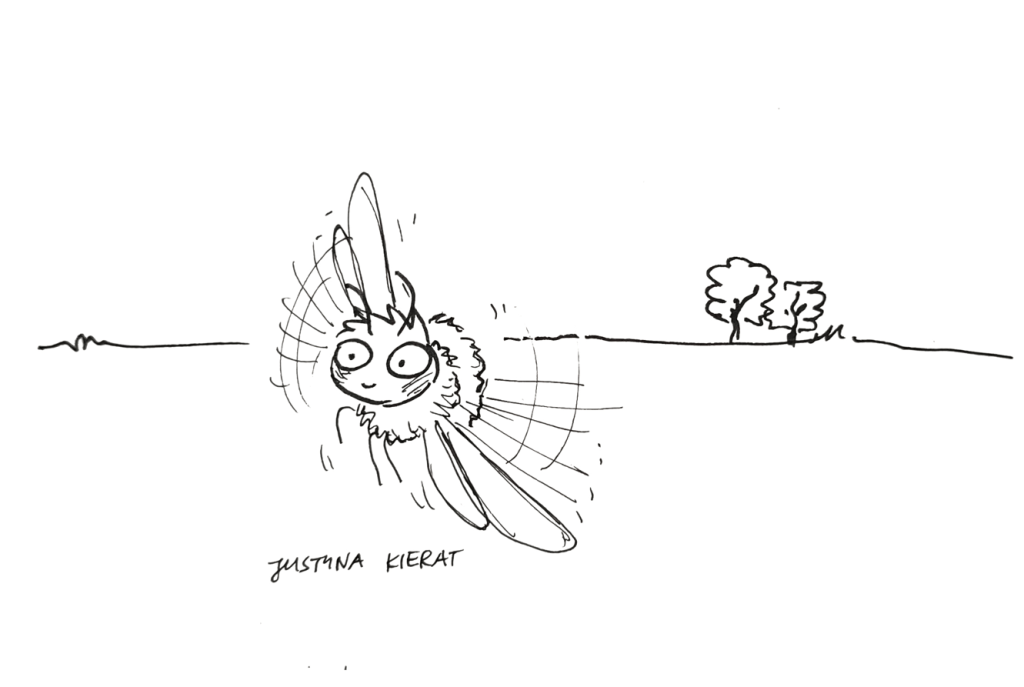
Being active in various fb groups taught me that many people don’t know what bees look like when they are making love. If you also didn’t know that, you do now, thanks to this cartoon.
Mimicry is a phenomenon whereby different species resemble each other. One type of mimicry involves defenseless species resembling species that are somehow armed, e.g., poisonous or venomous. This is the case with defenseless hoverflies and stinging bees.The mimic gains protection when predators mistake it for the model and refrain from attacking.
Mimicry is not always perfect—sometimes the mimic only superficially resembles the model, but this is enough for it to gain benefits. A predator’s moment of hesitation can mean the difference between life and death. It is also important to remember that our perception of the world differs from that of other species, and what is different to us may be similar to a bird.
Shortly after emerging from the nest and mating, young bumblebee queens start looking for a place to hibernate. Typically, a female will dig a hibernaculum in the ground — a relatively short tunnel with a small chamber at the end. I was surprised to read that when a digging female encounters an obstacle in her way, like a pebble, she doesn’t try to bypass it but leaves the burrow and starts a new one. What could be the adaptive significance of this? Or is there none? If you know, please tell me!
It’s a bit old news, but I’ve only just found out about it. During wild bee research in New York State, one species was observed for the first time in over 100 years in the state. Congratulations to the rediscoverer! Do you remember my previous post about oligolectic bees? Andrena rehni is a member of this group. It is common in plant-pollinator relationships that the specialisation is only on one side. This is also the case here. The American chestnut can be pollinated by other insects in the absence of its specialist. So, Andrena rehni can’t live without its favourite tree, but the tree didn’t miss the bee too much during its absence.
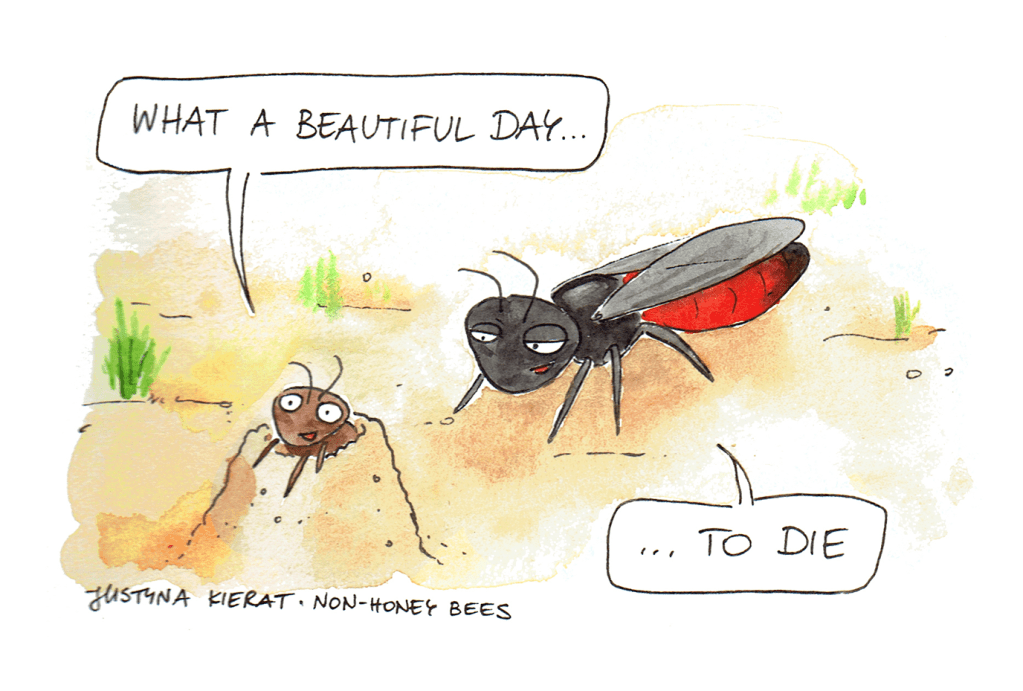
Parasitic bees are known as ‘cuckoos’ because they do not build nests or care for their offspring. Most of them sneak into the nests of other bee species when the owner bee is out collecting food, or open nests that have already been closed and are unguarded, and lay their own eggs there. With solitary bees, it is quite easy to find a moment when the mother is away. In colonies of social species, however, there is usually somebody home. Cuckoo bumblebees solve this problem by fighting and replacing the queen, making them more social parasites than classic “cuckoos”. Blood bees (genus Sphecodes) have another strategy that is even crueller, which Danforth and co-authors refer to as the “scorched earth attack” in their book The Solitary Bees. The female Sphecodes enters the nest of a social or communal host and kills or repels (probably using pheromones) as many bees as possible. Once the colony has been destroyed, the female blood bee can parasitise the brood cells undisturbed.
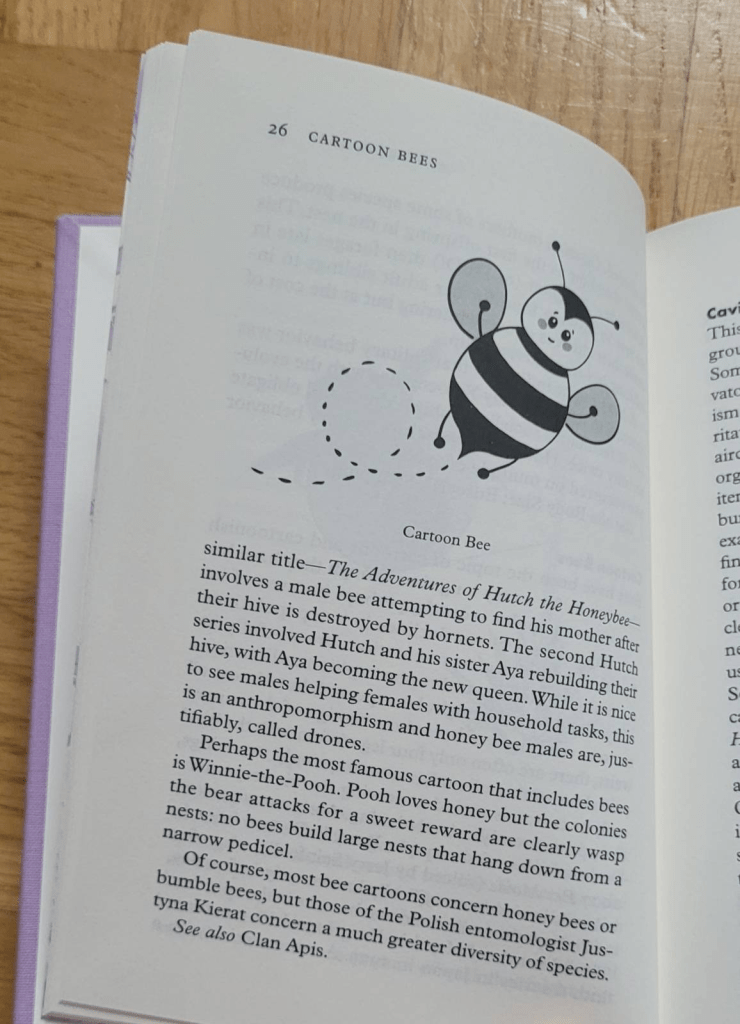
Today is my big day! Yesterday, I received Laurence Packer’s Beepedia. I plan to read it and then publish a review of it on my Polish-language blog about bees (I post there photos and longer texts in Polish, but if you would like to take a look, I hope the translator will be able to handle it). Before I had a chance to start reading the book, a friend wrote to tell me that he had found me inside (thank you, Robert!). I’m famous! That’s good motivation to post here more often.
And here’s the mention of me – in case you didn’t believe me! 😉
I just read an interesting study about the impact of apiaries on bumblebee colonies. It is one of quite a few studies exploring this topic. Honeybees, especially in high densities, can compete for food with wild bees. They can also transmit diseases and parasites to wild bee species. So, setting up an apiary is a potential threat for wild bees already living in the area. Despite that, beekeeping is often considered by the public to be a form of bee protection. It is a problem in bee conservation and we, bee-lovers, need to clarify this issue.
Returning to the study I mentioned. The researchers set up experimental bumblebee colonies in various distances from the apiary, and checked how this distance affects colony reproduction (production of workers and new queens), immunity of the individual bumblebees and risk of infestation of the colony by the bumblebee wax moth, Aphomia sociella. The bumblebee wax moth is native to Europe (where the research was conducted) and in natural conditions can invade bumblebee nests, feeding on wax, pollen or… bumblebee larvae. Nothing pleasant for the colony. It also can live in weak honeybee colonies.
What about the results? The nearer to the apiary, the more probable was infestation of the bumblebee nest by their wax moth. Worse still, the proximity of the apiary negatively affected immunity of bumblebees and their reproduction. The latter effects are explained by the authors by weakening of the colonies because of competition for food. All these effect can interact and strengthen each other – worse immunocompetence of bumblebees means higher risk of infestation with diseases, which is already increased by honeybees’ proximity.
What can we do with this knowledge? Surely not set up new apiaries “to help the bees”. Instead, we can provide food for all bees (honey- and non-honey-) in the form of flowering plants, preferably belonging to diverse native species. We can also protect habitats of wild bees, where they find food and nesting sites. We also can reduce pesticide use. And if we already have honeybees, let’s care for them as best we can, because healthy honeybees mean less risk of transmiting diseases to wild bee species.
How common is the knowledge that setting up apiaries doesn’t help bees, in your country? Is honeybee a native species where you live? Let me know 🙂
I must say it right away: bats don’t get tangled in peoples’ hair. It’s a myth, and they are harmless, nice animals in general. But I just came across such a sentence in a book “Bees of Costa Rica” by P. Hanson et al.:
“(…)some species of Partamona and Trigona are highly aggressive toward stimuli close to their colony and will attack humans by entangling themselves in hair and biting”.
Both abovementioned genera belong to Meliponini, the stingless bees which, as the name suggests, don’t possess functional stinger. However, they are not defenseless! Apart from biting, some species can also secrete irritating substances to make their attack even fiercer. Of course, I doubt you should be afraid of them in general. Just don’t mess with the nest, and everything should be fine!
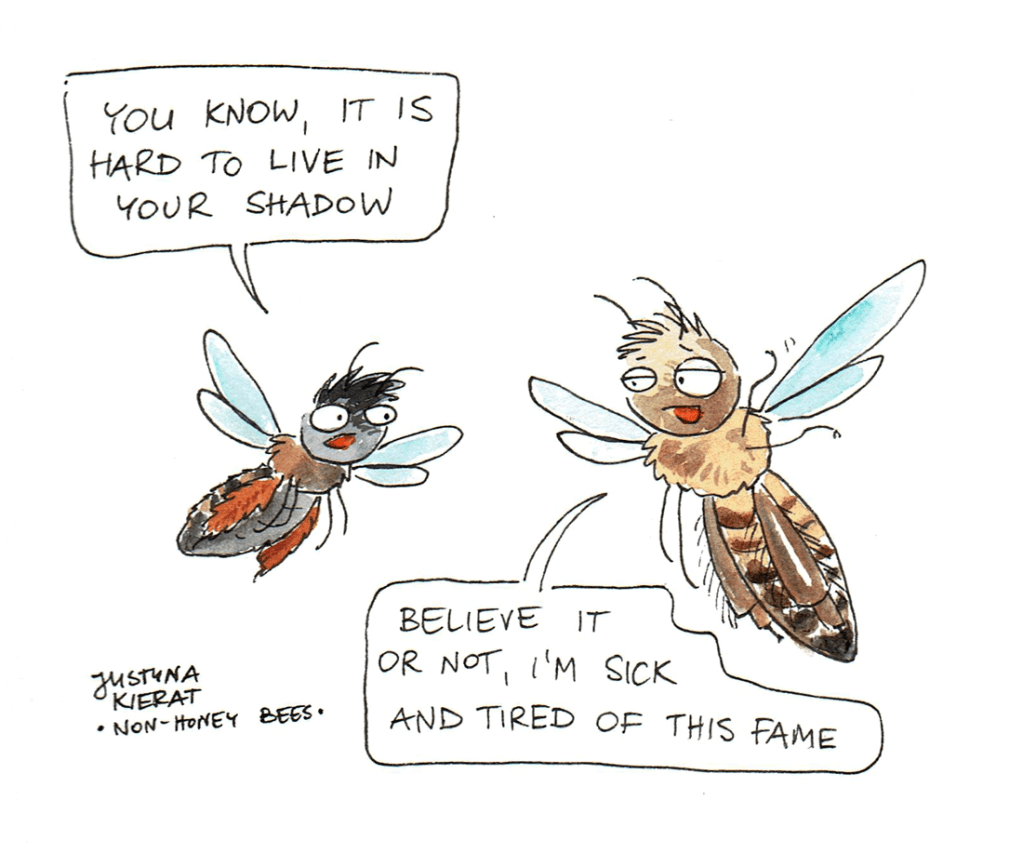
Do you have impression that the honeybee is the best known bee species, and that sometimes impairs the wild bee protection? I often see the reasoning like: “There are too few bees in the world? Let’s become beekeepers and make apiaries!”.
Although bees are really important and we would like to have them more in the world, their species diversity is also crucial. The honeybee is currently more a farm animal than a wild bee, and in many regions beekeeping made its population to rise too high. I just read a new article about this. It is in German, and if you know this language, I recommend reading this interesting paper. It describes problems caused by the presence of the honeybee (mostly, by its too large population) to the wild bees, and gives advice what can be done to reduce the negative impact.
It is important to note that when we postulate that the numbers of honeybees should be reduced, it’s not against the welfare of the honeybees.They also suffer when their density is too high. And they have all the right to live peacefully and be properly cared for by beekeepers! Making sure that the honeybees are in the best health condition also reduces the risk of transmiting diseases to wild species.
Have you seen any of these videos where a bird (eg a kestrel or a kingfisher, or even a hen) keeps its head still when flying or sitting on a moving branch? Bees also have this kind of optic stabilization. When they fly, their thorax might rotate but head keeps being oriented horizontally. Here you can find an example of studies on this topic.
My association with this topic was remote control. Well, this kind of control might be not exactly remote, as it’s about a parasite controlling behaviour of its host. Apocephalus borealis, a fly, makes its bee host into a kind of zombie. It is known to parasitize bumblebees but a paper from 2012 reported it parasitising also the honeybee.






 Non-honey bees