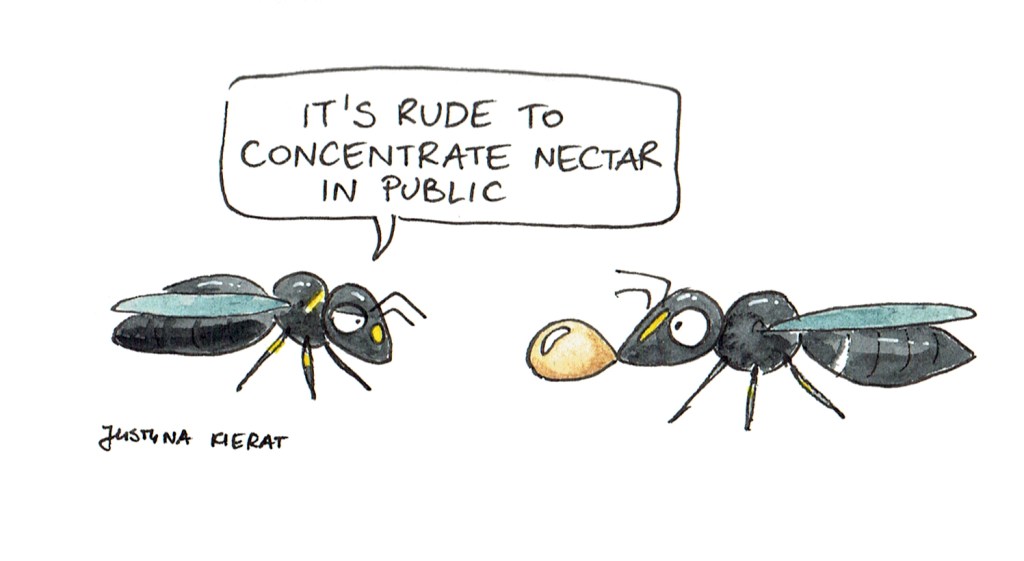
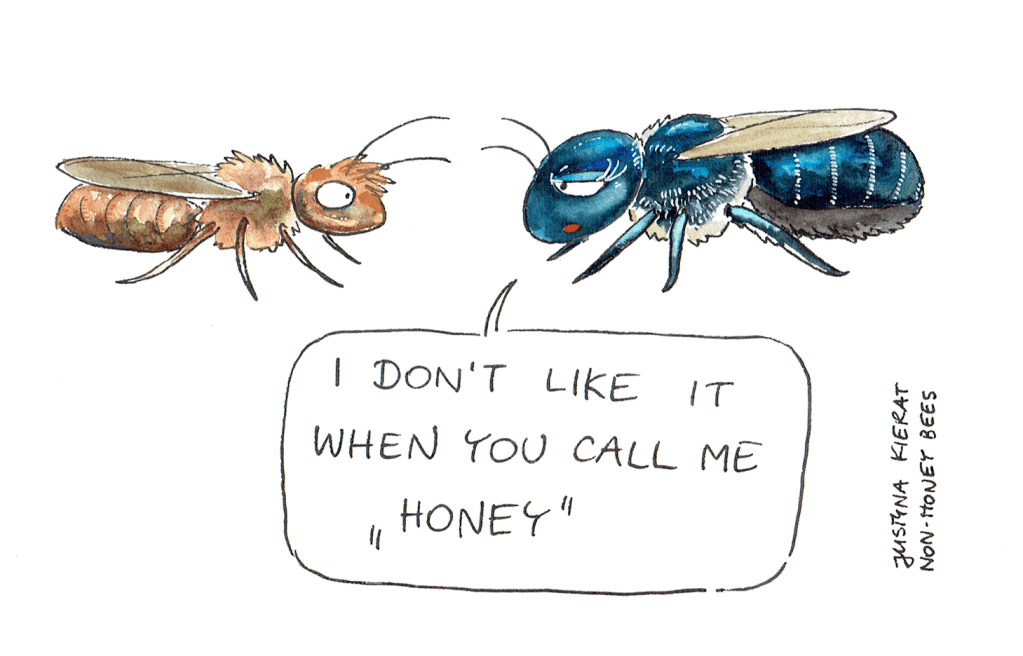
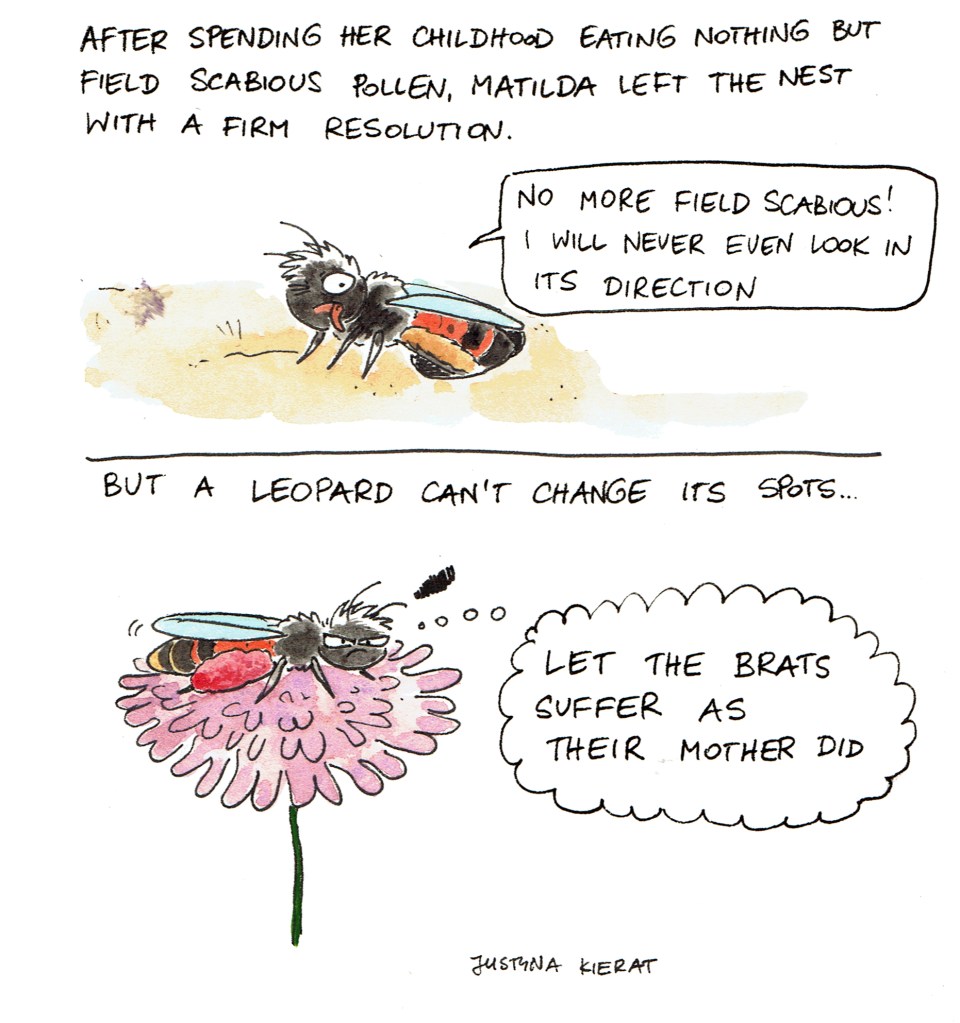
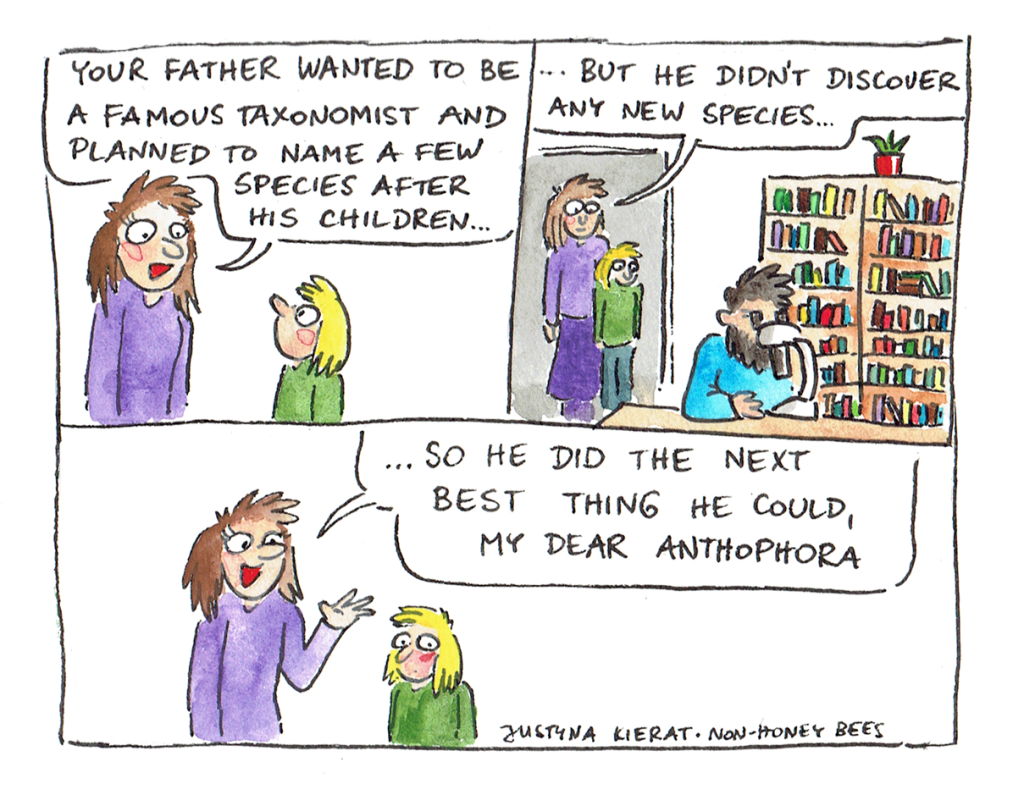
Whereas the majority of bees nest in the ground, there is also quite a large group of cavity-nesting species. These species nest in various holes, inside plant stems, in cavities in wood (sometimes they gnaw them by themselves). In cities, they can use man-made holes of various kinds (sometimes being very creative in their choices). If they happen to nest in a movable object (eg. a tree trunk ready for transport, or garden furniture) they can be accidentally transported with their nests… sometimes far away. It happened to a number of bee species which became invasive in their “new homes”, eg. the European wool carder bee (Anthidium manicatum) moved to the United States, or Megachile sculpturalis, native to Asia, which is now spreading across Europe.
…and the most cat-like bumblebee is the brown-banded carder bee! It just struck me how similar they are. Bombus humilis is called “trzmiel zmienny” in Polish, which means “the variable bumblebee”. It’s really accurate name. This species can come in various colour forms, some of them so dissimilar that you could think they are different species. My favourite form is the one I nicknamed ‘calico’ on the cartoon below.
PS I set up an account on BuyCoffee. If you want to support my work and help me buy more books about bees, I’ll be very thankful. And, as always, I’m thankful for all your shares and likes on social media, and positive comments and messages!
I just read an interesting study about the impact of apiaries on bumblebee colonies. It is one of quite a few studies exploring this topic. Honeybees, especially in high densities, can compete for food with wild bees. They can also transmit diseases and parasites to wild bee species. So, setting up an apiary is a potential threat for wild bees already living in the area. Despite that, beekeeping is often considered by the public to be a form of bee protection. It is a problem in bee conservation and we, bee-lovers, need to clarify this issue.
Returning to the study I mentioned. The researchers set up experimental bumblebee colonies in various distances from the apiary, and checked how this distance affects colony reproduction (production of workers and new queens), immunity of the individual bumblebees and risk of infestation of the colony by the bumblebee wax moth, Aphomia sociella. The bumblebee wax moth is native to Europe (where the research was conducted) and in natural conditions can invade bumblebee nests, feeding on wax, pollen or⦠bumblebee larvae. Nothing pleasant for the colony. It also can live in weak honeybee colonies.
What about the results? The nearer to the apiary, the more probable was infestation of the bumblebee nest by their wax moth. Worse still, the proximity of the apiary negatively affected immunity of bumblebees and their reproduction. The latter effects are explained by the authors by weakening of the colonies because of competition for food. All these effect can interact and strengthen each other – worse immunocompetence of bumblebees means higher risk of infestation with diseases, which is already increased by honeybees’ proximity.
What can we do with this knowledge? Surely not set up new apiaries “to help the bees”. Instead, we can provide food for all bees (honey- and non-honey-) in the form of flowering plants, preferably belonging to diverse native species. We can also protect habitats of wild bees, where they find food and nesting sites. We also can reduce pesticide use. And if we already have honeybees, let’s care for them as best we can, because healthy honeybees mean less risk of transmiting diseases to wild bee species.
How common is the knowledge that setting up apiaries doesn’t help bees, in your country? Is honeybee a native species where you live? Let me know π
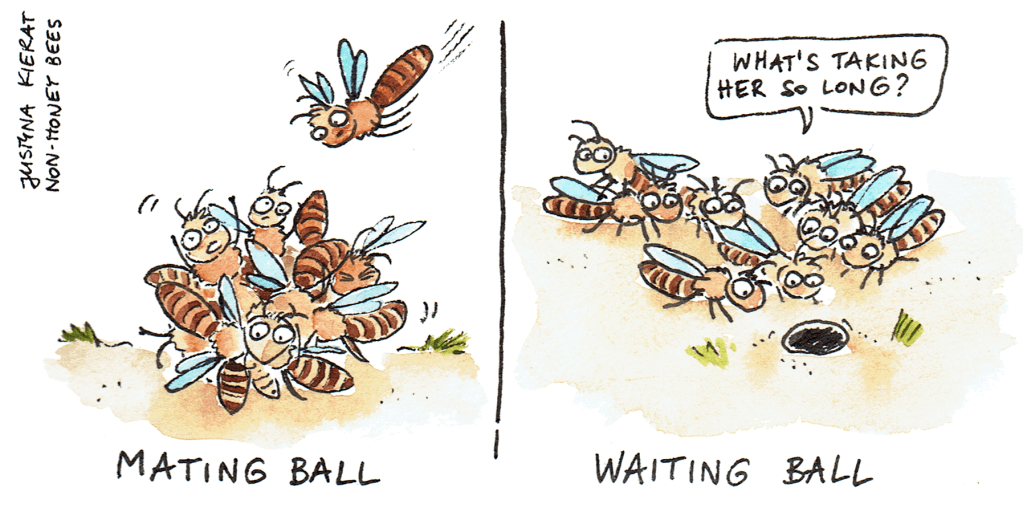
My activity on this page is inversely proportional to the activity of bees in the field in Poland… Now it’s time for mating balls. Fascinating clumps of male solitary bees, with a female (so I assume) somewhere inside. Males are crazy, chasing potential mates (and sometimes also everything remotely resembling a mate, for example other species of bees). When they are present in large numbers, like in nesting aggregations, they can scare people but they’re absolutely harmless.
Solitary bee (and, basically, all bee) males don’t have a stinger, and females do, but use it only to defend themselves when they have no other options. They don’t attack when you come near their nest, like honeybees do. Did you already know that? Tell it to your friends and family who might not know!
I must say it right away: bats don’t get tangled in peoples’ hair. It’s a myth, and they are harmless, nice animals in general. But I just came across such a sentence in a book “Bees of Costa Rica” by P. Hanson et al.:
“(…)some species of Partamona and Trigona are highly aggressive toward stimuli close to their colony and will attack humans by entangling themselves in hair and biting”.
Both abovementioned genera belong to Meliponini, the stingless bees which, as the name suggests, don’t possess functional stinger. However, they are not defenseless! Apart from biting, some species can also secrete irritating substances to make their attack even fiercer. Of course, I doubt you should be afraid of them in general. Just don’t mess with the nest, and everything should be fine!
Do you have impression that the honeybee is the best known bee species, and that sometimes impairs the wild bee protection? I often see the reasoning like: “There are too few bees in the world? Let’s become beekeepers and make apiaries!”.
Although bees are really important and we would like to have them more in the world, their species diversity is also crucial. The honeybee is currently more a farm animal than a wild bee, and in many regions beekeeping made its population to rise too high. I just read a new article about this. It is in German, and if you know this language, I recommend reading this interesting paper. It describes problems caused by the presence of the honeybee (mostly, by its too large population) to the wild bees, and gives advice what can be done to reduce the negative impact.
It is important to note that when we postulate that the numbers of honeybees should be reduced, itβs not against the welfare of the honeybees.They also suffer when their density is too high. And they have all the right to live peacefully and be properly cared for by beekeepers! Making sure that the honeybees are in the best health condition also reduces the risk of transmiting diseases to wild species.
It’s quite early but I’d like to wish you merry Christmas and loads of bees in 2025!
The bee celebrating on my cartoon is Megalopta genalis – one of few bees well equipped to go to the New Year’s Eve party – it is active year-round (so, 31st December, too) and stays up late.
Sharp-tailed bees (genus Coelioxys) owe their common name to the shape of the ending of the abdomen. In females, the abdomen usually ends in narrow, sharp spine. But it’s not always the case. For my cartoon I chose Coelioxys alatus but the other candidate I was considering was Coelioxys obtusiventris
Sharp-tailed bees are cuckoos, laying their eggs in other species’ nests. They share an interesting trait with the honeybee – their eyes are hairy.
Honeybee can visit many plant species all over the world – but it doesn’t make it the best pollinator for them all. For example, it doesn’t like visiting alfalfa (Medicago sativa). In order to be pollinated, alfalfa flower has to be tripped by a bee, and it hits it in the head with its stamens in the process. The honeybee doesn’t like such a mistreating but there are other species, like the alfalfa leafcutter bee (Megachile rotundata) or the alkali bee (Nomia melanderi) who don’t care. Both of them are bred as pollinators of alfalfa.
I’m not sure whether the plant on the drawing is alfalfa, or some related species but I hope you don’t mind.