I hope you don’t have yet enough of them! Here is the first post about these bees where you can learn more about them and find a link to a very interesting paper.
I hope you don’t have yet enough of them! Here is the first post about these bees where you can learn more about them and find a link to a very interesting paper.
Stingless bees are a constant source of inspiration. I’ve already shown you the cartoons about them getting entangled in intruder’s hairs as a form of nest defense, and about tear-drinking species. Now the time has come for Partamona helleri, which practises crash-landing.
Usually, the stingless bees slow down when they approach the narrow nest entrance. But not Partamona helleri! When they are about 20 cm from the nest, they speed up and fly inside like tiny bullets, crashing into the hind wall of the nest and then falling to the bottom. In a few cases, researchers studying the landing behaviour of these bees observed individuals that crashed with such a force that they bounced back and fell out of the nest.
Why do Partamona helleri act so strangely? It is a way to avoid ambush predators, which are sitting at the nest entrance, attempting to catch returning bees. It was shown that when a bee saw a predator, she increased her speed even more.
You can read more about this fascinating strategy in the paper by Shackleton et al.

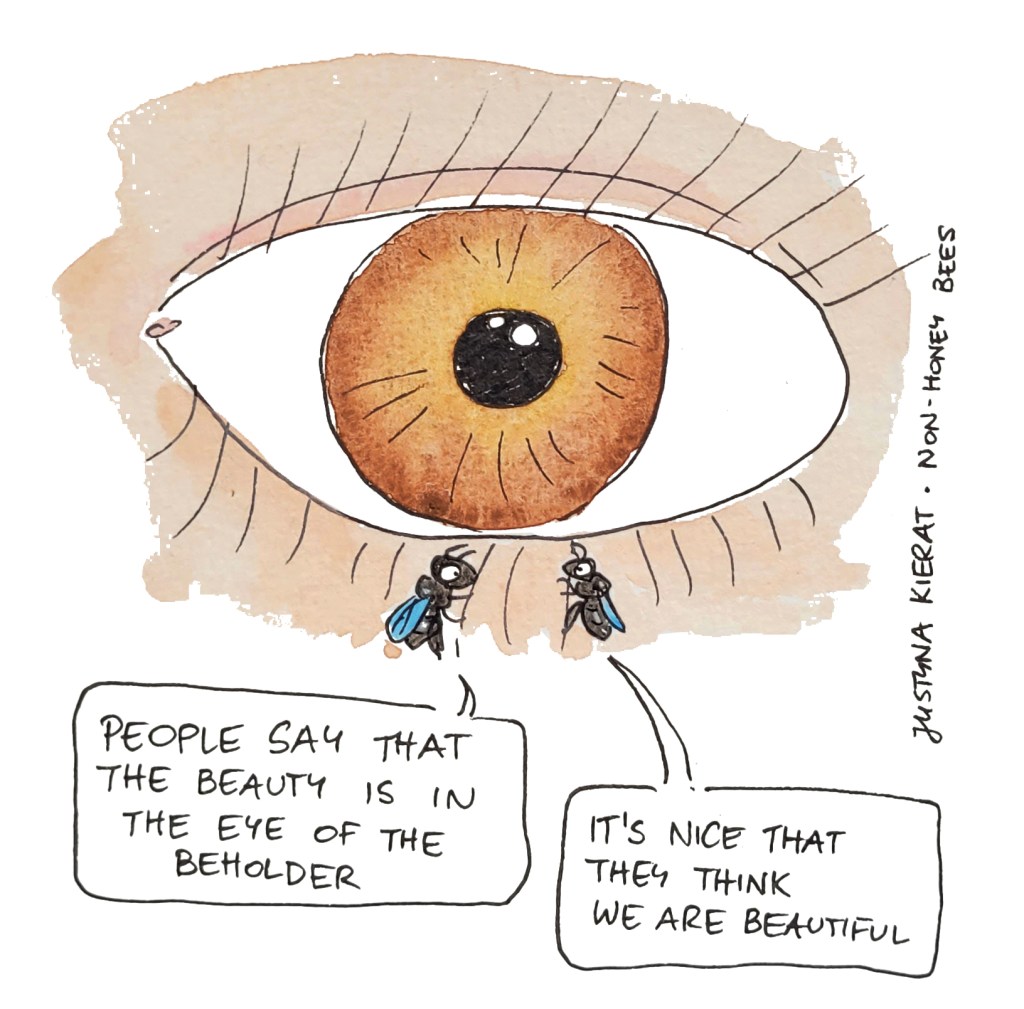
Do you remember my post about the fascinating Lisotrigona bees which feed on human tears? I know I’m not the only one who is impressed by them!

PS With best wishes to Antoine whom this cartoon is dedicated 🙂
I must say it right away: bats don’t get tangled in peoples’ hair. It’s a myth, and they are harmless, nice animals in general. But I just came across such a sentence in a book “Bees of Costa Rica” by P. Hanson et al.:
“(…)some species of Partamona and Trigona are highly aggressive toward stimuli close to their colony and will attack humans by entangling themselves in hair and biting”.
Both abovementioned genera belong to Meliponini, the stingless bees which, as the name suggests, don’t possess functional stinger. However, they are not defenseless! Apart from biting, some species can also secrete irritating substances to make their attack even fiercer. Of course, I doubt you should be afraid of them in general. Just don’t mess with the nest, and everything should be fine!

Oh no, I’m so hopeless in challenges. I haven’t even made it to half of the #inktobee and not sure if I’ll ever catch up. Never mind, I have some absolutely amazing story for you.
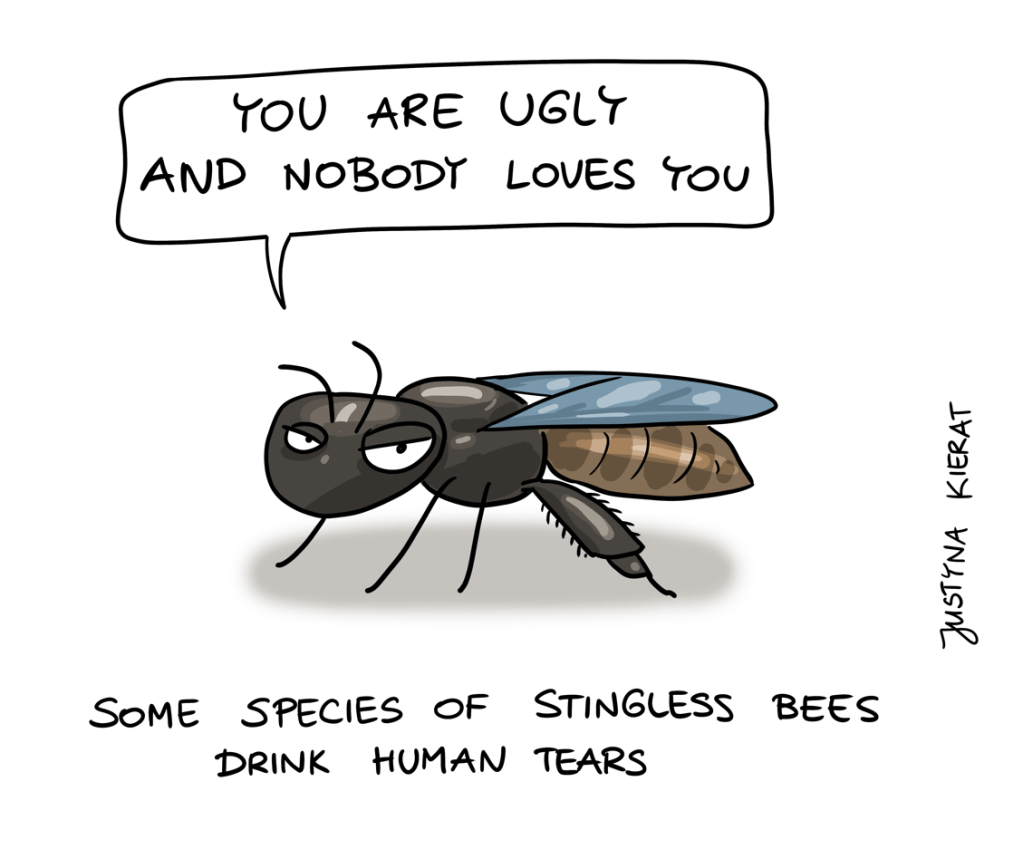
Stingless bees are very small social bees from the family Apidae which can be found in tropics and subtropics. Some of them have quite strange dietary habits – three famous species of “vulture bees” feed on carrion, some species come to humans to lick their sweat, and there are also a few species which… suck tears. According to the researchers, they are quite adept at collecting them. Experienced workers are so gentle that they almost don’t disturb their ‘victim’. I strongly recommend you read the recently published review article, the research on these bees is really interesting and there are photos of the bees in action. Hans Bӓnziger, the first author of the article, let the bees feed on his tears, and his dedication to research is impressive. I was amazed that he was marking these bees with spots of paint with the help of brush and mirror, when they were sitting at his eyes 😮 And these bees are tiny, only a few milimeters long!
I once read another paper about these bees, and the cartoon you see is a remake of a drawing I did in Polish for my other fanpage.
“[Stingless bee] colonies store both pollen and honey that can last the colony a few months (…). These stores can also allow marine dispersal of colonies via rafting.”
– from Roubik DW 2023, “Stingless bee (Apidae: Apinae: Meliponini) ecology”, Annual Review of Entomology

 Non-honey bees