Bee nests are usually divided into sections, called “cells”. Each cell contains one developing larva and a pollen-and-nectar provision for it.

Bee nests are usually divided into sections, called “cells”. Each cell contains one developing larva and a pollen-and-nectar provision for it.
I’d like to tell you about one of experiments I did during my PhD studies. I worked with the red mason bee (Osmia bicornis), a common solitary bee species. I was particularly interested in topics related to their reproduction. The red mason bees’ nests are linear, with individual cells in a row, which is common to many cavity nesters. Typically, there is only one entrance, and the other end of the nest is blind. The larvae must know the direction to the exit, and they do. Important source of information is the shape of mud partitions separating the individual cells. I pictured this on the cartoon – the nest entrance is to the right, and you can see that the side of the wall which should be chewed by the bee to go out is rough. The other side is smooth and concave. When you open the nest in winter, you can see the cocoons (each of them has a young adult bee inside) most of which are directed with bee’s head towards the exit. So, in the spring all that the bee has to do is to chew the cocoon wall, and then cell wall, all the time moving forward.
But my older colleagues from the lab observed that some cocoons are oriented in the other direction. Those misoriented bees are more often males than females. What happens to such individuals? Do they emerge from the cocoon and go forward, blocking and killing their siblings inside the nest, and eventually dying unable to exit? Or can they find out that they made mistake, and correct it? In order to check it, I prepared “artificial nest cells” which had the real cell walls attached, put the cocoons inside, and checked which way the misoriented bees will emerge.
The results were quite surprising. The majority of misoriented males turned around in the cell after emerging from cocoon, and exited their cells in the right direction. In contrast, most females didn’t turn around and got out the wrong way. Females are typically larger than males in the red mason bee but it was not the difficulty with maneuvering that prevented my females to choose the correct exit. The artificial cells were large enough for them to turn around – I checked.
It looks like the decision about which way to go out of the nest is made at the different moment by each of the sexes. Females position themselves already as larvae spinning their cocoons, and in spring they simply follow the chosen direction. Males are less rigorous in positioning their cocoons but before emergence they check where they should go. It’s quite reasonable strategy, as big females in real nests (in contrast to my artificial cells) can have difficulty with turning around as adults. If they postponed choosing direction for spring, it could turn out that they are not able to turn and are doomed. In contrast, smaller males don’t face such problems, so they can look for the correct exit later.
Here you can read a paper from my experiment.

Male bees usually don’t take part in any parental care. There is, however, an interesting exception. Males of Ceratina nigrolabiata guard nests when females forage. They defend it against parasites or small predators. What is interesting, males usually don’t stay in one nest forever but they switch between nests every couple of days.
If you want to know more, you can read the paper: Mikát, M., Matoušková, E., & Straka, J. (2021). Nesting of Ceratina nigrolabiata, a biparental bee. Scientific Reports, 11(1), 5026.
Orchid bees (Euglossini) are unusual not only because of their metallic colouration. Males pollinate certain species of orchids, but visit them not for food but for fragrances. They use them to mix their own perfumes with which they court females. Not only orchid oils are used but even as unexpected sources of perfumes as… feces.
I like to think that females not always choose their mates on the basis of their perfume quality but sometimes they just fall in love 😀 (yes, just joking, but then, it’s a page with funny cartoons, isn’t it)

I read this interesting article about decision-making by honeybees. The research shows that bees are faster to accept a flower than to reject it. In other words, the bee hovers in front of the flower for short time before eventually landing on it, but making decision not to land requires (on average) more time. The decision about accepting flower is made with high accuracy: bees rarely land on a flower which is not rewarding (provided they can know about it, of course, that is, they have experience with this type of flower, which was the case in the study), but some rewarding flowers are “mistakenly” rejected. When they have difficulty with making a decision because of limited evidence available, they’ll rather reject a flower than accept it. I think that would make them quite good review editors!
I must add that the flowers in the experiments were artificial ones, but I don’t think it matters much for the results 😉

Anyone who ever tried to learn bumblebee identification, knows that there are species which are very similar in colouration to each other. Moreover, there are some strange species where one colour morph is similar to one species, and another morph – to a different species. Bumblebees form mimicry rings, which are groups of species which are visually similar and live in more or less the same area. The advantage of this similarity is that predators more quickly learn which insects are not worth attacking (bumblebee females have stings which makes them a rather unpleasant lunch).

It’s such fun to look at the bees in an aggregation at the beginning of their flight season – let’s say, Colletes cunicularius in early spring – when males are flying like crazy and looking for virgin females. When they spot one, a mating ball forms immediately around her, with numerous males trying to get their chance.
I must add, in the real life males rather can’t be so easily fooled like on this cartoon, but quick escape of the successful male with his mate can be practiced in some species.

As you might figured out already, my favourite bee is, for now at least, Nomioides minutissimus, one of smallest bees in my coutry. It is not only sooo small but also quite rare. The most recent published observations I could find were from 90s, and there were only three places in Poland where it was known to live. After actively looking for it, and collaborating with other scientists and citizen scientists in the process, I learned that there are more localities where Nomioides minutissimus was seen in last twelve years. We just published an article which you can read here, with photos of the beautiful bee and her habitat.

Bumblebees don’t dance like honeybees and can’t communicate a precise location of food. However, they can recruit nestmates to the flowers. The worker who found a good food source is running excitedly, bumping into other bees in the nest and presenting samples of collected food to them.

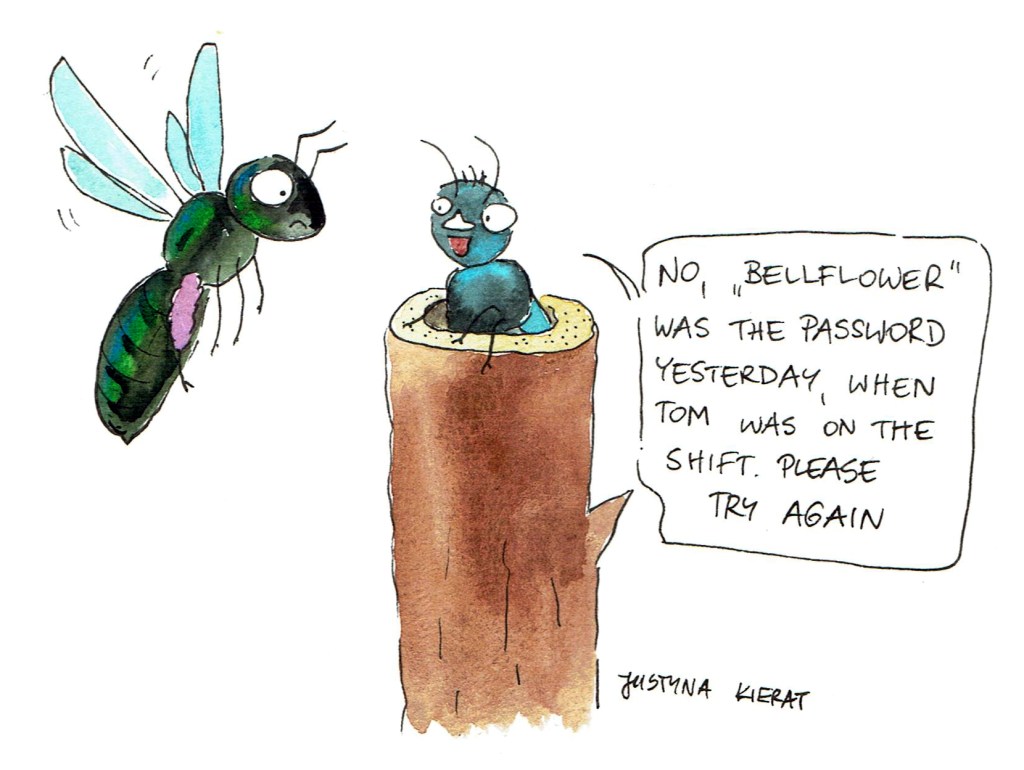
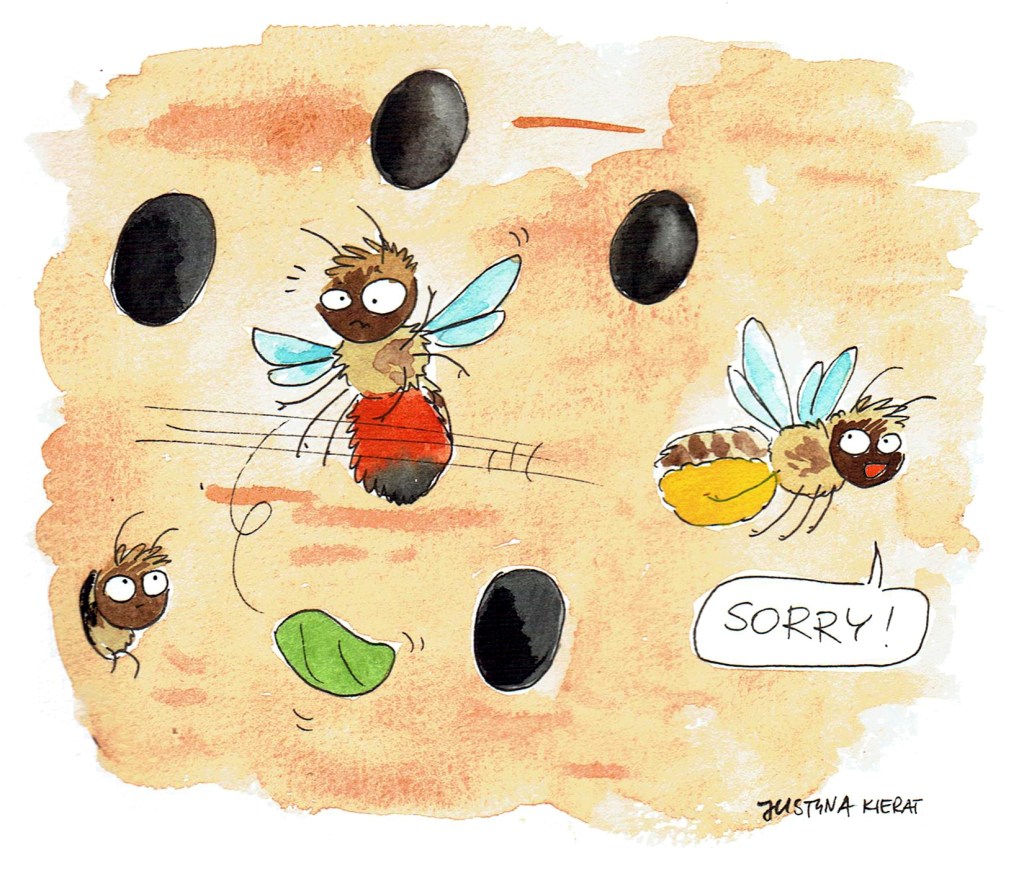
Leafcutter and mason bees can be bred in artificial trap-nests, for example for experimental purposes or for pollination of crops. When the density is high, and nest entrances to each other, females can get lost or engage in quarrels with their neighbours. Leafcutters can lose the leaf pieces they carry, and when a piece falls to the ground, it is not picked up but the poor bee must fly to cut another one.
Here is a citation of the paper which inspired this cartoon – one of research tasks was to weigh the dropped leaves 
Guédot, C., Bosch, J., James, R. R., & Kemp, W. P. (2006). Effects of three-dimensional and color patterns on nest location and progeny mortality in alfalfa leafcutting bee (Hymenoptera: Megachilidae). Journal of economic entomology, 99(3), 626-633.
I’m currently reading about mining bees (Andrena) and their cuckoos (Nomada), and I feel so sorry for them. The mining bees are being constantly watched. Sometimes Andrena and Nomada sit opposite to each other for several minutes, the mining bee in her nest, the cuckoo a few centimeters apart. But the cuckoo has plenty of time, and the mining bee has to collect pollen for her progeny, so it will be Nomada who wins this war of nerves.

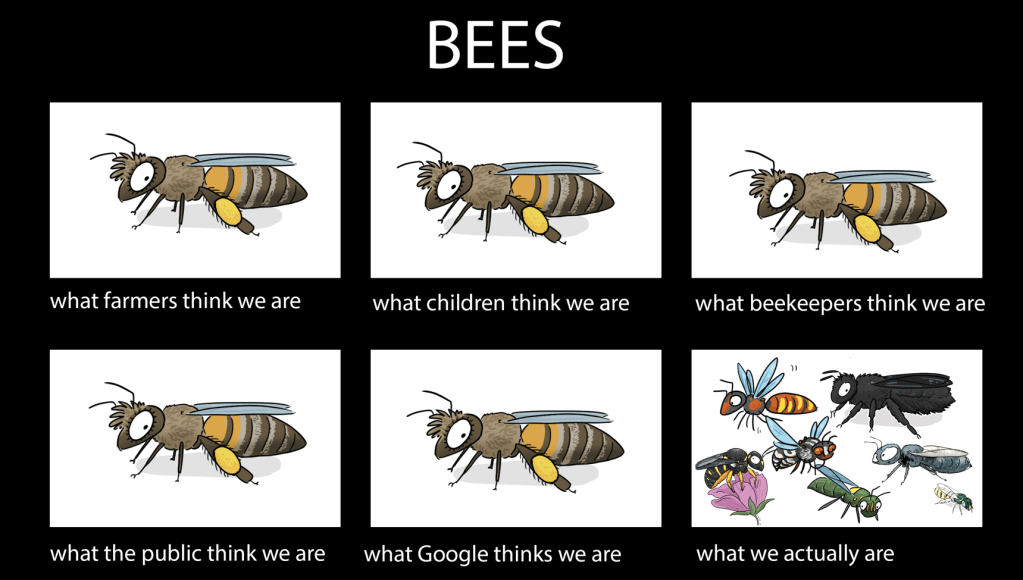
 Non-honey bees