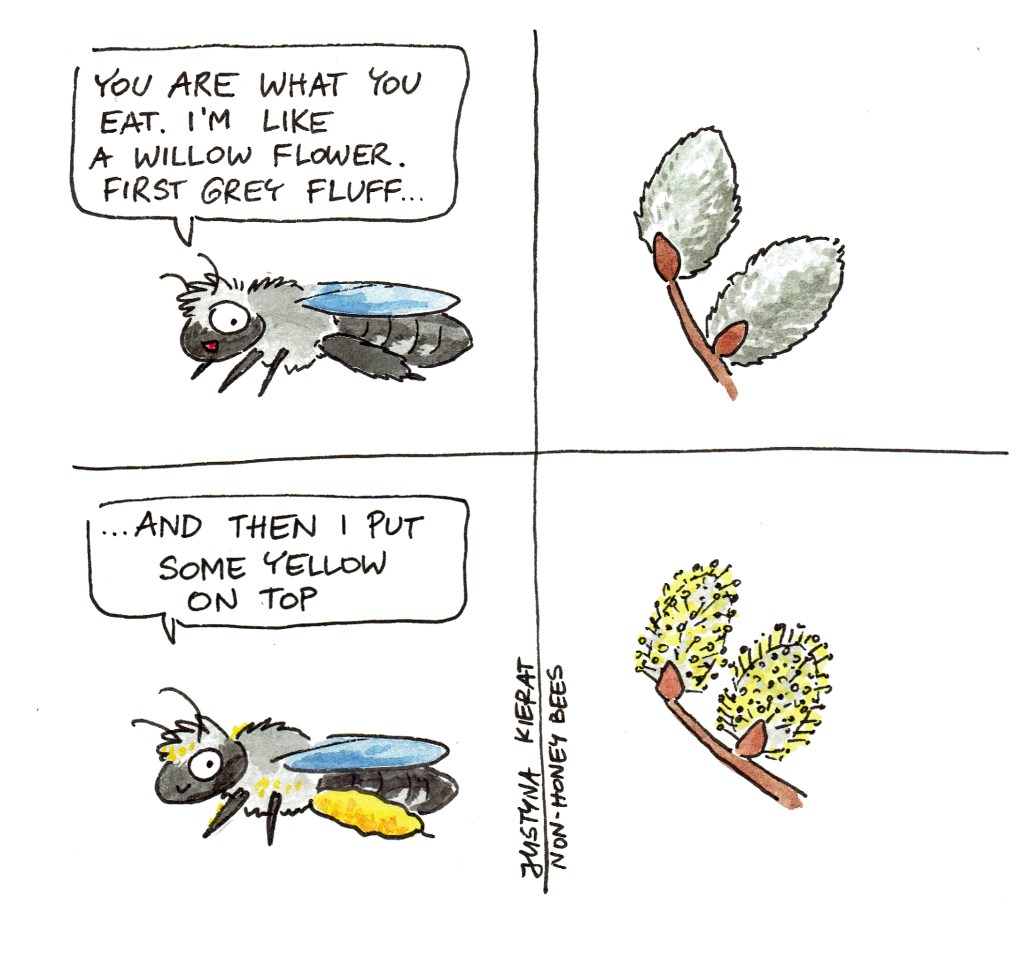
The Grey-backed Mining Bee (Andrena vaga) is one of signs of spring in Europe. It is a pollen specialist (oligolectic) species, and the females collect pollen only from willows (Salix). I didn’t notice that before but the fluffy fur on their thorax is strikingly similar in colour and texture to the hairy willow catkins before they become covered in yellow stamens.
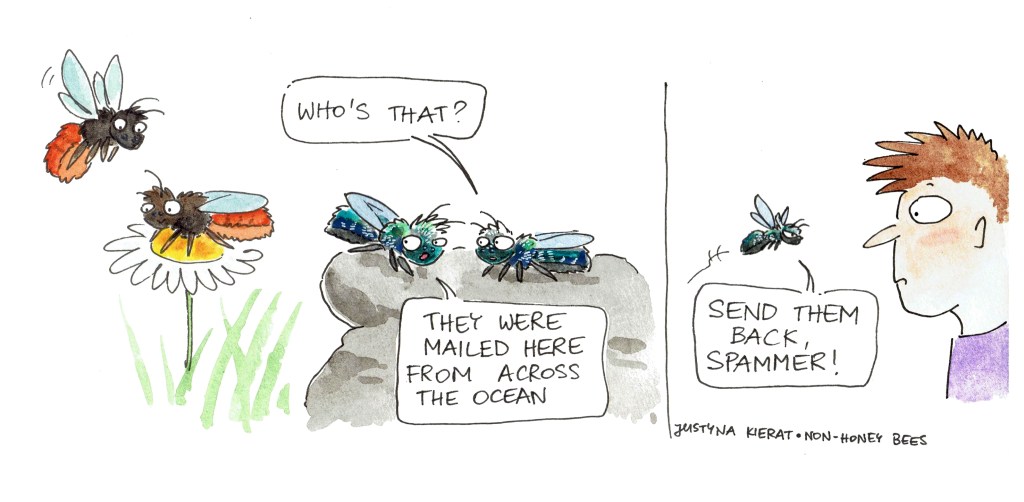
Spam is, basically, an unwanted mail appearing in large numbers, right? Wild bees might feel like being spammed by commercially sold bees, then.
Recently an important opinion paper by MacIvor and Irvin was published. The authors draw attention to the problem appearing when bee solitary bee cocoons are sold on a large scale. Why buy bee cocoons at all? They don’t make honey or wax but are great pollinators, and can be used in commercial orchards for that purpose. They are also often are reared as a hobby, or are bought by people who think that breeding bees is a way of helping them (actually, it is not).
There is too little oversight of the sale of bee cocoons. They can be shipped for large distances, even to the places where the sold bees aren’t a native species. At their destination, they are released into the environment and can interact freely with local species, competing and sharing pathogens and parasites with them. Even if they are shipped to the areas where they are a native species, they may belong to other subspecies or lineage. During interbreeding with wild conspecifics, the gene pools are mixed and that also can have negative consequences for the local populations.
The authors call for legal regulations which would allow to prevent large-distance mailing of wild bees. For now, everybody can help to make the situation better – just don’t buy bee cocoons from distant places, check what species you’re buying and if it’s native, and above all, don’t buy bees at all unless you really need to.
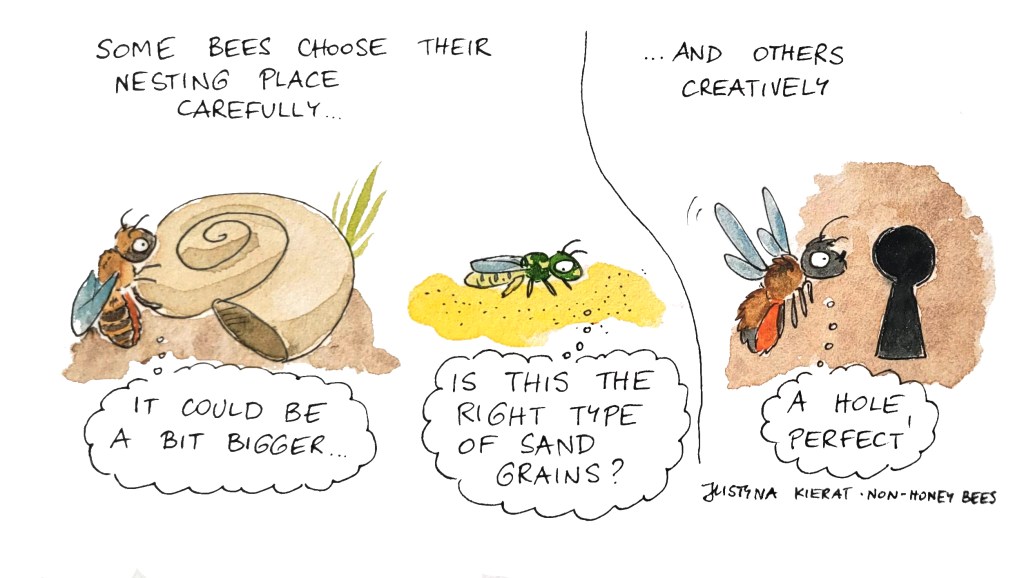
As you surely remember, there are over 20 000 bee species described by scientists so far. No wonder that among so many species, there is also a substantial diversity of nesting strategies. Most species nest in the soil, a smaller proportion chooses various cavities above ground, some make constructions from mud or resin. You can find a bee nest in a snail shell, plant gall or a termite mound.
The level of specialisation also differs between species – some bees are very choosy when it comes to nesting, others can be more flexible. The most creative species I know is the red mason bee (Osmia bicornis) – a common European species, which is often bred for pollination purposes. Females nest in pre-existing long and narrow cavities of about 4-8 mm in diameter – typically, hollow plant straws or holes in wood made by other insects. However, some females can nest in keyholes, nail holes, cracks in window frames, rolled-up carpets and a many other man-made cavities of various sizes. Once I saw a photo of a nest made in a bicycle wheel.
This post was published on Instagram in cooperation with The Pollinator Academy. I’m happy to be involved in this initiative. If you are interested to learn about European pollinator species, in particular bees, hoverflies and butterflies, and recognizing them, check out the PA website!
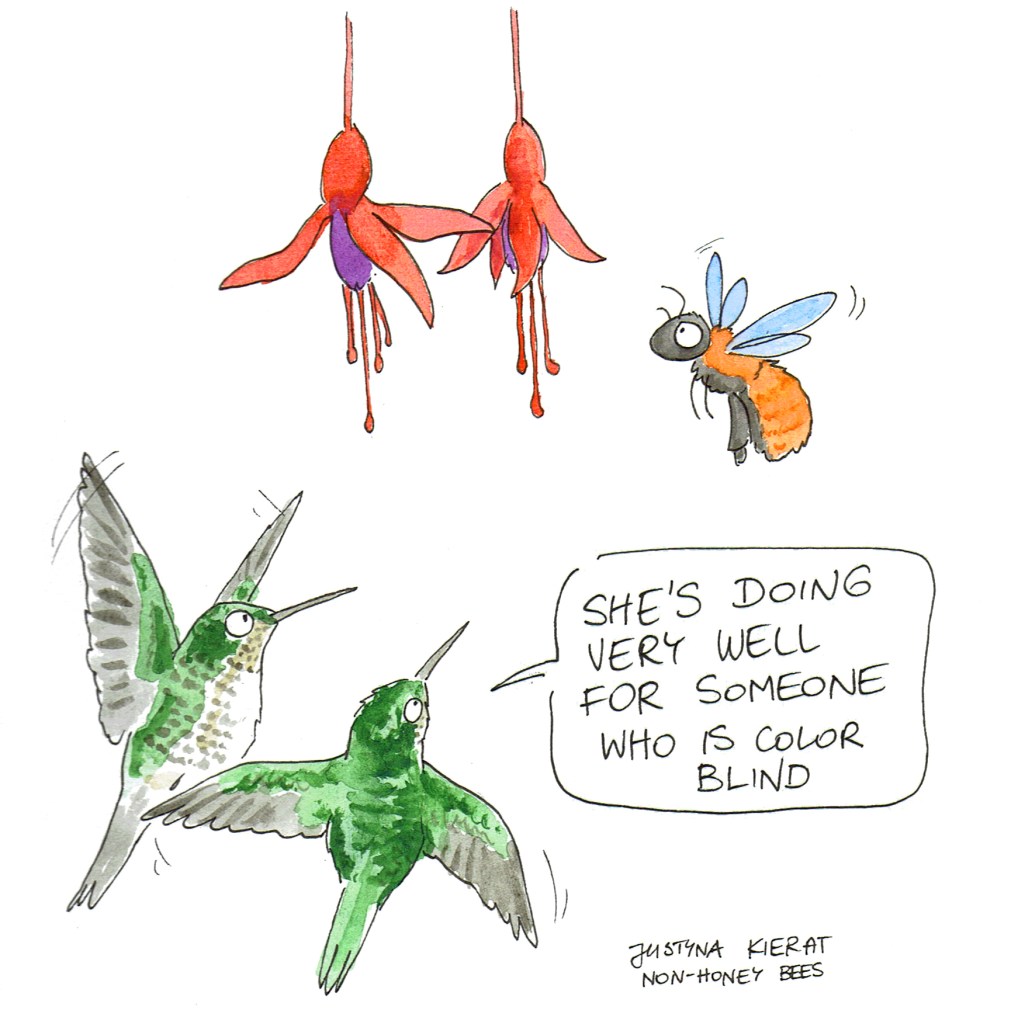
Have you heard that bees can’t see the red color? I guess so. Maybe you even read that in some of my posts. Recently, I stumbled upon two papers, one by Chittka and Waser, published in 1997, and a bit more recent one, by Martinez-Harms et al. (2009). And these papers, especially the first one, have shown me that the issue of bee color vision isn’t so black and white (pun intended). Let me explain it a bit below, but I strongly recommend you reading the original papers.
Bees are trichromats, as we are, which means that they have three types of receptors in their eyes, each type sensitive to different light wavelengths. We can see the wavelengths from, basically, violet to red, whereas bees can also see UV, and they are less sensitive to the red part of the spectrum. However, they are not completely blind to red: one of the receptor types is sensitive to wavelengths which humans could well describe as red color. So, a monochromatic red object will not be black to bee.
But then, although bees can see the red light, they seem not to be able to see red as fully distinct color. If you show them monochromatic green, yellow, orange or red light, the bees will perceive them as the same or very similar hues, but they will differ in their brightness. As Chittka and Waser put it, “for example, a monochromatic red light of strong intensity will generate the same sensation as a green light of moderate intensity”. So, you can trick a bee into believing there is no color difference between the two stimuli if you cleverly choose wavelengths and light intensities for them.
But the story doesn’t end here! In real life, bees rarely have to do with monochromatic objects. What an eye perceives as a given color, is usually a mix of different wavelengths. Therefore, it is much less likely that a red flower will so perfectly match a green background that it will be invisible to bees. If it reflects light of some shorter wavelengths in addition to the red ones, it’s easy – a bee can distinguish its colors well. If it reflects only red light, however, she will rely on brightness contrast, which will be a bit more demanding but still possible. It was observed that bees foraging on “truly red” flowers take more time flying between distant inflorescences than between flowers of other colors, probably because locating them is more challenging.
And regarding the cartoon, the hummingbirds are quite justified in speaking about color-blindness of the bumblebee, as their color vision is amazing, better than bees’ and ours. The bumblebee in the cartoon is Bombus dahlbomii, the rare South American species which is known for its love of red flowers.
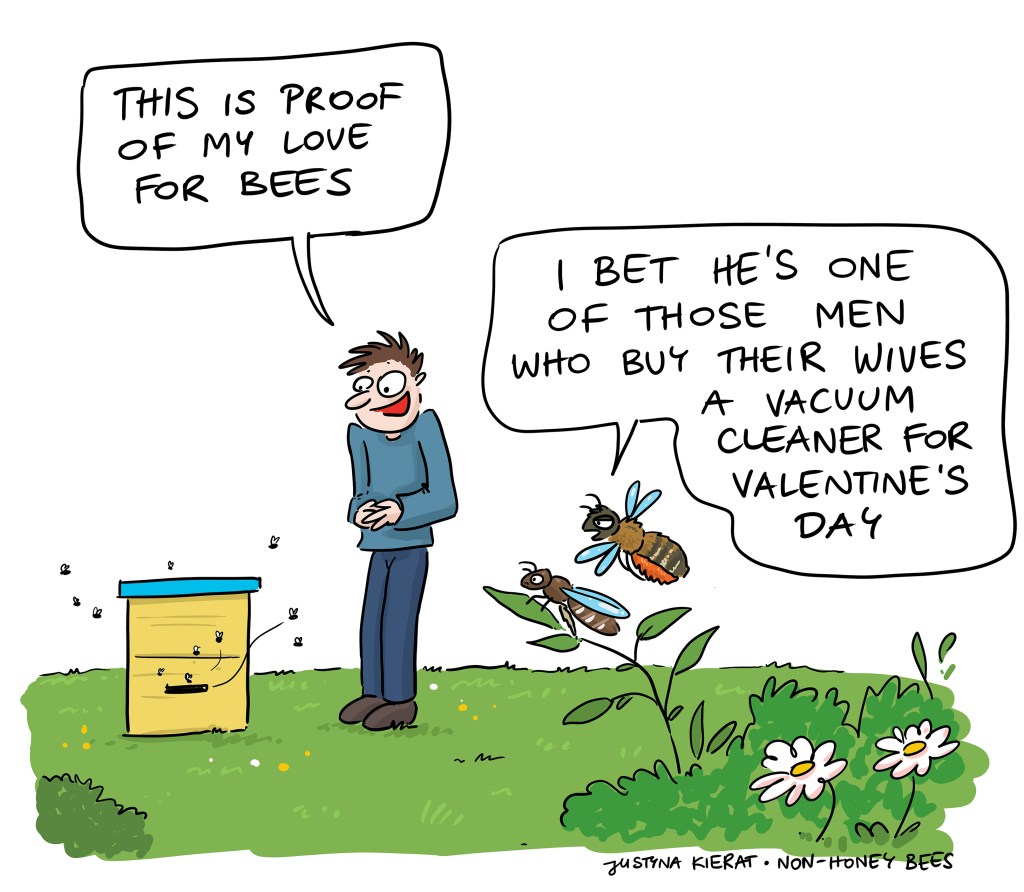
You love bees and want to do something for them? Dont be ‘that guy’. Don’t buy hives. Increasing the domesticated honeybee population doesn’t do any good for bees. In fact, it can harm both the wild species and honeybees.
I hope you don’t have yet enough of them! Here is the first post about these bees where you can learn more about them and find a link to a very interesting paper.
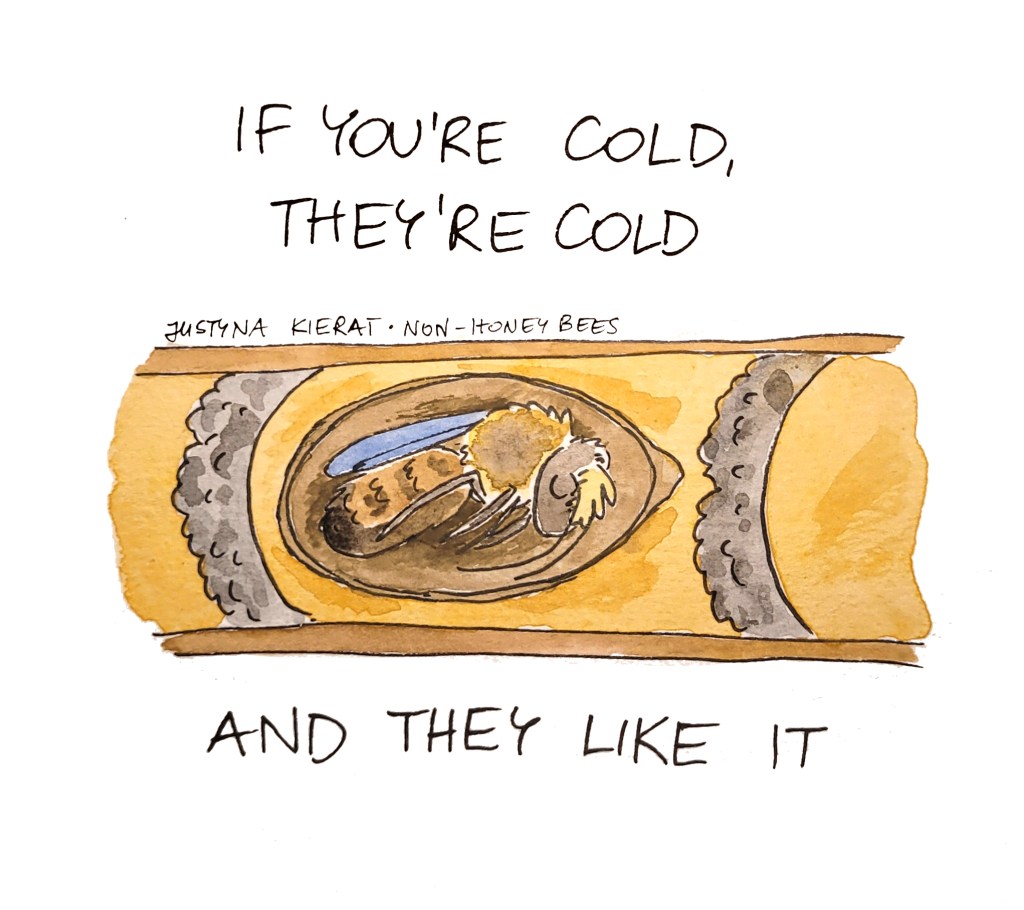
In a temperate, seasonal climate bees spend winter in diapause. They usually overwinter as prepupae (that is, as a larva that ate everything it could and is ready for pupation) or, more rarely, as adults. I often hear from people who have bee hotels in their gardens, or who breed red mason bees as a hobby, that they are afraid that their bees will freeze in winter. They want to put them somewhere in a sheltered and warm place to help them survive. Actually, it’s a very bad idea. The bee species native to the seasonal environment are not only adapted to survive low temperatures. They may simply need them! The red mason bee, one of the best studied solitary bee species, can endure about -30°C (-22°F) but constant temperature of about a dozen Celsius degrees can cause trouble. When kept in a room temperature, the red mason bees may emerge in the middle of winter or die in the cocoon. It sometimes happens when a female built her nest inside a house, or the nest was brought home, either accidentally or purposefully (in an attempt to ‘keep the bees warm’).
Bringing the nests home for winter is not the biggest threat for overwintering bees. More disturbing is the climate change, manifesting itself with higher mean temperatures, but also warmer and shorter winters.
This post was published on Instagram in cooperation with The Pollinator Academy. I’m happy to be involved in this initiative. If you are interested to learn about pollinators, in particular bees, hoverflies and butterflies, and recognizing them, check out the PA website!
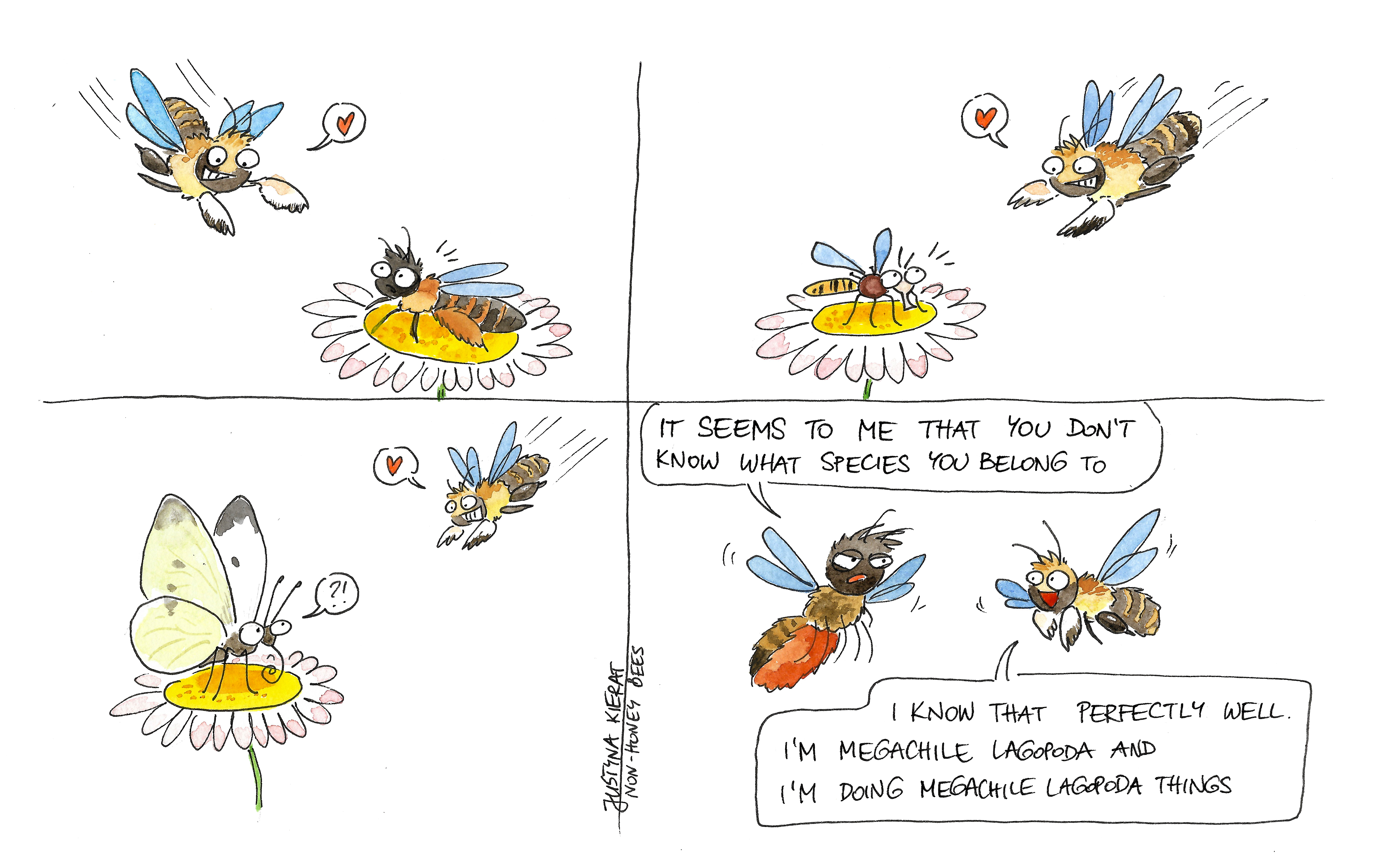
I was asked to draw a cartoon about a male Megachile lagopoda. Stephanie Rübenach, a wild bee photographer, told me that she likes these bees because of their habit of rushing at everybody sitting on a flower – be it another bee, or a fly, or even a butterfly… Yes, male bees can be little bullies. Some of them aggressively defend their little territories (have I ever told you about Anthidium manicatum?) but often it is rather curiosity and eagerness to mate than aggression. They just have to make sure this butterfly over there is not a female of their own species.
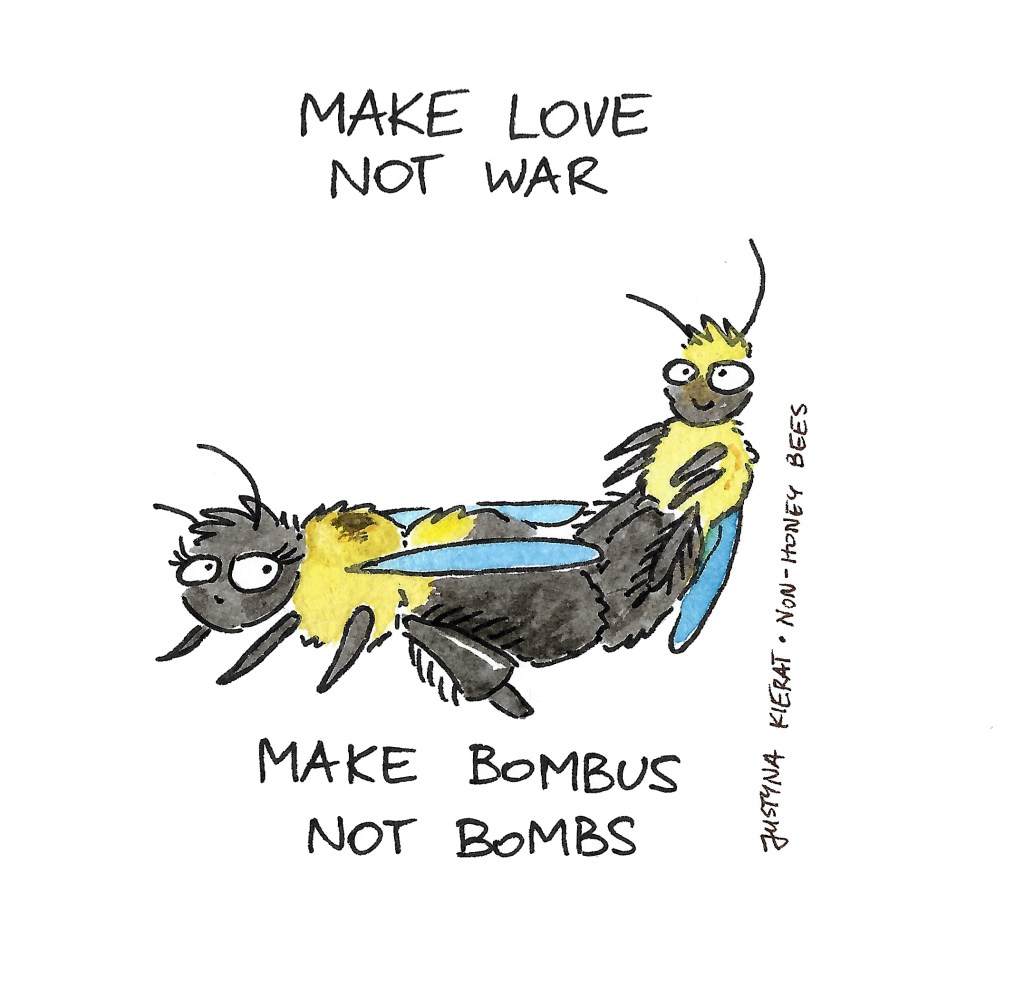
Being active in various fb groups taught me that many people don’t know what bees look like when they are making love. If you also didn’t know that, you do now, thanks to this cartoon.
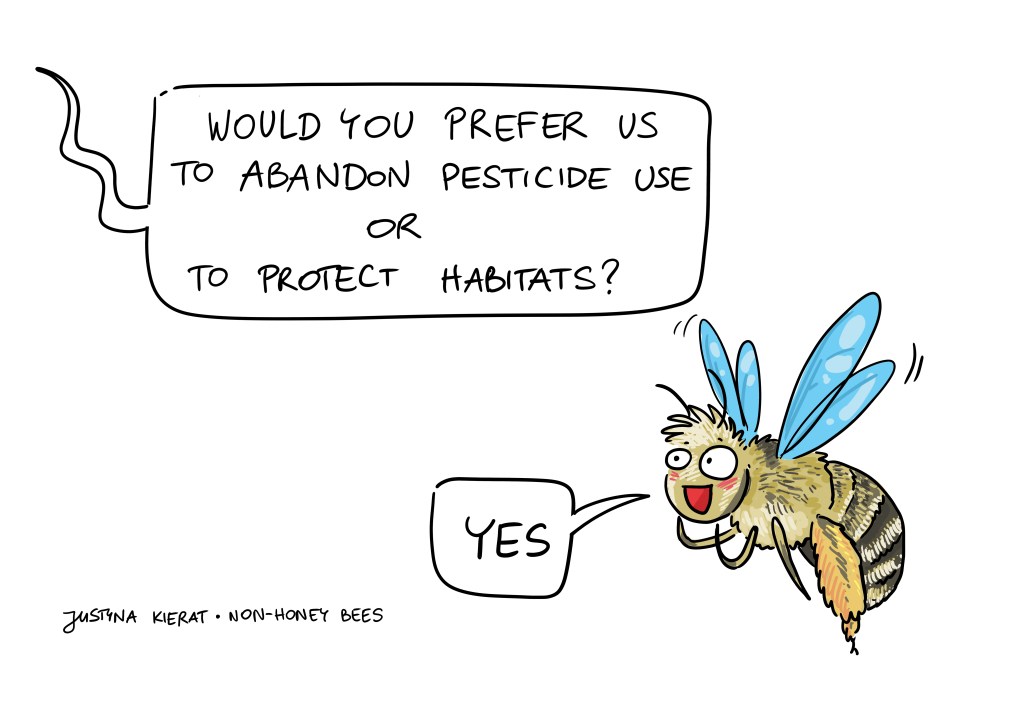
Today’s cartoon is a slightly changed version of one I posted on my Polish blog some time ago. I remembered about it after reading a paper entitled “Pesticides and habitat loss additively reduce wild bees in crop fields” by Anina Knauer et al. (2025). It is a huge analysis of data collected from nearly 700 crop fields, aiming to answer the question of how pesticide use and habitat loss impact bee numbers and species diversity.
Unsurprisingly, it turned out that both these factors have important effects on wild bees. But what was less expected, pesticides and availability of semi-natural habitat act additively. It means that, for example, pesticides aren’t less harmful if we provide the bees with more semi-natural habitat in places where they are used. To help bees, we must address both these issues.
It doesn’t mean that action aimed at solving one of the bees’ problems alone is useless. Every small step can help and is important to do. But we should not assume that solving only one problem is enough to save our pollinators.
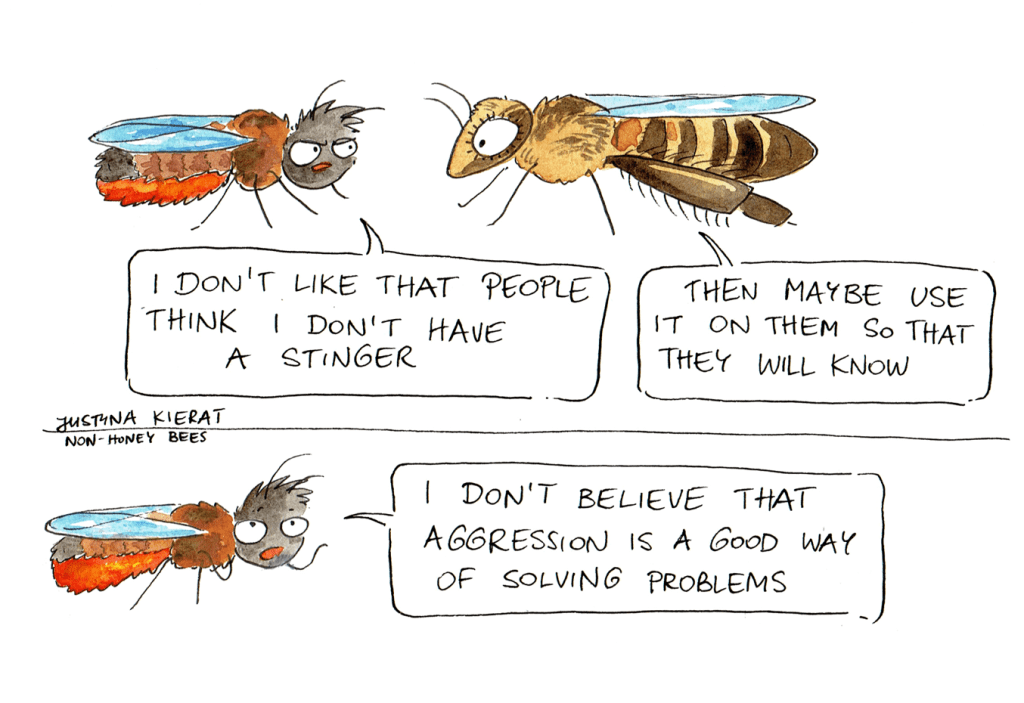
I’ve heard many misconceptions about bees. Among them, there are two beliefs which are contradictory to each other… and both are false. On one hand, many people are afraid of all bees because they believe that there is high risk of being stung by any bee species. On the other hand, there is a popular belief that solitary bees, for example mason bees, are harmless because they do not have a stinger. What are the facts?
Females of almost all bee species in the world have stingers. The only group of bees I know of with reduced stingers are stingless bees, which live in the tropics and subtropics (if you know of any other examples, please let me know!). In contrast, males never have stingers.
Despite having a stinger, most bee species are very unlikely (or sometimes unable) to sting us. Why is it so? Most bees (not only solitary, but also social, as is the case in many halictid bees) do not defend their nests against large intruders like me, you, your children or pets. Even when their nest is being destroyed, they will flee rather than fight. They will make use of their sting when they cannot escape – like, held in hand or squeezed. Some species, however, have too minute stingers to pierce human skin so they pose no risk at all (I tested this on several Andrena females – they tried to sting me when held in hand, but didn’t succeed).
Summing up, most bees have stingers, but usually are unlikely to use it against us. The funny thing is, the stingless bees which I mentioned earlier, can effectively defend their colonies even though they can’t sting. They bite, pull hairs and sometimes produce secretions irritating skin of an intruder.
Stingless bees are a constant source of inspiration. I’ve already shown you the cartoons about them getting entangled in intruder’s hairs as a form of nest defense, and about tear-drinking species. Now the time has come for Partamona helleri, which practises crash-landing.
Usually, the stingless bees slow down when they approach the narrow nest entrance. But not Partamona helleri! When they are about 20 cm from the nest, they speed up and fly inside like tiny bullets, crashing into the hind wall of the nest and then falling to the bottom. In a few cases, researchers studying the landing behaviour of these bees observed individuals that crashed with such a force that they bounced back and fell out of the nest.
Why do Partamona helleri act so strangely? It is a way to avoid ambush predators, which are sitting at the nest entrance, attempting to catch returning bees. It was shown that when a bee saw a predator, she increased her speed even more.
You can read more about this fascinating strategy in the paper by Shackleton et al.

 Non-honey bees