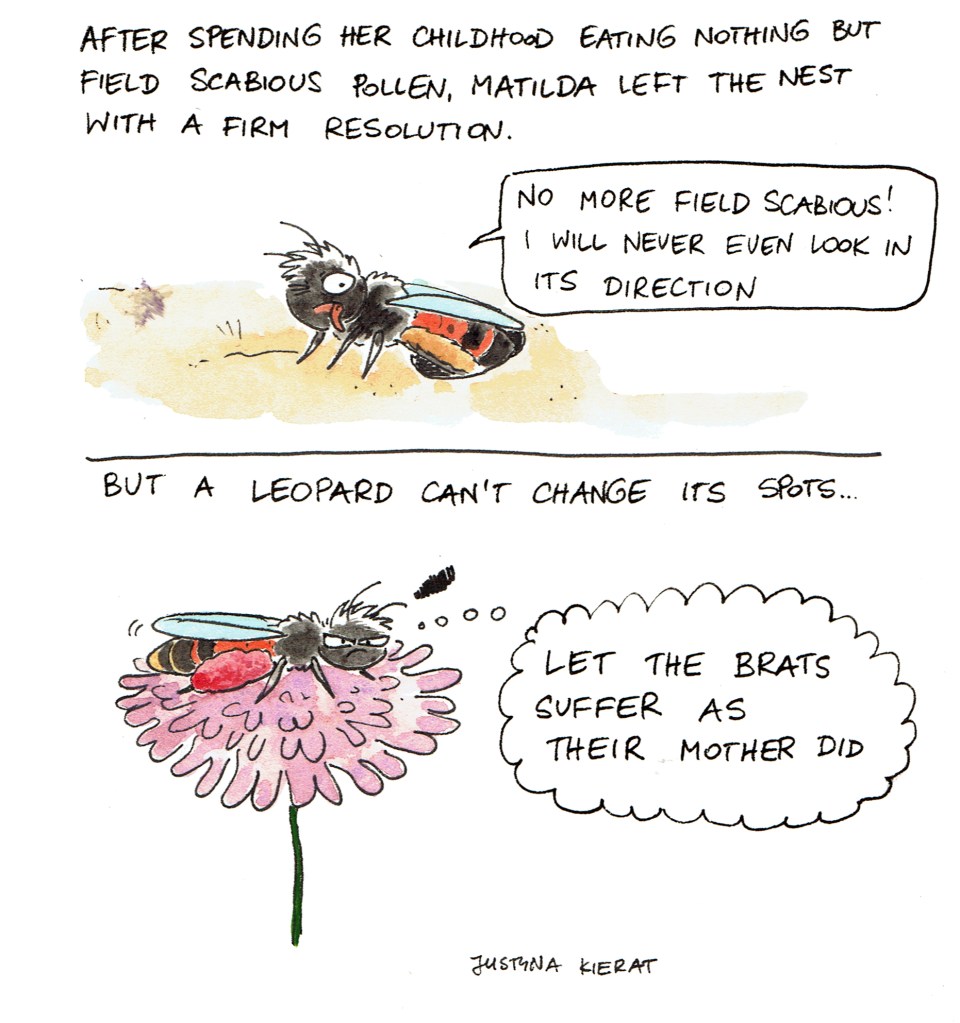
The females of some bee species collect pollen only from certain plants’ flowers. Those that collect pollen from a single plant species (or genus, according to some authors) are called monolectic, while those that can choose from a larger group of plants (but no larger than a single family) are called oligolectic. These bees can’t live in areas where their food plants are not present. If these plants are rare or endangered, so are the bees. There is no single plant group on which all oligolectic bees forage; some depend on members of the Asteraceae family, while others specialize on the Fabaceae, Ericaceae, Malvaceae or others. In the picture below you can see a large scabious mining bee (Andrena hattorfiana), which collects pollen almost exclusively from field scabious.
One could think that larvae of oligo- and monolectic bees can’t survive on other pollen types than those collected by their mothers. Surprisingly, it is sometimes the other way around. There are experiments showing that the larvae of specialists developed perfectly well on other pollen types. Conversely, generalist larvae may experience difficulties when fed a monodiet typical for oligolectic species. For example, bumblebees don’t develop well on Asteraceae pollen, whereas females of species such as Colletes daviesanus and Heriades truncorum feed their larvae almost exclusively on pollen from this very family.
It seems that being a larva of food specialist may be challenging and require special adaptations. Adult females of these species are limited in their pollen choice, which can cause problems if their preferred plant type becomes scarce. So what are the advantages of specialization? In the case of plant species which are hard to use (eg. those with structurally complicated flowers, or chemically protected pollen), specialists have fewer competitors. Also, mastering the art of foraging on one or a few species could make it quicker and more efficient.
 Non-honey bees
Leave a comment