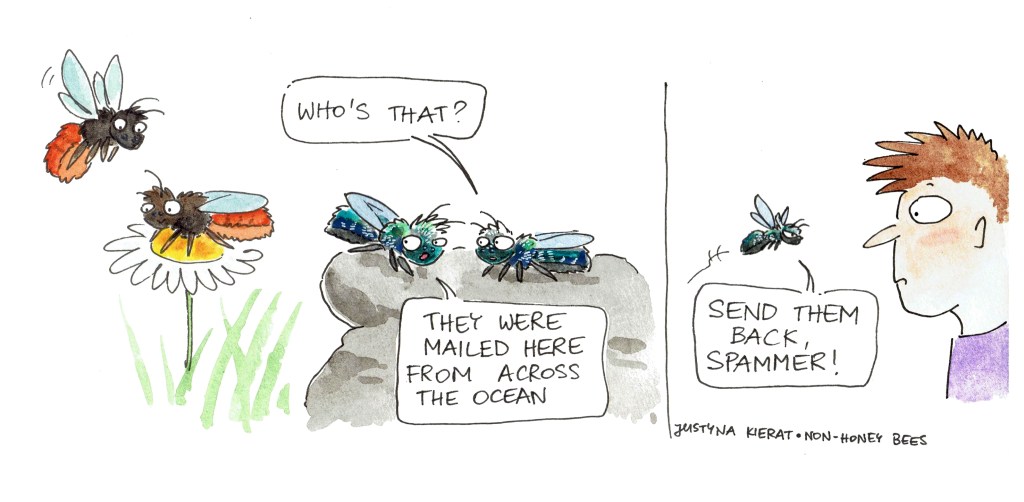
Spam is, basically, an unwanted mail appearing in large numbers, right? Wild bees might feel like being spammed by commercially sold bees, then.
Recently an important opinion paper by MacIvor and Irvin was published. The authors draw attention to the problem appearing when bee solitary bee cocoons are sold on a large scale. Why buy bee cocoons at all? They don’t make honey or wax but are great pollinators, and can be used in commercial orchards for that purpose. They are also often are reared as a hobby, or are bought by people who think that breeding bees is a way of helping them (actually, it is not).
There is too little oversight of the sale of bee cocoons. They can be shipped for large distances, even to the places where the sold bees aren’t a native species. At their destination, they are released into the environment and can interact freely with local species, competing and sharing pathogens and parasites with them. Even if they are shipped to the areas where they are a native species, they may belong to other subspecies or lineage. During interbreeding with wild conspecifics, the gene pools are mixed and that also can have negative consequences for the local populations.
The authors call for legal regulations which would allow to prevent large-distance mailing of wild bees. For now, everybody can help to make the situation better – just don’t buy bee cocoons from distant places, check what species you’re buying and if it’s native, and above all, don’t buy bees at all unless you really need to.
 Non-honey bees
Leave a comment